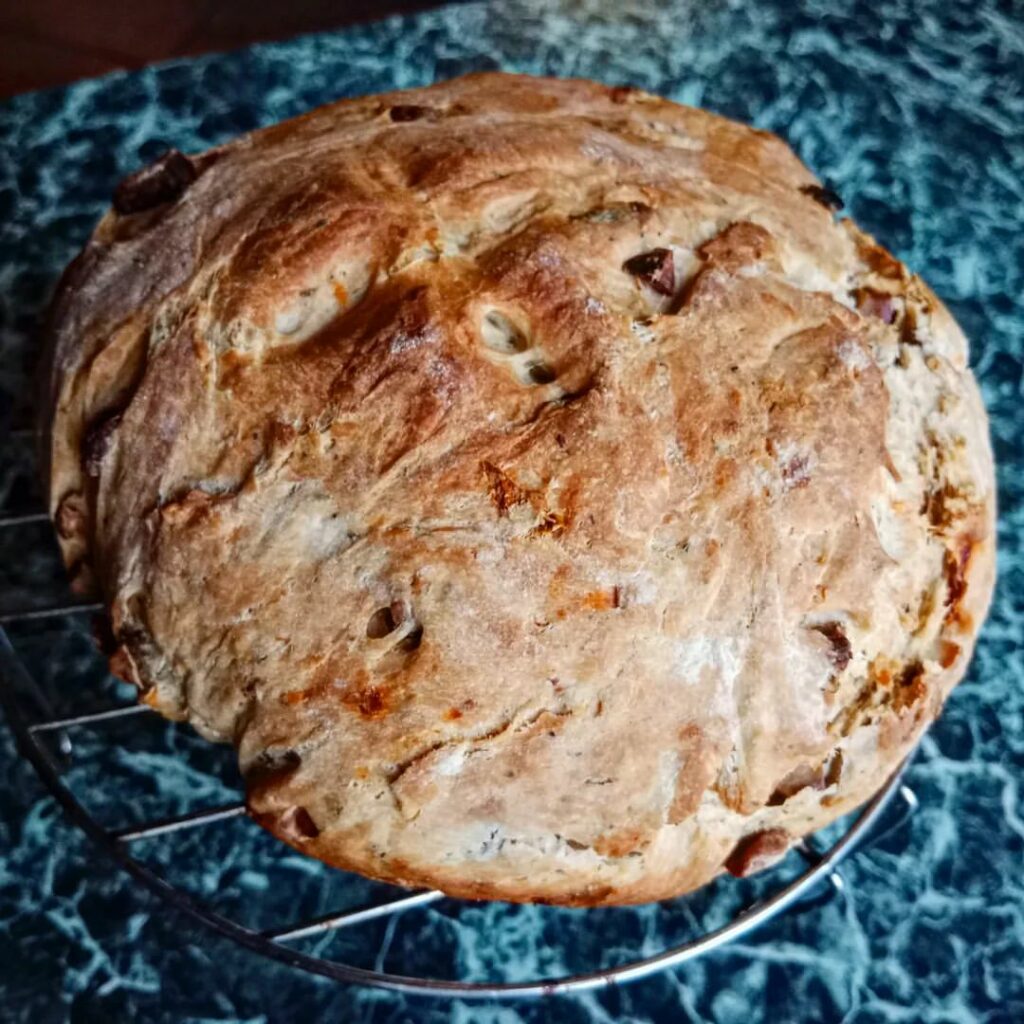
Homemade bread always feels a little special, but vegan olive bread with thyme and basil is something else entirely. A golden, crackling crust, a soft and fragrant crumb packed with juicy olives and Mediterranean herbs. It works as a breakfast loaf, a dinner accompaniment, or just torn into chunks and dipped in good olive oil. And it happens to be completely plant-based, no eggs, no dairy, nothing complicated.
Which olives work best in bread? Can you make it without kneading? How long does it keep, and can you freeze it? All of that is answered here, alongside the full recipe and practical tips to make sure your loaf turns out right every time.
Why you will love this recipe
Olive bread sounds impressive, but this recipe keeps things straightforward. Here’s what makes it worth baking.
- Golden, crackling crust and a soft, fragrant crumb studded with olives throughout
- Only 8 ingredients, all easy to find in any supermarket
- Naturally vegan with no animal-derived ingredients whatsoever
- Versatile, excellent on its own, as a soup accompaniment, or with plant-based spreads
- Keeps for several days and freezes beautifully
This is also a loaf that non-vegans will reach for without hesitation. Mediterranean flavours speak for themselves, and nobody misses anything here.
Interesting facts about olives and their history
Olives are technically a fruit, specifically a drupe (stone fruit), not a vegetable. This botanical fact surprises most people. The olive tree has been cultivated in the Mediterranean for more than 6,000 years, making it one of the oldest cultivated crops in human history. Ancient Greeks considered the olive tree sacred, a symbol of wisdom and peace. Winners of the ancient Olympic Games received crowns woven from olive branches.
Green and black olives are the same fruit at different stages of ripeness. Green olives are harvested before they ripen fully, while black olives are allowed to ripen on the tree. As they ripen, their flavour profile shifts from sharp and slightly bitter to softer and more buttery. Both work well in bread; green olives give a firmer texture and more assertive flavour, while black olives blend more gently into the crumb. For something thinner and crunchier, olives also go into our crispy Italian grissini, made from just six ingredients.
The Mediterranean diet, built around olives, olive oil, vegetables, and legumes, is consistently ranked as one of the healthiest dietary patterns in the world. Studies link it to reduced rates of heart disease, type 2 diabetes, and certain cancers. A homemade olive bread is one of the most enjoyable ways to bring that culinary tradition into everyday cooking. A batch of yeasted olive breadsticks with thyme is another, perfect with soup or a glass of wine.
Health benefits
Olives and olive oil, the two star ingredients in this recipe, are exceptional nutritionally. Both are rich in monounsaturated fatty acids, particularly oleic acid, which helps lower LDL cholesterol and raise HDL cholesterol. This contributes to a meaningfully reduced risk of cardiovascular disease, which is one of the reasons the Mediterranean diet has attracted decades of positive research attention.
Olives also contain oleocanthal, a natural anti-inflammatory compound that works similarly to ibuprofen. Research suggests that regular olive consumption may help reduce chronic low-grade inflammation, which underlies many modern diseases. 100 g of olives provides approximately 2.6 g of dietary fibre, along with calcium, magnesium, and polyphenols that act as powerful antioxidants.
Thyme and basil are more than flavour additions here. Thyme has long been used for its antimicrobial properties, thanks to thymol, a naturally occurring compound with antiseptic effects. Basil contains flavonoids and essential oils with antioxidant and anti-inflammatory potential. Together with olives and olive oil, these herbs make this loaf genuinely good for you, as well as delicious.
Approximate nutritional values
The values below are per slice, based on a loaf cut into approximately 12 slices.
| Nutrient | Amount per slice |
|---|---|
| Calories | ~195 kcal |
| Protein | 5 g |
| Carbohydrates | 33 g |
| Fat | 5 g |
| Fibre | 2 g |
Approximate values per slice. Actual values depend on specific ingredients and slice thickness.

Vegan Olive Bread
Ingredients
- 540 g bread flour
- 300 ml lukewarm water
- 100 g olives pitted, chopped into larger pieces
- 40 ml olive oil
- 1 tsp salt
- 7 g dry yeast
- 1 tbsp dried thyme
- 1 tbsp dried basil
Instructions
- Combine the flour, dry yeast, and salt in a large bowl. Pour in the water and olive oil and knead into a dough.
- Add the chopped olives, thyme, and basil. Mix well to incorporate. Cover and leave to rise in a warm place for 2 hours.
- Shape the dough into a loaf. Place on a baking sheet lined with parchment paper and leave to rise for another hour.
- Bake at 220°C (fan 200°C) for 40-50 minutes until the crust is deep golden and the loaf sounds hollow when tapped on the base. Cool on a wire rack before slicing.
Notes
Tips and variations
The recipe is straightforward, but a few details separate a good loaf from a great one.
- Olive choice matters. Kalamata olives give an intense, slightly bitter depth. Green olives are firmer and more assertive. A mix of both creates interesting texture and flavour in every slice.
- Pat the olives dry with kitchen paper before adding them to the dough. Excess brine can make the dough too wet and affect the final texture.
- Overnight fridge rise is a great option for morning baking. After the second rise, cover the shaped loaf and refrigerate overnight. The slow fermentation deepens the flavour noticeably.
- For an extra-crispy crust, place a dish of hot water in the bottom of the oven for the first 15 minutes of baking. The steam helps the crust form properly and caramelise beautifully.
- Store the loaf wrapped in a clean kitchen towel at room temperature for 3 to 4 days, or slice and freeze for up to 2 months.
Want to take the flavour further? Add a teaspoon of garlic powder or a handful of fresh rosemary to the dough. Sun-dried tomatoes also work brilliantly alongside the olives for a richer, more complex loaf.
What to serve with this bread
Vegan olive bread is one of the most versatile things you can pull from a home oven.
It’s at its best eaten warm from the oven, drizzled with good extra-virgin olive oil and a pinch of flaky sea salt. It pairs beautifully with vegetable soups, lentil or tomato especially. Sliced thicker, it makes an excellent base for open sandwiches with plant-based spreads. For a Mediterranean-style table, serve it with a dish of olive oil for dipping, sliced tomatoes, and a few fresh basil leaves. If you enjoy plant-based spreads, our vegan avocado hummus is a perfect partner for this loaf, and our vegan homemade bagels are worth bookmarking for your next baking session too.
Leftover slices are wonderful toasted, the olive oil in the dough makes them crisp up beautifully in a dry pan or toaster.
Frequently asked questions
What olives are best for olive bread?
Kalamata olives are the classic choice, giving deep flavour with a slight bitter edge. Green olives (such as Castelvetrano) are firmer and more buttery. A mix of both gives the best of both worlds. Whatever you use, pat the olives dry before adding them to the dough so the brine doesn’t affect the dough hydration.
Can you make olive bread without kneading?
Yes. A no-knead olive bread is made by simply mixing all the ingredients together, then allowing the dough to rise slowly overnight in the fridge. The long fermentation time develops the gluten naturally, without any hand kneading. Shape it the next morning and bake. The result has excellent flavour and an open crumb structure.
At what temperature do you bake olive bread?
Bake olive bread at 220°C for 40 to 50 minutes. The high temperature creates a properly crackling crust and well-baked crumb. The loaf is done when it sounds hollow when tapped on the base. If the crust browns too quickly, cover loosely with foil partway through baking.
How long does homemade olive bread keep?
Wrapped in a clean kitchen towel at room temperature, olive bread keeps well for 3 to 4 days. A towel preserves the crust better than a plastic bag, which causes it to soften. For longer storage, slice and freeze the loaf for up to 2 months.
Can you freeze vegan olive bread?
Yes, this bread freezes very well. Slice it before freezing so you can take out individual pieces as needed. Thaw at room temperature or toast slices directly from frozen in a toaster. The olive oil in the dough helps the crumb stay moist even after freezing and thawing.
Bake this vegan olive bread once and it will earn a regular spot in your home baking routine. It’s the kind of loaf that makes the whole kitchen smell extraordinary, and tastes just as good as it smells. Let us know in the comments which olives you used and whether you added any extra herbs. And if you share a photo, tag us on Instagram, we love seeing your bakes.
Newsletter
Get our free e-books
Join the newsletter and download Our Vegan Christmas Kitchen straight away, 10 recipes for Czech cookies, gingerbread and vánočka. Then once a month, new places from the vegan map and new articles. Unsubscribe with one click.