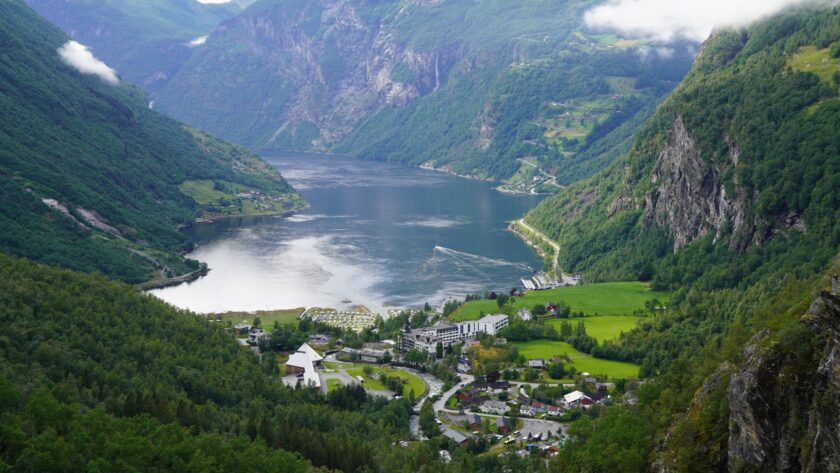
The best fjords in Norway are Nærøyfjord, Geirangerfjord, Sognefjord, Hardangerfjord and Lysefjord. They are narrow arms of the sea with mountains dropping almost straight into the water. Two of them, Geirangerfjord and Nærøyfjord, have been on the UNESCO World Heritage List since 2005. Sognefjord runs for 205 km and is more than 1,300 metres deep in places.
You can see them from a ship’s deck, a train window, a car or a viewing platform 650 metres above the water.
Which fjord should you pick if you only have a week? Is a Norway fjords cruise worth it, or is one day by train and boat enough? When do the boats and mountain roads actually run?
And what will you eat on board, or in a village with one shop and one pub, if you don’t eat meat, fish or cheese? We answer all of that below, for vegans and for anyone travelling with one.
We haven’t made it to the fjords together yet. Lenka went to Norway twice as a child with her dad, by bus and ferry, but she can’t tie those memories to one particular fjord.
So this is a research-led article. In November 2026 we checked fjord lengths and depths in the Norwegian encyclopedia Store norske leksikon. We checked timetables and prices with the operators, and food on board in the cruise lines’ own terms. For restaurants, we read their own menus.
See every verified place from this article on our vegan map.
Where are the fjords in Norway, and what is a fjord?
A fjord is a long valley carved by a glacier and flooded by the sea once the ice retreated. That’s why fjords have steep U-shaped sides, and why they are often deeper inland than at the mouth, where the glacier left a rock sill. Sognefjord’s sill is only 100 to 200 metres deep, but further inland the fjord drops to 1,303 metres.
Norway has more than a thousand fjords. Wikipedia’s list counts about 1,190 including Svalbard, though every source counts a little differently. What matters for a first trip is that the famous fjords sit on the west coast between Stavanger and Ålesund, a region sold to visitors as Fjord Norway.
Bergen sits roughly in the middle of that coast, which makes it the usual base. North of Bergen are Sognefjord, with its arms Nærøyfjord and Aurlandsfjord, and further up Geirangerfjord. South-east lies Hardangerfjord, and near Stavanger the Lysefjord. There are fjords in the Arctic north too, around Lofoten and Tromsø, but people mostly go there for the northern lights and the midnight sun.
Bergen on our vegan map
5 places, 1 fully vegan. Tap a pin to see the details.
Loading the map…
- 100% vegan
- Vegan options
The best fjords in Norway at a glance
The best fjords in Norway for a first trip are Nærøyfjord, Geirangerfjord, Sognefjord, Hardangerfjord and Lysefjord. They differ in how you reach them and what you do there. Use the table to choose by time and travel style.
| Fjord | Where | Why go | Best way to see it | Base |
|---|---|---|---|---|
| Nærøyfjord | arm of Sognefjord, between Flåm and Gudvangen | UNESCO, easiest to reach from Bergen or Oslo | boat from Flåm, Norway in a Nutshell | Flåm, Bergen |
| Geirangerfjord | Sunnmøre, between Hellesylt and Geiranger | UNESCO, waterfalls, abandoned cliff farms | boat from Ålesund, summer coastal voyage, car | Geiranger, Ålesund |
| Sognefjord | from the sea north of Bergen to the Jotunheimen mountains | Norway’s longest and deepest fjord | express boat from Bergen, car | Balestrand, Flåm |
| Hardangerfjord | south-east of Bergen | orchards, waterfalls, Trolltunga | car, day trip from Bergen | Odda, Lofthus, Eidfjord |
| Lysefjord | east of Stavanger | Preikestolen and Kjerag | boat from Stavanger, hike Preikestolen | Stavanger |
First-trip tip: If you only have one day and you’re starting from Bergen or Oslo, choose Nærøyfjord. It’s the one UNESCO fjord you can do there and back in a day by train and boat, with no car and no overnight stay.
The most beautiful fjords in Norway, one by one
The most beautiful fjords in Norway look more alike in photos than they do in real life. Some are narrow and dark, others wide and lined with orchards. Here’s what to expect from each one and how to get there.
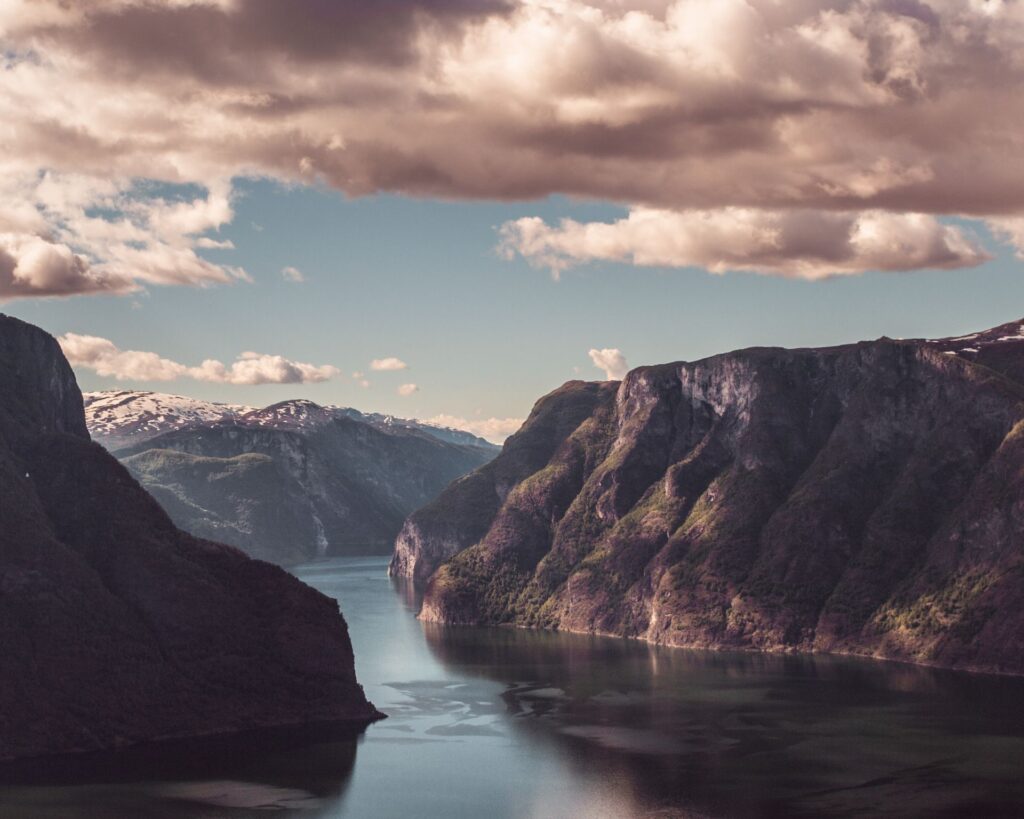
Nærøyfjord and Aurlandsfjord
Nærøyfjord is one of the narrowest and most dramatic fjords in Norway. It’s 17 to 19 km long depending on how you measure it, less than 500 metres wide south of the hamlet of Bakka, and the mountains above it reach 1,761 metres. It’s a side arm of Aurlandsfjord, which is itself an arm of Sognefjord. Together with Geirangerfjord it makes up the West Norwegian Fjords UNESCO site.
The village of Flåm sits at the end of Aurlandsfjord, at the bottom of the famous Flåm Railway. A sightseeing boat runs from Flåm through Nærøyfjord to Gudvangen. Above Aurlandsfjord is the Stegastein viewpoint, a platform 650 metres above the water that sticks out 30 metres over the trees. According to Norway’s road authority, it’s open all year.
Geirangerfjord
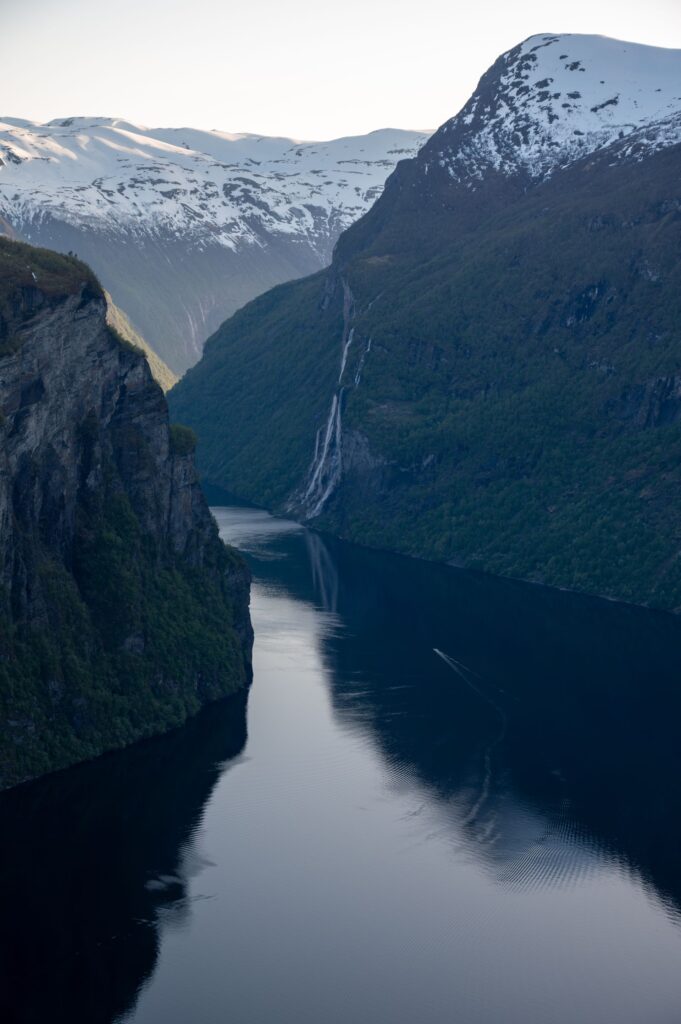
Geirangerfjord is one of the most visited natural sights in Norway. It’s 15 km long and runs from Hellesylt to Geiranger, between mountains of 1,400 to 1,700 metres, with abandoned farms on rock ledges high above the water. From the boat you’ll see waterfalls like the Seven Sisters (De syv søstrene).
You can reach Geiranger by car, by boat from Ålesund, or in summer on the Hurtigruten coastal voyage. The village is small and fills up with cruise passengers in summer. Stay overnight if you can and see the fjord early in the morning or in the evening.
There are two well-known viewpoints above Geiranger. Geiranger Skywalk on Dalsnibba mountain is a viewing platform over a sheer drop with a 360-degree view. It’s reached by a mountain toll road that closes in winter. Flydalsjuvet is a few kilometres up the road from the village (4 to 5 km). For a short hike, a trail leads from the village to the Storseterfossen waterfall, where you can walk behind the falling water.
Sognefjord
Sognefjord is the longest and deepest fjord in Norway. Store norske leksikon puts it at 205 km long and 1,303 metres deep off Vadheim. Unlike its narrow arms, the main fjord is wide and open, with fruit farms and villages along the shore.
Express catamarans run from Bergen along Sognefjord, so you can see it without a car. Balestrand and Flåm both work as a base. From Flåm, Nærøyfjord and Aurlandsfjord are right on your doorstep.
Hardangerfjord
Hardangerfjord is Norway’s second longest fjord, 180 km including its Sørfjorden arm. It’s known for orchards that blossom in spring and for waterfalls. Odda sits at the end of Sørfjorden and is the starting point for Trolltunga.
Trolltunga is a tongue of rock jutting out horizontally high above the lake Ringedalsvatnet. The hike from Skjeggedal is 28 km return and takes 10 to 11 hours, so it’s not a stroll. The official Trolltunga website says experienced hikers can go on their own from 1 June to 30 September. Outside that season it recommends a guide.
Lysefjord and Preikestolen
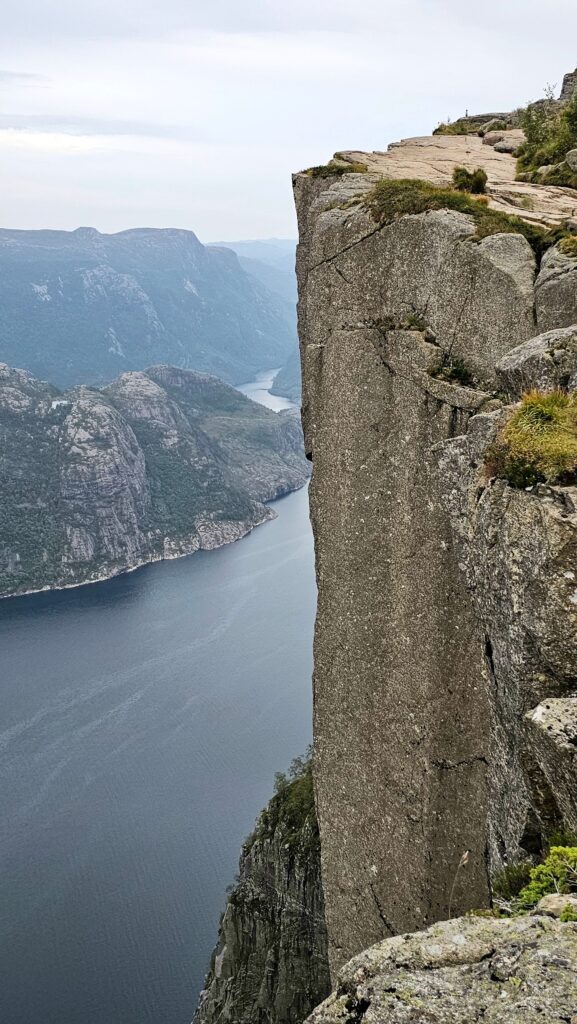
Lysefjord near Stavanger is 42 km long and famous for two rocks. Preikestolen (Pulpit Rock) is an almost flat platform 604 metres above the fjord. Kjerag, across the water, drops close to 1,000 metres in a sheer wall.
The trail to Preikestolen is a little over 4 km each way, and most people hike it between April and October; in winter, go with a guide. From the water, you’ll see Preikestolen from the boats that leave Stavanger, and only from below do you realise how high that rock hangs. Stavanger is also a good food stop, with the fully vegan tasting-menu restaurant Bellies.
What about Hjørundfjord and the northern fjords?
Hjørundfjord is Geirangerfjord’s quieter neighbour south of Ålesund, surrounded by the Sunnmøre mountains. According to Hurtigruten, its coastal ships sail into Hjørundfjord instead of Geirangerfjord on some dates. Up north, Trollfjord in Lofoten is worth knowing about, but it’s a separate trip built around the northern lights and the midnight sun. How to get there and when to go is in our Lofoten Islands holiday planner.
Norway fjords cruise: coastal voyage, big ship or day boat?
A Norway fjords cruise comes in three forms. A coastal voyage with Hurtigruten or Havila sails the whole coast over a week or more. A big cruise ship brings you from a European port.
A day boat takes you through one fjord in a couple of hours. Each suits a different kind of traveller.
| Type | Length | Price from | Fjords you’ll see | Food for vegans |
|---|---|---|---|---|
| Hurtigruten coastal voyage | 6 to 12 days | €1,731 / £1,470 (7 days north) | whole coast, Geirangerfjord in summer | plant-based dishes at lunch and dinner, tell them 2 weeks ahead |
| Havila coastal voyage | 6 to 12 days | depends on dates | whole coast | vegetarian and vegan dishes, wider choice 3 weeks ahead |
| Big cruise ship | depends on itinerary | depends on line | Geiranger, Flåm, Bergen, Ålesund | depends on the line, ask before you book |
| Day boat or ferry | 1 to 3 hours | depends on route | one fjord | café on board, bring your own food |
Hurtigruten and Havila coastal voyages
Hurtigruten has run along the Norwegian coast since 1893, from Bergen to Kirkenes near the Russian border. It stops at 34 ports and carries tourists, locals and freight. The 12-day round trip starts at €2,342 (about £1,990) and seven days northbound from €1,731 (about £1,470), full board included.
In summer, Hurtigruten sails into Geirangerfjord. On some dates it swaps Geiranger for Hjørundfjord, so if Geiranger is the point of your trip, check your specific departure. Havila Voyages sails the same route with newer ships.
You can also book a short port-to-port leg on the coastal voyage, Bergen to Ålesund for example. Meals aren’t included then, but you can buy them on board.
A coastal voyage suits you if you don’t want to drive or pack every morning. It also shows you the whole coast, from the fjords to beyond the Arctic Circle.
For vegans it has one big advantage, because the kitchen knows your diet in advance and cooks for you all week. The downsides are the price and the short port stops, which follow the timetable. Don’t count on it for a full day inland.
Big cruise ships and the 2026 zero-emission rule
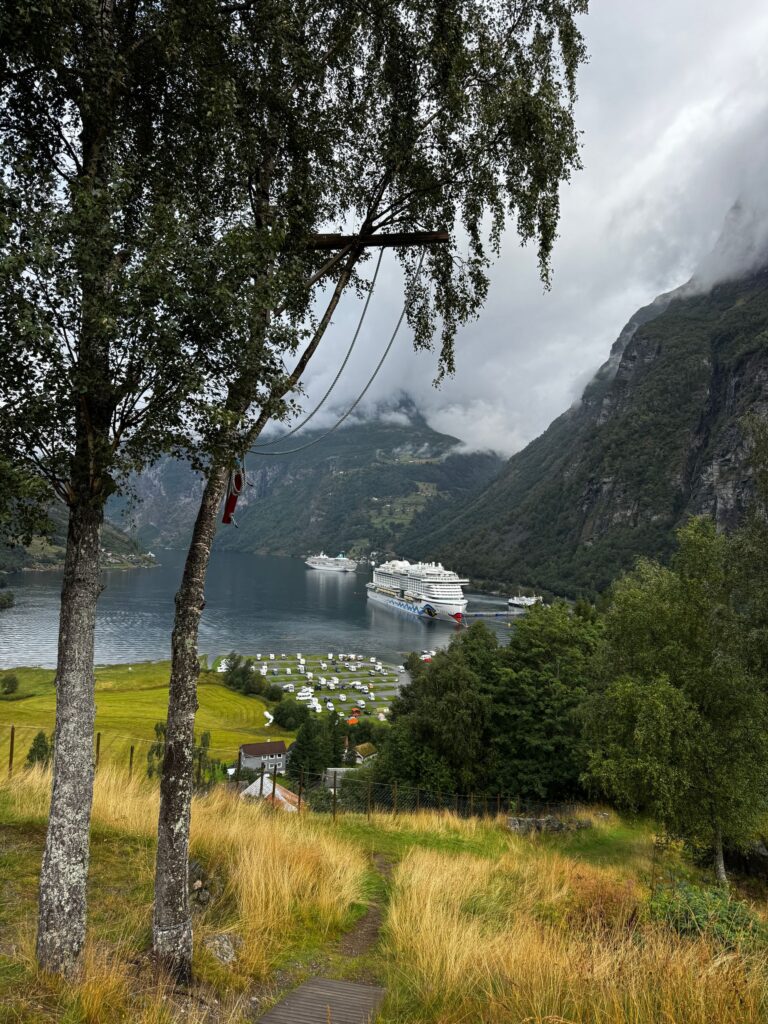
Big cruise ships sail from Germany, Denmark or the UK and call at Bergen, Ålesund, Flåm and Geiranger. They suit people who want comfort and no logistics. You’ll see fewer fjords than the brochure suggests, though, and you’ll share each port with thousands of other passengers.
Since 1 January 2026, Norway’s UNESCO fjords have a new rule. According to the Norwegian Maritime Authority, passenger ships under 10,000 gross tonnage must now be zero-emission there. From 1 January 2032 the same rule applies to bigger ships. On short trips through Nærøyfjord and Geirangerfjord, you’re increasingly likely to be on an electric or hybrid boat.
Day boats and ferries
A day boat is the cheapest way to see a fjord from the water. From Flåm, a sightseeing boat sails through Nærøyfjord to Gudvangen. Between Ålesund and Geiranger there’s a silent fjord cruise that takes about three hours one way. From November to May, the same operator runs a full-day winter boat trip on selected dates from Ålesund to Geiranger from NOK 1,539 (about €146 / £123).
Be careful with the classic Geiranger–Hellesylt car ferry. Its operator Fjord1 says on its website that the route is suspended until further notice, with news about the 2027 season to follow. Check it’s running before you build a route around it.
Deck tip: Bring a jacket and a hat on board, even in July. The wind funnels through the fjord, and if you want photos from the bow you’ll be outside longer than you think.
Seeing the fjords without a cruise: Flåm Railway, Norway in a Nutshell and car
You can see the fjords without a cruise, and often better. A train, a bus and a short boat ride will get you through Nærøyfjord in a day. A car gets you to viewpoints no boat can reach.
The Flåm Railway
The Flåm Railway (Flåmsbana) is a 20 km line from the mountain station of Myrdal, 867 metres up, down to Flåm, 2 metres above sea level. According to the operator Vy, the ride takes an hour, stops at eight stations and runs at a 5.5% gradient for most of the way. Trains run every day of the year and pause for about five minutes at the Kjosfossen waterfall.
You reach Myrdal on the Bergen Line between Oslo and Bergen. That makes the Flåm Railway the perfect detour on a trip between the two cities.
Norway in a Nutshell
Norway in a Nutshell is a ready-made route that links the Bergen Line, the Flåm Railway and a boat through Nærøyfjord. It’s sold by Fjord Tours, starts in Oslo or Bergen and runs all year. In November 2026 it cost from NOK 2,698 (about €255 / £215).
The upside is that you don’t have to piece anything together, and all the connections line up. The downside is that you only get as long in each place as the connection allows, so it’s worth adding a night in Flåm. If you start in Oslo, give the capital a day or two as well, with our things to do in Oslo.
By car: Trollstigen, Stegastein and the Geiranger viewpoints
A car gives you the most control, but expect closed mountain roads. Fjord1 notes that the Trollstigen road between Åndalsnes and Geiranger is usually closed from October until late May. The same source puts Bergen to Geiranger at six to seven hours by car.
The best viewpoints by car are Stegastein above Aurlandsfjord and, above Geiranger, Dalsnibba and Flydalsjuvet. Driving through fjord country means plenty of car ferries, so check departures in the Entur app.
Read next: Bergen
Most fjord trips start in Bergen. For what to see in two or three days and where to eat well without meat, read Things to Do in Bergen (and Where to Eat Vegan).
Can you eat vegan on a Norway fjords cruise?
Yes, you can eat vegan on both coastal voyage lines if you tell them in advance. Hurtigruten and Havila both say on their websites that vegan dishes are available. On day boats and ferries it’s harder, so bring your own food.
Hurtigruten: plant-based dishes at lunch and dinner
Hurtigruten’s food FAQ says it offers plant-based dishes at lunch and dinner that suit both vegetarians and vegans. It also asks you to tell Customer Service about your diet at least two weeks before departure. Hurtigruten’s kitchen is built on Norwegian produce, from cod to Lofoten cheese, so giving notice is what makes sure there’s a proper plant-based plate for you every day.
Havila: vegan dishes, three weeks’ notice
Havila Voyages answers the vegan question simply. Vegetarian and vegan dishes are available on board. For a wider choice, it asks you to contact Havila’s customer service at least three weeks before departure. Hot meals at the Havly Café on board are served from noon to 9pm, but its menu is built around waffles, pizza, burgers and fish soup.
Booking tip: Put your diet in the booking and in an email, then introduce yourself to the head waiter on day one. On a big ship it’s easy for the starters to arrive before you’ve had the chance to ask.
Big cruise ships and day boats
Big cruise lines each have their own rules, and they vary from ship to ship. Before you book, find the line’s dietary page and write “vegan”, not “vegetarian”. Day boats and ferries usually have just a café with coffee, waffles and sandwiches. Bring a packed lunch from the supermarket or from Bergen.
You won’t go hungry in the fjords. You’ll just eat best where you planned ahead, on a ship that knows your diet and in the cities at either end of the trip.
Where to eat vegan in the fjord villages
We didn’t find a fully vegan place in any of the fjord villages. What you will find are restaurants with one or two vegan dishes and small shops where you can stock up for a picnic. For a proper hot plant-based meal, Bergen, Oslo and Stavanger are your best bets.
Bergen and Stavanger: eat well before the fjord
Bergen and Stavanger are the best places to eat before and after a fjord trip. Bergen has the fully plant-based fast-food chain Dirty V for burgers, and Daily Pot, a soup place with clearly labelled vegan pots. In Stavanger, the fully vegan restaurant Bellies serves a seasonal tasting menu from a wood-fired oven. Opening hours and what to order are on our vegan map.
Flåm: vegan soup at Ægir and a Coop
In Flåm, the Ægir Gastropub at Flåmsbrygga has a tomato soup that it serves as a vegan version, with green peas and herb oil. It costs NOK 160 as a starter (about €15 / £13) and NOK 295 as a main (about €28 / £24). The rest of the menu is mostly meat and salmon, and the vegetarian tasting plank includes goat’s cheese. From May to October food is served from noon to 10pm; the rest of the year it’s dinner only, from 5pm.
For groceries, Flåm has a Coop Marked on A-Feltvegen. Pick up bread, hummus, fruit and something for the boat.
Mixed-group tip: Ægir works well if you’re travelling with someone who eats meat. They can order the five-course Viking plank paired with five beers from the Ægir brewery, or the reindeer shank, while you have the vegan soup as a main, and nobody feels short-changed.
Geiranger: Berserk and Joker
In Geiranger, Berserk Bar & Grill says on its website that it has vegan and vegetarian options. It doesn’t list the dishes, so ask what’s actually vegan when you order, including the bun and the sauce. For groceries, there’s a Joker shop on Maråkveien in the village.
How to eat on a full-day trip
For a full-day trip, sort your food out the evening before. Supermarkets like Rema 1000, Kiwi, Coop and Meny sell plant-based yoghurts, oat milk, hummus and bread. Take a flask of tea and a lunchbox, because coffee and a waffle on the boat or bus will cost more than the whole shop.
For more on travelling vegan with a backpack and your own food, read our guide on how to travel vegan.
Best time to visit the Norway fjords
The best time to visit the Norwegian fjords is June to August. All the boats run, the mountain roads are open, and you can hike Trolltunga without a guide. May and September are quieter and cheaper, but some roads and hikes aren’t open yet, or have already closed.
| Month | What runs | Best for |
|---|---|---|
| January to March | Flåm Railway, Norway in a Nutshell, winter boats | quiet and snow, not hiking |
| April and May | boats, Hardanger orchards in blossom, Trollstigen closed until late May | a calm trip without crowds |
| June to August | all boats, roads and hikes, Trolltunga without a guide | a first visit |
| September | most boats, Trolltunga without a guide until 30 September | hiking and autumn colours |
| October to December | Flåm Railway, some boats, short days | a cheaper, quieter trip |
The northern lights are hard to find in the western fjords. For those, head north in winter to Tromsø or Lofoten. For month-by-month Norway and how to combine the fjords with the north, see our Norway holiday article.
It rains a lot on the west coast, even in summer, and low cloud can hide the mountaintops for a whole day. Build in at least one spare day so you can move a boat trip, viewpoint or hike to when it clears. Pack a waterproof jacket in any month.
How many days do you need for the fjords?
One day is enough for a first taste of the fjords, but plan on a week for a proper trip. It mostly depends on whether you go by train or by car.
One day: Nærøyfjord from Bergen or Oslo
In one day you can do Norway in a Nutshell with the train, the Flåm Railway and a boat through Nærøyfjord. Leave Bergen or Oslo in the morning and you’re back in the evening, or carry on to the other city. Have breakfast and dinner in the city and take a packed lunch for the journey.
Three to four days: Bergen, Flåm and Sognefjord
With three or four days, spend one or two nights in Flåm. In the morning, before the first train arrives, head up to Stegastein or walk the village. On the next day, take the express boat along Sognefjord back to Bergen (it runs from April to October; in winter go back by train).
A week: by car from Hardangerfjord to Geiranger
With a week and a car, you can drive Hardangerfjord, Flåm and Aurlandsfjord, Sognefjord and Geirangerfjord, and finish in Ålesund. Expect several car ferries, and mountain roads that are often closed outside summer. Self-catering accommodation will save you a lot of money and food hunting on a trip like this.
How much does a fjord trip cost, and where should you stay?
A trip to the Norwegian fjords is one of the pricier holidays in Europe. A day on Norway in a Nutshell costs about €255 per person, and a week on a coastal voyage over €1,700. You’ll save with supermarket food and self-catering stays.
Example prices
| What | Price | Roughly in € / £ |
|---|---|---|
| Norway in a Nutshell from Oslo or Bergen | from NOK 2,698 | €255 / £215 |
| Hurtigruten, 7 days from Bergen north, full board | from €1,731 | €1,731 / £1,470 |
| Hurtigruten, 12-day round trip | from €2,342 | €2,342 / £1,990 |
| winter boat trip Ålesund–Geiranger | from NOK 1,539 | €146 / £123 |
| vegan tomato soup, Ægir in Flåm | NOK 160 starter, NOK 295 main | €15 / £13, €28 / £24 |
Prices are from November 2026 and the conversions are approximate. Boat and tour prices change with the dates, so treat them as a guide.
Where to stay in the fjords
The easiest option is to stay in Bergen and do the fjords as day trips. If you want a fjord to yourself in the morning, stay overnight in Flåm, Geiranger or Balestrand. Book early for summer, as the villages have few hotels.
Apartments and cabins with a kitchen make a lot of sense here. When you cook for yourself, you don’t have to worry whether the only restaurant in the village has anything without meat. We didn’t find a fully vegan hotel in Norway, but there are a few ideas across Europe in our list of vegan hotels.
Norwegian phrases for vegans in the fjords
English works almost everywhere in Norway, even in a small fjord village. Norwegian words help with labels in the shop and with café menus on board.
| English | Norwegian | When it helps |
|---|---|---|
| I’m vegan. | Jeg er veganer. | at the start of your order |
| Is this vegan? | Er dette vegansk? | soup, cake, sandwiches |
| without meat, without fish | uten kjøtt, uten fisk | when asking to change a dish |
| without milk, butter and eggs | uten melk, smør og egg | bread and desserts |
| Is there cheese in it? | Er det ost i? | pizza and salads |
| plant-based | plantebasert | labels in the shop |
| oat milk | havremelk | coffee on board |
Our pick: which of the best fjords in Norway to see first
If it’s your first time in Norway and you eat plant-based, start with Nærøyfjord. You’ll have Bergen or Oslo at either end, where the food is good. In between come a train, the Flåm Railway and a boat you can take a packed lunch on.
Save Geirangerfjord for a second trip by car, or for a coastal voyage where the kitchen knows your diet. The fjords aren’t a foodie trip, but with a little planning you won’t go hungry a single day.
Which fjord is calling you? And have you sailed with Hurtigruten or Havila as a vegan? We’d love to hear how the food was.
Frequently asked questions
What is the most beautiful fjord in Norway?
Geirangerfjord and Nærøyfjord are most often called the most beautiful, and both have been on the UNESCO World Heritage List since 2005. Geirangerfjord has waterfalls and cliff-top farms, while Nærøyfjord is narrower and more dramatic. For a first trip without a car, Nærøyfjord is easier.
When is the best time to visit the Norwegian fjords?
June to August is the best time, when all the boats run and the mountain roads are open. May and September are quieter and cheaper. In winter the Flåm Railway and some boats still run, but days are short and hikes need a guide.
Can you see the fjords without a cruise?
Yes. Norway in a Nutshell links the train from Oslo or Bergen, the Flåm Railway and a boat through Nærøyfjord in one day. By car you can reach viewpoints like Stegastein above Aurlandsfjord and Dalsnibba above Geiranger.
Is Hurtigruten vegan friendly?
Yes. Hurtigruten says it serves plant-based dishes suitable for vegans at lunch and dinner. You need to tell Customer Service at least two weeks before departure. Havila is similar, and asks for three weeks’ notice if you want a wider choice of vegan dishes.
How many fjords are in Norway?
Norway has more than a thousand fjords. Wikipedia’s list counts about 1,190 including Svalbard, though the total depends on how you count. The best known are on the west coast between Stavanger and Ålesund.
Newsletter
Get our free e-books
Join the newsletter and download Our Vegan Christmas Kitchen straight away, 10 recipes for Czech cookies, gingerbread and vánočka. Then once a month, new places from the vegan map and new articles. Unsubscribe with one click.