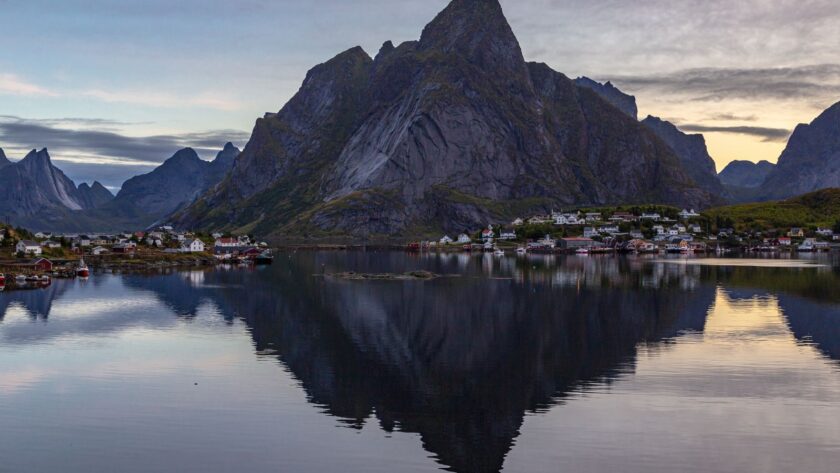
The Lofoten Islands are a chain of mountains rising straight out of the sea above the Arctic Circle in northern Norway, with red fishing cabins on stilts at their feet. In summer the sun doesn’t set for six weeks, and in winter the northern lights dance over the peaks. A Lofoten Islands holiday sounds like it needs a big budget and a tour company, but it doesn’t, as long as you know how the islands work.
How do you actually get to the Lofoten Islands from the UK or the rest of Europe? When should you go for the midnight sun, and when for the northern lights? What should you see in a week, and can you do it without a car? And where do you eat if you don’t eat meat or fish, on islands that have lived off cod for a thousand years?
We haven’t made it to Lofoten together yet. Lenka was in Norway twice as a child with her dad, travelling by bus and ferry, but they never got this far north. So this is a well-sourced guide rather than a trip report. In November 2026 we checked transport with Visit Lofoten (the official tourist board) and the ferry and bus operators. We took the weather from Norwegian climate data, and for every place to eat we read its own menu.
See every verified place from this article on our vegan map.
Where are the Lofoten Islands?
The Lofoten Islands (Lofoten in Norwegian) are an archipelago in Nordland county, above the Arctic Circle, between the mainland town of Bodø and the open Atlantic. From Bodø they look like a single stone wall about 100 km long and 800 to 1,000 metres high. According to Wikipedia, about 24,500 people live there, on 1,227 km² of land.
The main islands run from north-east to south-west. Austvågøy has Svolvær and Henningsvær, then comes little Gimsøy, then Vestvågøy with Leknes, Flakstadøy with its beaches and Moskenesøy with Reine and the village of Å. Further south-west lie the small islands of Værøy and Røst, which you can only reach by boat or plane. One road, the E10, links the big islands with bridges and undersea tunnels.
North of Lofoten lies Vesterålen, another archipelago with similar scenery and fewer visitors. People often combine the two in one trip. This article sticks to Lofoten.
Lofoten is much warmer than you’d expect above the Arctic Circle. According to Wikipedia, it has one of the mildest winters in the world for its latitude, thanks to the warm Atlantic water flowing past the islands. In Svolvær the January average is around 0 °C, milder than many cities far to the south.
Lofoten on our vegan map
4 places. Tap a pin to see the details.
Loading the map…
- Vegan options
How to get to the Lofoten Islands
Most people get to the Lofoten Islands by flying to Bodø or to Evenes (Harstad/Narvik), then continuing by boat, small plane, bus or car. There’s no direct flight from the UK to Lofoten itself, so expect to connect, usually in Oslo. The table shows the main routes as listed by Visit Lofoten.
| Route | From – to | Time | Take a car? |
|---|---|---|---|
| Car ferry | Bodø – Moskenes (near Reine) | about 3 h 15 min to 3.5 hours | yes |
| NEX 2 express boat | Bodø – Skrova – Svolvær | depends on stops, all year | no |
| Widerøe flight | Bodø – Svolvær or Leknes | short hop, several a day | no |
| Flight + bus 300 | Evenes – Svolvær – Leknes – Å | Evenes is 170 km from Svolvær | no |
| Drive the E10 | mainland – Lofast road – Lofoten | ferry-free since 2007 | yes |
| Hurtigruten or Havila | coastal route, stops at Stamsund and Svolvær | depends on route | rarely (very few car spaces, pre-book) |
Flying to Bodø or Evenes
The fastest way to reach the Lofoten Islands is to fly to Oslo and on to Bodø or Evenes. From Bodø, Widerøe flies small propeller planes to Svolvær and Leknes several times a day, according to Visit Lofoten. Evenes is about 170 km from Svolvær, but since summer 2024 it has more direct flights from Europe, which has made it a popular gateway.
Order a plant-based meal before you fly, though short domestic hops often don’t serve one. We explain how in our guide to ordering a vegan airline meal.
The Bodø to Moskenes ferry
The Bodø to Moskenes ferry is the shortest sea crossing and takes about 3 h 15 min to 3.5 hours, depending on the sailing. Torghatten Nord runs it. Foot passengers travel free and only pay if they want to reserve a place (65 NOK per adult). A car up to 6 metres costs 605 NOK, about £48, on Torghatten’s price list.
In summer the ferry fills up and cars without a booking sometimes wait for the next sailing. Torghatten releases only about half of the spaces (up to 60%) for booking and keeps the rest for the queue. If you have booked, you must be at the port at least 45 minutes before departure.
Ferry tip: Every passenger must register their full name, nationality and date of birth before boarding. There’s a QR code on the pier, but it’s easier to do it calmly the day before. Save the boarding pass on your phone, as it works for later trips too.
Express boat to Svolvær and the coastal route
The NEX 2 express boat runs all year from Bodø via the little island of Skrova to Svolvær. You can’t take a car. Ask about bikes when you book. Buy tickets in the Reis app. Hurtigruten and Havila ships call at Stamsund and Svolvær, and Visit Lofoten notes you can book a short port-to-port hop. The evening sailing from Stamsund to Svolvær takes about an hour and a half.
Driving the E10
You can drive to the Lofoten Islands without a ferry on the Lofast road, which has linked the islands to the mainland since 1 December 2007. It runs through tunnels and over the Raftsund bridge. Most visitors don’t drive from home, though. They fly into Evenes or Bodø and hire a car there. Book early for summer, as cars are scarce up north.
Lofoten itinerary without a car: buses, boats and one base
You can do Lofoten without a car if you pick one or two bases around the buses and boats. Long-distance route 300 (Lofotekspressen) runs from Evenes through Svolvær and Leknes all the way to Å. According to Visit Lofoten’s local transport page, it leaves Evenes Airport daily at 10:50 and 17:05.
Shorter local routes run between villages, for example from Svolvær via Kabelvåg to Henningsvær, or from Å via Reine to Hamnøy. Timetables change between summer and winter, so plan everything in the Reis app, where you can also buy tickets. Paying the driver costs 20 NOK more.
If you’ll be riding a lot, get the Travel Pass Nordland. The Reis Nordland 2026 brochure prices it at 1,990 NOK (about £155) for seven days on all buses and express boats in Nordland county. It doesn’t cover ferries, but foot passengers ride most of them free anyway.
Going car-free has an upside nobody mentions. You won’t have to deal with paid parking at beaches and viewpoints (often through the EasyPark app), or narrow roads full of campervans. The cost is time and freedom. Kvalvika beach or a midnight viewpoint are harder to reach without wheels.
Best time to visit the Lofoten Islands
The best time to visit the Lofoten Islands is June to August for hiking, beaches and the midnight sun, or September to March for the northern lights. July is the busiest and most expensive month. The table shows a year in Lofoten, using Svolvær’s average temperatures for 1991–2020. Iceland poses the same midnight sun or northern lights question, which we look at in our piece on the best time to visit Iceland.
| When | Average temp | Light | Go for | Food and services |
|---|---|---|---|---|
| June–August | 10–13 °C | midnight sun until 14 July | hiking, beaches, kayaking, photography | most cafés and restaurants open |
| September–October | 6–10 °C | dark nights return | northern lights, autumn colours | seasonal places start closing |
| November–January | 0–3 °C | very short days, no sunrise around Christmas | northern lights, quiet | many places closed, self-cater |
| February–April | −0.4 to 3 °C | days lengthen fast | northern lights, snow by the sea | some places reopen |
| May | about 7 °C | midnight sun from late May | first hikes, few people | the season warms up |
Weather tip: Lofoten weather changes within the hour, so keep two plans every day, one for a hike and one for rain. Check the Norwegian Meteorological Institute’s forecast on yr.no each morning, and pack layers and a waterproof even in July.
Summer and the midnight sun
The midnight sun shines over the Lofoten Islands from 28 May to 14 July, according to Visit Norway. The sun doesn’t set at all, so you can hike at midnight. Svolvær averages 13 °C in July, and the sea near Skrova reaches about 14 °C in August. You can swim, briefly.
Summer is high season and Lofoten accommodation sells out weeks ahead. If you can, go in June or late August. It’s quieter and the days are still long. Pack an eye mask, as sleeping in daylight takes getting used to.
Northern lights in Lofoten
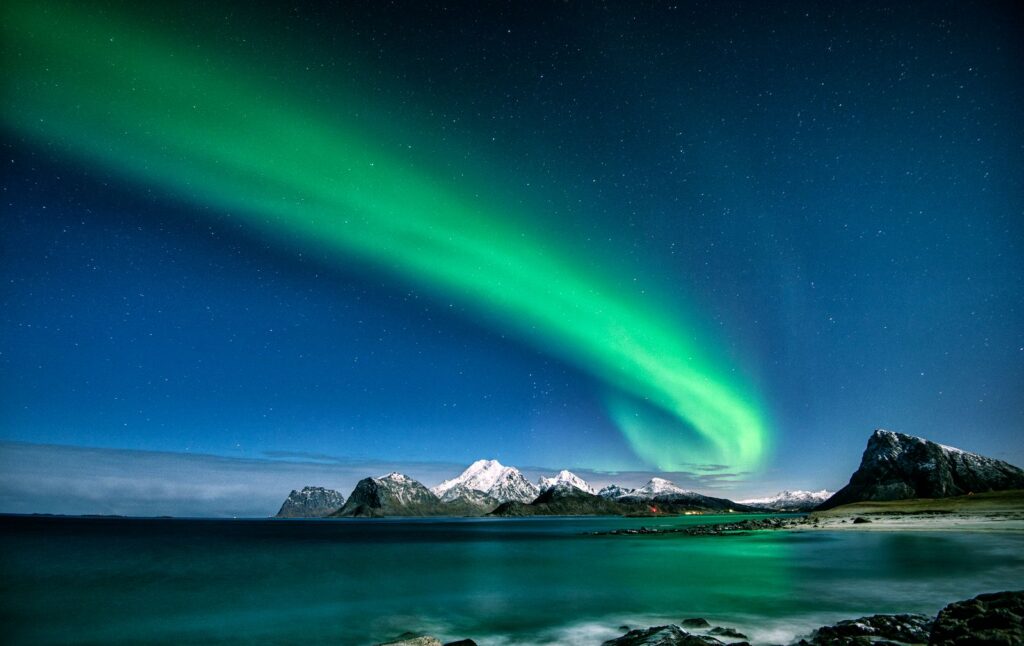
You can see the northern lights in Lofoten from roughly late August to late March, whenever it’s dark and clear. Activity tends to peak in September and October and again in March and April, according to Visit Norway. Nobody can promise them, and Lofoten weather changes by the hour. Allow several nights and watch the cloud forecast on yr.no.
Lofoten’s edge over Tromsø is that you see the lights over mountains and sea, not over a city. Drive a few kilometres out to a beach such as Haukland or Uttakleiv and look north.
Winter and the polar night
In winter Lofoten is dark for most of the day. In Svolvær the sun doesn’t rise above the horizon from roughly early December to early January, though there are a few hours of blue twilight around noon. Winters are mild, with averages around freezing. Roads can be icy and the mountains carry avalanche risk, so hike only with a guide.
Winter is the hardest season for plant-based eaters. Many seasonal cafés and restaurants close, and Lofoten Beach Camp’s kitchen, for example, is shut until 15 January 2027. Book somewhere with a kitchen.
Things to do in Lofoten, island by island
You’ll see the most of Lofoten by driving the E10 from one end to the other, island by island. The most famous views are in the south-west around Reine, and most services are in the north-east around Svolvær. Here are the highlights, from the far end back towards the mainland.
Reine, Hamnøy and Å on Moskenesøy
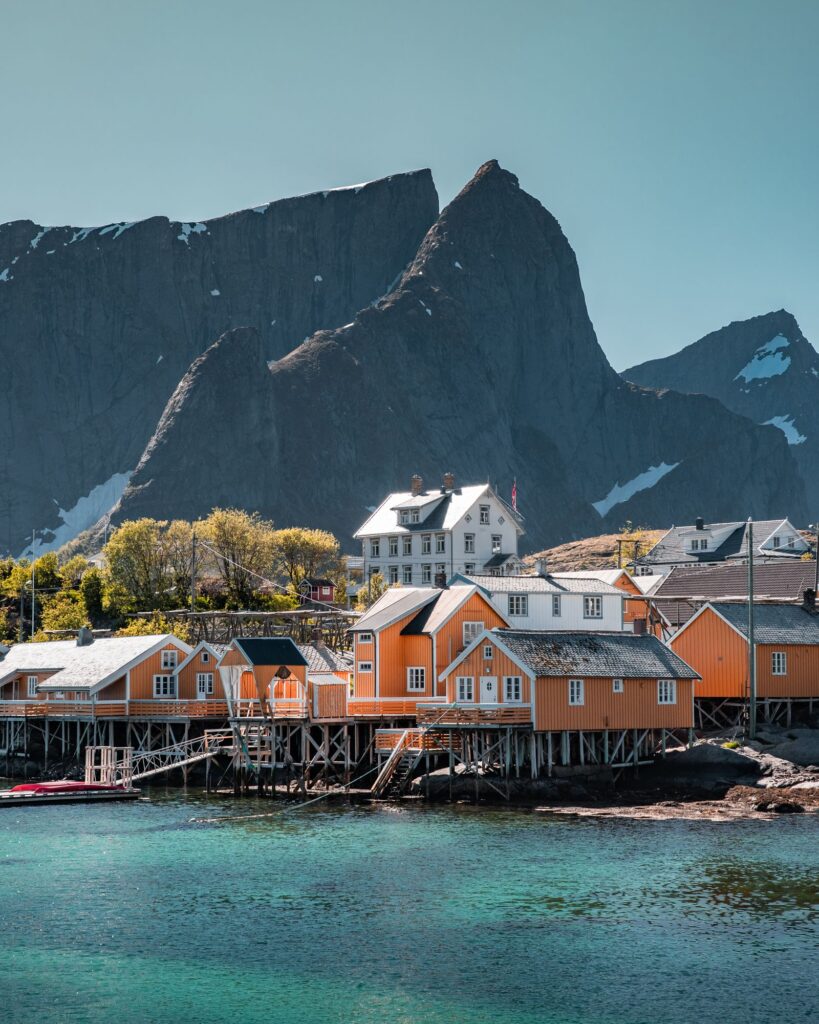
Reine is the postcard village. Red cabins on little islands, mountains behind, and the Reinebringen viewpoint at 448 metres. Steep stone steps lead up, and the climb takes about an hour, according to Full Suitcase. Don’t go when the steps are icy or snow-covered. From Reine a local boat runs to Vindstad, where you can walk to Bunes beach.
Hamnøy is a few kilometres from Reine, and its bridge is where Lofoten’s best-known photo is taken. At the very end of the road sits Å, a village that lived from dried cod. Today it has the Lofoten Stockfish Museum and the Norwegian Fishing Village Museum. You’ll see wooden fish-drying racks all over Lofoten, hung with cod in winter and spring.
Beaches in Flakstad: Ramberg, Skagsanden and Kvalvika
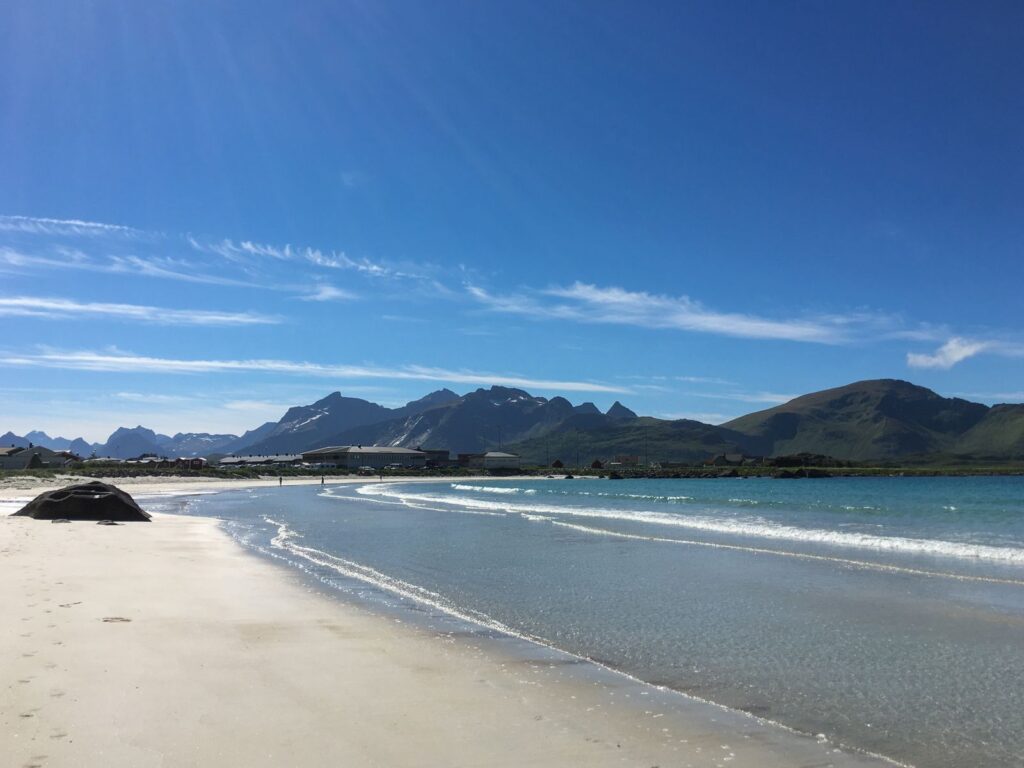
Flakstad has white-sand beaches that look tropical until you touch the water. Ramberg and Skagsanden are right by the road, so you just pull over. Kvalvika can only be reached on foot, usually from Fredvang, and you can climb to the Ryten viewpoint above it on the way.
Lofoten Beach Camp sits on Skagsanden beach, a campsite with a café and surfboard hire. More on its food below.
Vestvågøy: Lofotr, Unstad and Haukland
Vestvågøy is where Lofoten’s history lives. The Lofotr Viking Museum at Borg has a reconstructed chieftain’s house 83 metres long. According to Museum Nord, it’s the world’s longest reconstructed longhouse, and a new exhibition opens there in December 2026.
On the north side of the island lies Unstad bay, where people surf even in winter in thick wetsuits. Further south-west along the same coast are Haukland and Uttakleiv beaches, joined by a coastal path.
Henningsvær, Svolvær and Trollfjord
Henningsvær is a fishing village spread over several islets joined by bridges, with galleries, cafés and the old Trevarefabrikken factory, now a hotel and pizzeria. Above it rises Festvågtind, with a view over the whole village.
Svolvær is Lofoten’s biggest town and its transport hub, with the airport, the express boat and the coastal route stop. Boats leave from here for narrow Trollfjord, which no road reaches. Svolvær also has the biggest supermarkets at this end of the islands.
Don’t come to Lofoten for the food, come for the landscape. Plan your meals as carefully as your ferry, and nothing will catch you out.
Where to eat vegan on a Lofoten Islands holiday
We couldn’t find a fully vegan restaurant with regular opening hours in Lofoten in November 2026. We did find four places with vegan dishes on the menu on their own websites. We dropped every other tip from the internet, because we couldn’t check the menu or the place had closed. Most of these places are seasonal, so always check opening hours.
Why Lofoten is a fishing archipelago
Lofoten has lived off cod for more than a thousand years, and the menus show it. Every winter, according to Wikipedia, cod migrate from the Barents Sea to spawn around the islands, and fishermen dry them outdoors on wooden racks. Dried cod (tørrfisk, or stockfish) is Norway’s oldest export, and Italy loves it most. The village of Å has a whole museum about it.
That means two things for you. First, in a typical Lofoten restaurant most dishes will be fish or seafood, often including soups and sauces. Second, Lofoten cooks see tourists from all over the world and won’t blink at “Er dette vegansk?” (“Is this vegan?”). If a dish isn’t vegan, ask whether it can be adapted, without cheese or with a different sauce.
If you’re travelling with someone who eats fish, you don’t need a separate restaurant. Gammelbua in Reine and Lofoten Beach Camp have cod for them and a vegan dish for you on the same menu. And the best dinner in Lofoten is often the one you cook yourself in a cabin with a mountain view.
| Place | Where | What to order | Price | Type |
|---|---|---|---|---|
| Trevarefabrikken | Henningsvær | Mycelium pizza (vegan) | 250 NOK | vegan option |
| Unstad Arctic Surf | Unstad, Vestvågøy | vegan cinnamon bun, vegan brownie | 119 NOK | vegan option |
| Lofoten Beach Camp | Skagsanden, Flakstad | vegan toast, pulled vegan burger | 80 NOK, 249 NOK | vegan option |
| Restaurant Gammelbua | Reine | vegan spiced lentil soup | 225 NOK | vegan option |
Henningsvær: vegan pizza at Trevarefabrikken
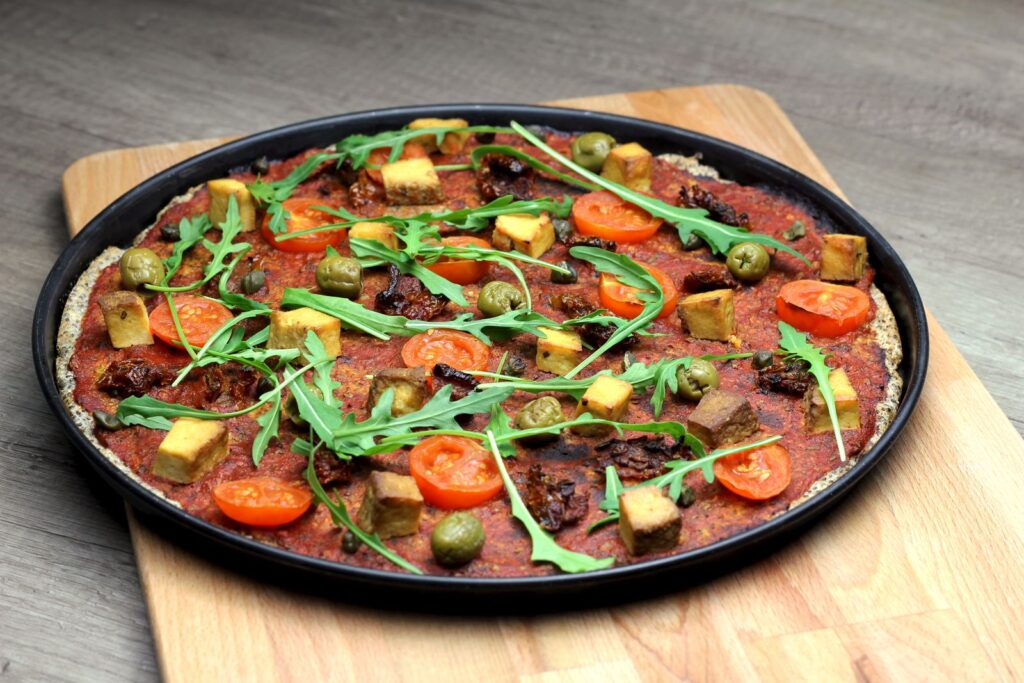
Trevarefabrikken is an old factory in Henningsvær (Dreyers gate 72) with a wood-fired pizzeria. Among the pizzas is the vegan Mycelium at 250 NOK (about £20), with artichoke cream, caramelised mushrooms, pickled onion and a walnut and miso sauce. According to the pizzeria menu, pizza is served Friday to Monday from 17:00 to 21:00.
The café at Trevarefabrikken opens from February to December. Its autumn lunch (Friday to Tuesday, 12:00 to 15:00) has a roasted pumpkin soup made with vegan cream. It isn’t labelled vegan, so ask about the bread and whether the chanterelles are fried in butter.
Unstad: a vegan cinnamon bun after the surf
The café at Unstad Arctic Surf in Unstad bay (Unstadveien 105) is famous for its cinnamon buns, and one of them is vegan. Ask for it without the whipped cream, which is dairy. It costs 119 NOK, the same as the vegan, gluten-free brownie with peanuts. Coffee comes with oat milk. The Unstad Arctic Surf menu also lists a carrot and ginger soup with coconut milk. It isn’t labelled vegan, so ask.
The café opens seasonally, and in November 2026 it was open Friday to Sunday from 10:00 to 18:00. Unstad is famous for its buns, so it’s a good stop with non-vegan friends too.
Flakstad: a vegan burger at Lofoten Beach Camp
Lofoten Beach Camp on Skagsanden beach has a café with Atlantic views and two vegan dishes on the menu. In the morning there’s a vegan toast with vegan cheese and sun-dried tomatoes for 80 NOK. In the afternoon there’s a pulled vegan burger with soya, guacamole and a gluten-free bun for 249 NOK (about £20). According to the Lofoten Beach Camp menu, the café is closed until 15 January 2027.
Reine: lentil soup at Gammelbua
Restaurant Gammelbua in Reine belongs to the Reine Rorbuer cabins and is one of the few restaurants around Reine with a vegan dish on its menu. The Gammelbua menu lists a vegan spiced lentil soup with tomato and grilled pepper for 225 NOK. It’s a starter, but you can have it as a main. Dinner runs from 17:30 to 21:30.
The menu also has crispy falafel with roast vegetables and sweet potato for 415 NOK, but it isn’t marked vegan. Ask about the dip and sauce.
Supermarkets and cooking in your cabin
On a Lofoten Islands holiday you’ll cook most of your own food, and that’s fine. The biggest supermarkets are in Leknes and Svolvær, for example Extra in Leknes (Storgata 8) and Coop Extra in Svolvær by the Lofotgata bus stop. Plant milk, tofu and frozen plant-based burgers are mostly found there, as small village shops carry little.
Tinned beans, pasta, rice and vegetables are in every shop. In Norway, look for plant-based alternatives next to the cheese and meat, not on a separate shelf. If you’re hiking or camping, read our guide to vegan backpacking food.
Shopping tip: Do a big shop in Svolvær or Leknes before heading south-west to Reine. The far end of the islands only has small shops, and most Norwegian supermarkets close on Sundays.
Where to stay in the Lofoten Islands
Most people in Lofoten sleep in a rorbu, a traditional fisherman’s cabin on stilts by the water, now converted into holiday flats. Most have a kitchen, which is the single most useful thing a plant-based traveller can have here. Beyond rorbuer you’ll find hotels in Svolvær, campsites and hostels.
Pick your base by what you want to see. Svolvær has the most services, shops and connections. Leknes sits in the middle, near the airport and a good supermarket. Reine and Hamnøy have the best views but the fewest shops. For a week, two bases work well, say three nights around Svolvær and four near Reine.
If you want to camp, Norway’s right to roam lets you pitch a tent in nature (at least 150 m from houses), but it doesn’t cover vehicles. A campervan may stay on a roadside lay-by for up to two nights where no sign forbids it, never off-road. Visit Lofoten recommends campsites, which also have kitchens. We know of no fully vegan hotel in Lofoten. If you’re curious where in the world there are, see our list of vegan hotels.
Read next: Norway
Lofoten is just one part of Norway. When to see the fjords, what food costs in the shops and where to eat well plant-based in Oslo, Bergen and Stavanger is all in Norway Holiday: Fjords, Costs and Where to Eat Vegan.
How many days in Lofoten, with a sample itinerary
Give the Lofoten Islands at least five days, ideally a week. One or two will go on travel, and the weather will rearrange another. In three days you’ll only cover one end of the islands.
Seven days in Lofoten by car
On day 1, fly into Evenes, pick up a car and drive to Svolvær for a big shop. Day 2 is Henningsvær and a boat into Trollfjord. Day 3 takes you to Vestvågøy for the Lofotr museum and Haukland and Uttakleiv beaches.
On day 4, drive on to Flakstad, stop at Skagsanden and walk to Kvalvika. Day 5 is Reine, Hamnøy and Å. Keep day 6 free for Reinebringen or the boat to Bunes, depending on the weather. On day 7, take the ferry from Moskenes to Bodø and fly home.
Five days without a car
Without a car, take the express boat from Bodø to Svolvær and stay there two nights. Buses run to Henningsvær and Kabelvåg. Then ride route 300 via Leknes to Reine and stay three nights. From Reine a local bus runs to Å and Hamnøy, and a boat runs to Vindstad. Go home on the Moskenes ferry, free on foot.
What does a Lofoten Islands holiday cost?
The Lofoten Islands aren’t a cheap holiday, but they needn’t be outrageous either. The biggest saving is food, if you cook. A restaurant meal costs roughly 250 to 500 NOK (about £20 to £40), going by the menus above. Supermarkets are much cheaper, though pricier than in most of Europe.
Work out transport by travel style. Foot passengers ride the ferry free, and a car up to 6 metres costs 605 NOK one way. A seven-day Travel Pass Nordland for buses and express boats costs 1,990 NOK. Flights and summer accommodation are usually the biggest costs, so book both as early as you can.
Tour operators sell Lofoten packages, often combined with the fjords or Tromsø. A package suits you if you’d rather not drive or juggle timetables. Going independently gives you more freedom and lets you choose somewhere with a kitchen. If you book a tour, ask in advance how they handle plant-based meals, as hotel dinners up north are mostly fish. For general advice on travelling plant-based, including with people who eat meat, see our guide on how to travel vegan.
Budget tip: If you’re travelling with a non-vegan, take them for the Mycelium pizza at Trevarefabrikken. It costs only 15 NOK more than the margherita, and wood-fired caramelised mushrooms are no compromise.
Norwegian phrases for vegans in Lofoten
English works almost everywhere in Lofoten, even in a tiny shop. Norwegian words help most with labels in the supermarket and on café boards.
| English | Norwegian | When it helps |
|---|---|---|
| I’m vegan. | Jeg er veganer. | at the start of your order |
| Is this vegan? | Er dette vegansk? | soup, cake, sandwiches |
| without meat, without fish | uten kjøtt, uten fisk | when asking to change a dish |
| without milk, butter and eggs | uten melk, smør og egg | bread and desserts |
| Is there cheese in it? | Er det ost i? | pizza and salads |
| plant-based | plantebasert | labels in the shop |
| oat milk | havremelk | coffee |
Is a Lofoten Islands holiday worth it if you don’t eat fish?
Yes. People come to Lofoten for mountains over the sea, the midnight sun and the northern lights, not for dinner. Nobody will hand you a plant-based meal on a plate here. But if you book a cabin with a kitchen, shop in Svolvær or Leknes and know the four places with vegan dishes on the menu, you won’t go hungry a single day.
For a first trip, choose summer and two bases, Svolvær and Reine. Come back another time for the northern lights. Where would you start in Lofoten, Reine or Henningsvær? Tell us in the comments.
For more of Norway and the north, see our articles on things to do in Bergen, the best fjords in Norway and the best time to visit Scandinavia.
Frequently asked questions
How do you get to the Lofoten Islands?
Most people fly via Oslo to Bodø or Evenes. From Bodø you continue by ferry to Moskenes (about 3 h 15 min to 3.5 hours), express boat to Svolvær, or a Widerøe flight to Svolvær or Leknes. From Evenes you take bus 300 or drive, as Svolvær is 170 km away.
When is the best time to visit the Lofoten Islands?
Go from June to August for hiking, beaches and the midnight sun, which lasts from 28 May to 14 July. Go from September to March for the northern lights. July is the busiest month, while June and late August are quieter.
How many days do you need in Lofoten?
A week is ideal and five days is the minimum. One or two days go on travel, and Lofoten weather often changes plans. In three days you’ll only see one part of the islands.
Can you visit Lofoten without a car?
Yes, but plan around the timetables. Route 300 runs from Evenes through Svolvær and Leknes to Å, and local buses and boats link the villages. A seven-day Travel Pass Nordland (1,990 NOK) and one or two bases make it work.
Can you eat vegan in the Lofoten Islands?
Yes, though you’ll cook a lot yourself. Trevarefabrikken in Henningsvær, Unstad Arctic Surf, Lofoten Beach Camp and Gammelbua in Reine all have vegan dishes on their menus. Plant-based groceries are easiest to find in the supermarkets in Svolvær and Leknes.
Newsletter
Get our free e-books
Join the newsletter and download Our Vegan Christmas Kitchen straight away, 10 recipes for Czech cookies, gingerbread and vánočka. Then once a month, new places from the vegan map and new articles. Unsubscribe with one click.