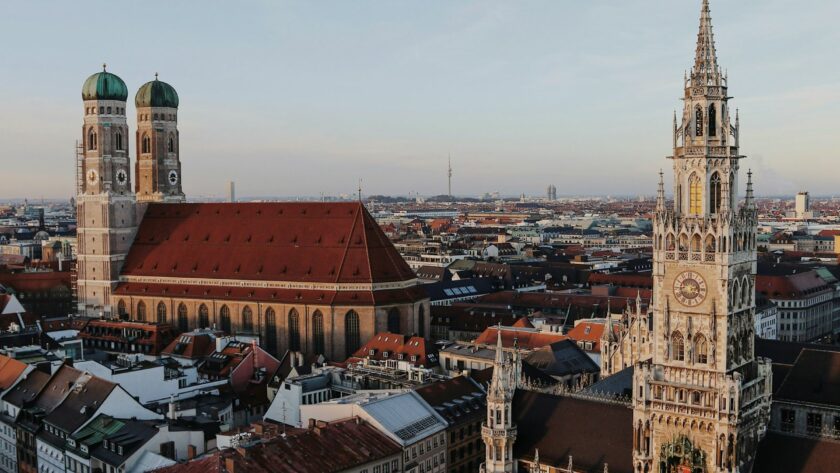
Munich has a reputation as the city of roast pork knuckle, white sausages and litre-sized beer steins. Search for things to do in Munich and you get the town hall with its mechanical clock, the English Garden and Oktoberfest. What the lists leave out is the vegan side of the Bavarian capital.
There’s a vegan tavern serving seitan “duck” with dark beer gravy and a vegan butcher’s shop a few steps from the Viktualienmarkt. And there are beer gardens where, by tradition, you’re allowed to bring your own food.
Munich is also easy to reach. From Prague there’s a direct train every two hours and a bus that does it in under five hours. And 2026 is a year to watch the calendar, because the main Christmas market on Marienplatz opens earlier than usual and the Prague–Munich train changes operator on 13 December.
So what should you actually see in Munich in a weekend? How many days do you need, and what will it cost? When exactly does the Munich Christmas market start in 2026, and what can you eat there if you don’t eat meat? And where can you eat vegan in Munich so that your meat-eating travel companion leaves happy too? We’ve got all of it below, with prices in euros.
We haven’t made it to Munich together yet, so this isn’t a trip diary. In October 2026 we read every venue’s own menu, checked dates and prices on the official city and attraction websites, and looked up train times in the Czech timetable search. Places whose menu we couldn’t find on their own website are left out, even if other lists still recommend them.
Is Munich worth visiting?
Yes, Munich is worth visiting, especially if you like a beautifully kept historic centre, huge parks and world-class museums. It’s a wealthy, clean, well-run city. You can walk the centre, and the U-Bahn and trams take you everywhere else.
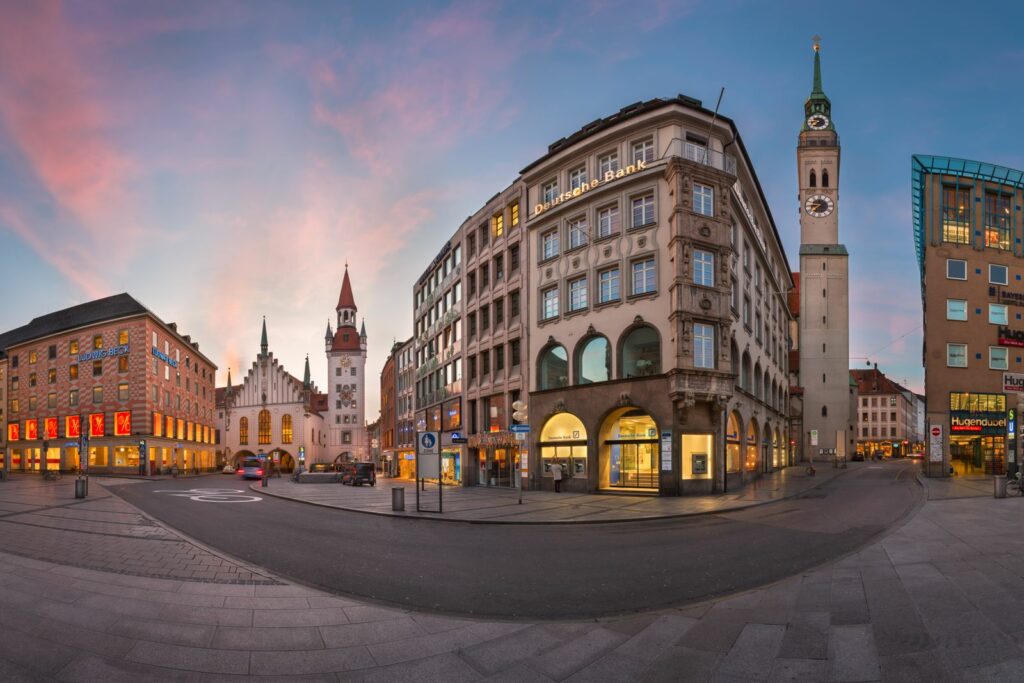
Munich isn’t cheap, though, and it isn’t edgy. If you want an alternative scene and an endless choice of vegan places, you’ll be happier in Berlin, which has more vegan spots than anywhere else in Germany. If you want a comfortable weekend city with the Alps on the horizon, beer gardens and some of Europe’s best Christmas markets, Munich is the one.
How many days do you need in Munich?
Two to three days is enough for Munich. On day one, walk Marienplatz, the Viktualienmarkt and the Alter Peter tower. Day two belongs to the English Garden and one big museum.
Keep day three for Nymphenburg Palace, the Dachau Memorial, or a long lunch in a beer garden. If you arrive on a morning train from Prague, you’re on Marienplatz around midday and don’t lose the first day.
Munich on our vegan map
25 places, 22 fully vegan. Tap a pin to see the details.
Loading the map…
- 100% vegan
- Vegetarian
See every place from this article on our vegan map.
Top things to do in Munich: Marienplatz and the old town
The top things to do in Munich start on Marienplatz. From there, the New Town Hall, the Alter Peter church tower, the Frauenkirche cathedral and the Viktualienmarkt are all a few minutes’ walk apart, so you can see them in one morning without buying a single ticket.
Marienplatz and the Glockenspiel
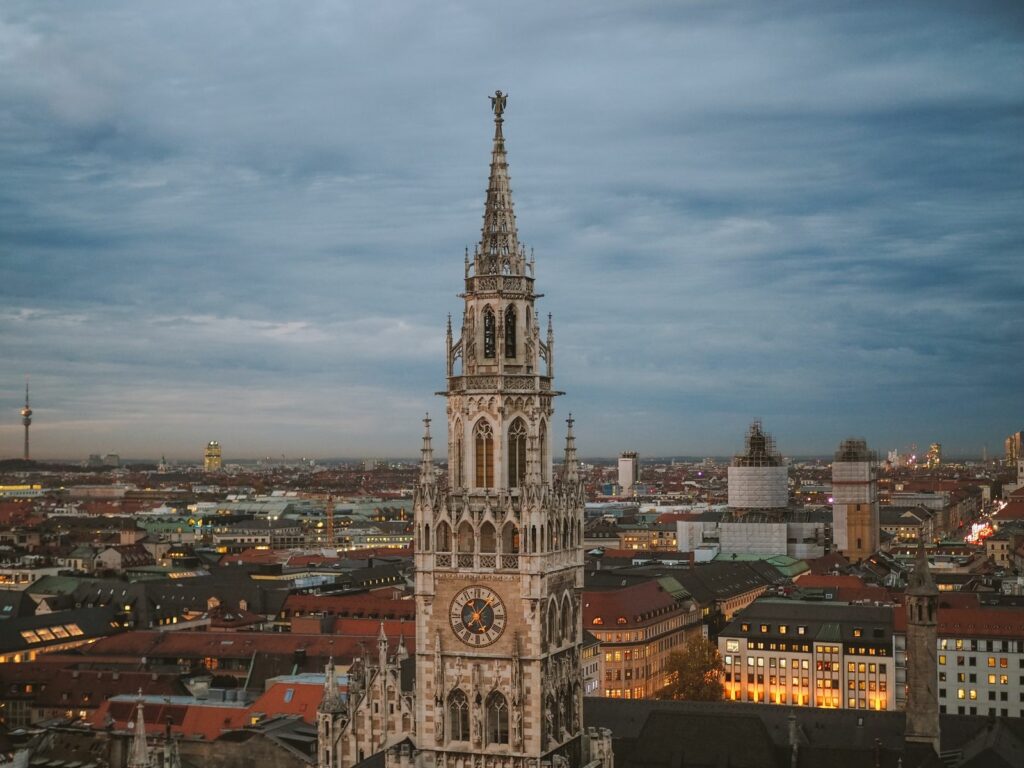
Marienplatz is Munich’s main square and the best place to start. It’s dominated by the neo-Gothic New Town Hall (Neues Rathaus) and the Glockenspiel in its tower. According to the city’s official Glockenspiel page, it plays every day at 11 am and 12 noon, with an extra show at 5 pm from March to October. The figures dance and two knights joust for several minutes, so get there a few minutes early to see over the crowd.
Tip: In November and December there’s no 5 pm Glockenspiel. If you arrive for the Christmas market in the afternoon, wait for the shorter 9 pm evening show (the night watchman and the Münchner Kindl), or come back at 11 or 12 the next day. In the evening, though, Marienplatz has a 25-metre Christmas tree lit with 3,000 lights.
The view from the Alter Peter tower
The best view of Munich is from the tower of St Peter’s Church, which locals call Alter Peter (“Old Peter”). It’s 306 steps to the viewing platform, and on a clear day you can see the Alps. According to the St Peter’s parish website, adult entry is €5 and the tower is open every day except 25 December and 1 January. In winter it closes at 6:30 pm on weekdays and 7:30 pm at weekends, and at 2 pm on Christmas Eve and New Year’s Eve.
The Frauenkirche, the Viktualienmarkt and the Residenz
The two onion-domed towers on every Munich postcard belong to the Frauenkirche cathedral. It’s worth a short stop between Marienplatz and the Kaufingerstraße shopping street.
Right behind Alter Peter is the Viktualienmarkt, Munich’s best-known market for fruit, vegetables, spices and food stalls. For vegans it’s a good place to pick up fruit and bread for a picnic. The hot food here is mostly meat, though, so look elsewhere for a cooked lunch.
North of Marienplatz is the Residenz, the former palace of Bavaria’s rulers, with the Hofgarten behind it. The garden is free and the palace tour is paid. We couldn’t confirm the current price on the official site, so check it before you go.
More things to do in Munich: museums, palaces and Dachau
The museums most worth your time in Munich are the Pinakotheken galleries, the Deutsches Museum and Nymphenburg Palace. If you’re interested in 20th-century history, set aside half a day for the Dachau Concentration Camp Memorial Site.
The Pinakotheken for €1 on Sundays
The Pinakotheken are a group of art galleries in the Maxvorstadt district. The Alte Pinakothek shows the Old Masters, and the Pinakothek der Moderne shows modern art and design. According to the Pinakotheken visitor information, admission on Sundays is just €1.
The Neue Pinakothek is closed for renovation and is planned to reopen in 2029. In the meantime, a selection of its 19th-century paintings hangs in the Alte Pinakothek.
The Deutsches Museum and Nymphenburg Palace
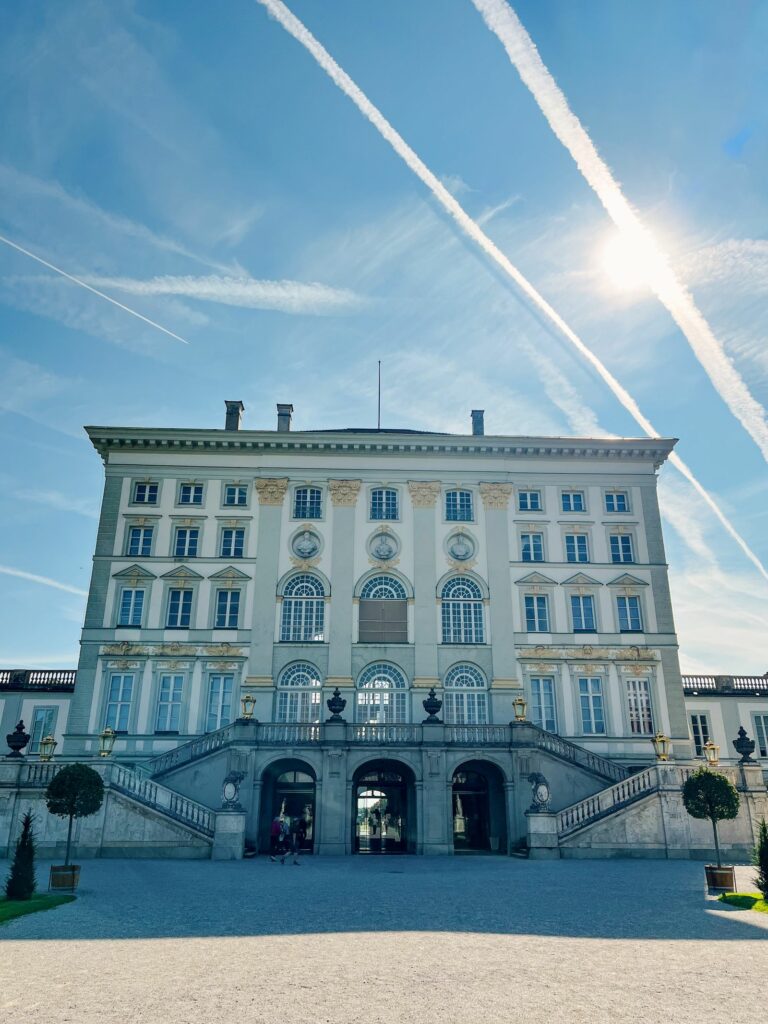
The Deutsches Museum, on an island in the River Isar, is one of the world’s largest science and technology museums. It’s the perfect rainy-day plan, kids included. Nymphenburg Palace in the west of the city was the summer residence of the Bavarian electors, and its park is free even in winter. We couldn’t read current admission prices for either on their official sites, so we haven’t listed them.
The Dachau Memorial Site
The Dachau Concentration Camp Memorial Site is in the town of Dachau, northwest of Munich. Take the S2 train and then bus 726, and buy a day ticket for zones M-1, as the memorial advises, because zone M alone doesn’t cover Dachau. According to the memorial’s official website, entry is free, it’s open daily from 9 am to 5 pm, and it’s closed only on 24 December. It’s an emotionally heavy visit, so don’t plan anything too lively for the rest of that day.
The English Garden, the Eisbach and beer gardens
The English Garden (Englischer Garten) is the biggest reason to love Munich even if you skip every museum. It has the Eisbach surfers and the Chinese Tower beer garden, and it’s all free.
The English Garden is bigger than Central Park
Elector Karl Theodor had the English Garden laid out in 1789, and from the start it was meant for everyone, not just the nobility. According to the Bavarian Palace Department, it covers 376 hectares, or 411 with the adjoining parks, which makes it bigger than New York’s Central Park. Inside are 78 kilometres of paths, the Kleinhesseloher See lake and the Chinese Tower with a beer garden for 7,000 people.
The Eisbach surfers
At the southern tip of the English Garden, near Prinzregentenstraße, people surf a standing wave on the icy Eisbach stream. Surfing was banned after a fatal accident in April 2025, and the wave later disappeared. According to the city’s German-language Eisbach page, surfing has been allowed again since 8 May 2026, with a quick-release leash required and no surfing after 10 pm.
The English version of the same page still says surfing isn’t permitted, so trust the newer German one. Swimming in the Eisbach isn’t allowed.
Beer gardens: bring your own food
In a proper Bavarian beer garden (Biergarten) you’re allowed to bring your own food and only buy drinks. It’s an old Bavarian tradition, and according to the city portal muenchen.de it’s actually what makes a beer garden a beer garden. If a landlord bans outside food, muenchen.de says, it isn’t technically a Biergarten at all, just an ordinary outdoor seating area.
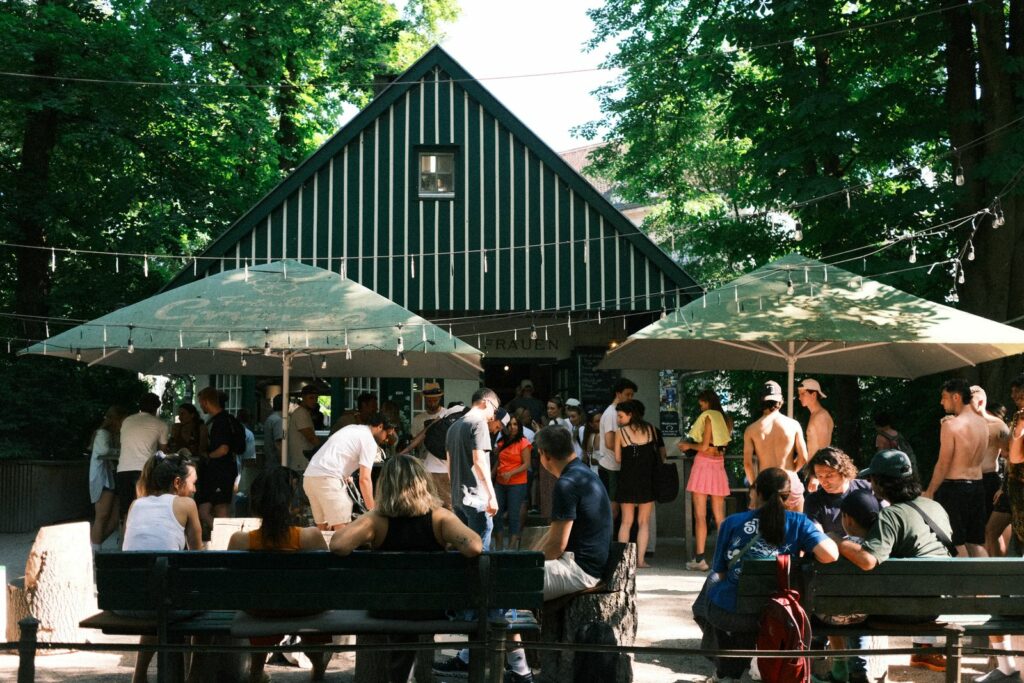
For vegans, that’s great news. Beer garden food is mostly sausages, pork knuckle and obatzda (a cheese and butter spread). You can bring a vegan sandwich or takeaway and sit down with everyone else over a beer or a lemonade.
Vegan picnic tip: On your way to the Chinese Tower beer garden, stop at Die Vegane Fleischerei at Frauenstraße 11 and take away a vegan Weißwurst (white sausage) or a Leberkäse roll. There’s more about it in the food section. Just watch the hours, because it’s closed on Sundays.
In Munich you don’t have to choose between a beer garden and vegan food. You just bring the food.
Things to do in Munich in winter and when it rains
Munich is easy to enjoy in winter and in the rain, because its best attractions are indoors. On a Sunday, see the Alte Pinakothek or the Pinakothek der Moderne for €1. The Deutsches Museum fills a whole day. And the vegan Katzentempel café, where rescue cats wander between the tables, is a cosy place to dry off.
From late November to Christmas, winter in Munich is all about the Christmas markets, covered in the next section. On New Year’s Eve, the Tollwood festival on Theresienwiese throws a big party. And if you get a clear, frosty day, climb the Alter Peter tower, because that’s when the Alps look closest.
Munich Christmas market 2026: dates, hours and food
The main Munich Christmas market (Christkindlmarkt) on Marienplatz runs from 20 November to 24 December 2026. That’s a few days earlier than many older guides say. It’s closed on Sunday 22 November, though, because that’s Totensonntag, the German day of remembrance for the dead.
| Market | 2026 dates | Opening hours | Where |
|---|---|---|---|
| Christkindlmarkt | 20 Nov – 24 Dec (closed 22 Nov) | Mon–Sat 10 am–9 pm, Sun 10 am–8 pm, 24 Dec 10 am–2 pm | Marienplatz and Rindermarkt |
| Tollwood Winter Festival | 24 Nov – 23 Dec | Mon–Fri from 2 pm, Sat–Sun from 11 am | Theresienwiese |
The Christkindlmarkt on Marienplatz
Munich’s Christmas market is said to have roots in the 14th century and has been held on Marienplatz since 1972. According to the official Christkindlmarkt website, it has more than 130 stalls, with a 25-metre tree and 3,000 lights at its centre. On Sunday 13 December from 3 to 5 pm, the Krampus run (a parade of horned, fur-clad Alpine devils) passes through, and the organisers say it draws up to 50,000 onlookers. For a calmer visit, go on a weekday morning.
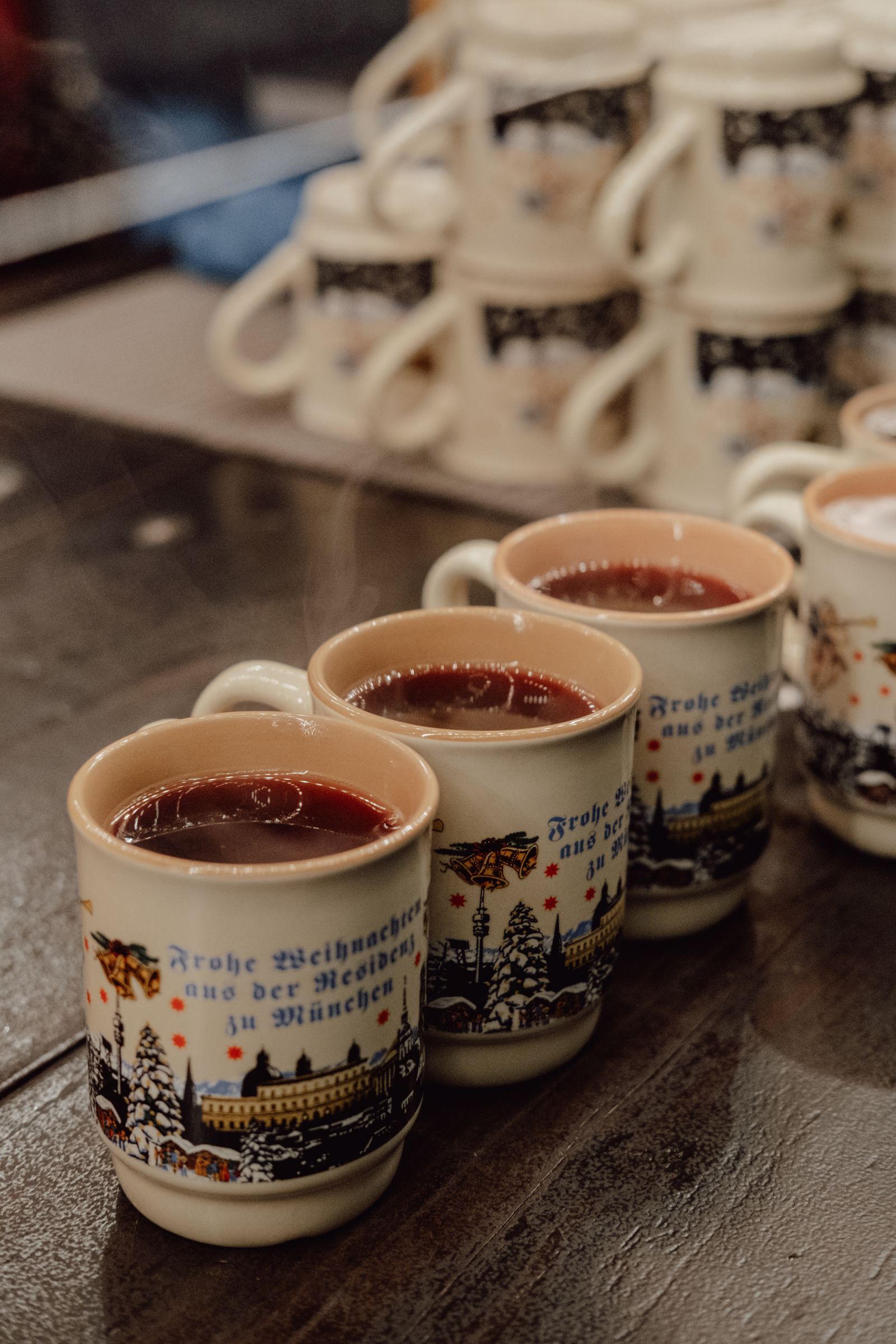
Right next to it, in front of St Peter’s Church, is the Kripperlmarkt, a market of nativity scenes. The organisers call it probably the largest of its kind in Germany. It’s a good place for an unusual Christmas present that fits in a suitcase.
Tollwood: organic food on Theresienwiese
For vegans, the most interesting Christmas market in Munich is the alternative one at the Tollwood festival. It runs from 24 November to 23 December 2026 on Theresienwiese, the field where Oktoberfest is held. According to the city’s Tollwood 2026 page, entry to the market is free and more than 50 stalls sell certified organic food from around the world.
Vegan stalls aren’t listed in the programme. But an international, certified-organic food market gives you a much better chance of a plant-based dinner than a classic sausage stand.
What to eat at the Munich Christmas market as a vegan
The official Christkindlmarkt website promises that people who eat vegan, or avoid gluten or lactose, will find something too. It doesn’t publish a list of vegan stalls, so it pays to ask. Roasted chestnuts (Maroni) are just chestnuts. Candied almonds (gebrannte Mandeln) are usually just almonds, sugar, water and cinnamon.
Potato pancakes (Reiberdatschi) and gingerbread (Lebkuchen) often contain egg or honey. With mulled wine (Glühwein), stricter vegans mainly worry that some wines are clarified with animal products. For a reliable dinner, head to one of the vegan restaurants below.
If you’re combining several cities, see our guide to the best Christmas markets in Europe for vegans, including markets where vegan food is the rule rather than the exception.
Vegan restaurants in Munich
Eating vegan in Munich is easy. The city has several fully vegan places, from a Bavarian tavern to a Vietnamese restaurant. Every place below is 100% vegan, and we read each menu on its own website in October 2026. Just watch Mondays and Sundays, when some of them close.
| Place | Area | What to order | Price | Closed |
|---|---|---|---|---|
| bodhi | Westend | seitan “duck” roast, Kaiserschmarrn | Bavarian mains €16.50–24.50 | never |
| Max Pett | near Sendlinger Tor | soy schnitzel, Bavarian breakfast | €16–23.50 | Monday |
| SOY | Maxvorstadt | pho, bún, weekday lunch menu | lunch menu €11.50 | never |
| Padme Hum | Schlachthofviertel | sushi, udon | lunch dishes €10.90 | never |
| Katzentempel | Maxvorstadt | breakfast, bowls, cakes | not checked | never |
| Die Vegane Fleischerei | city centre | vegan Weißwurst, Leberkäse to go | not checked | Sunday |
bodhi: a Bavarian tavern without the meat
bodhi at Ligsalzstraße 23 in the Westend district is a vegan Wirtshaus, a classic Bavarian tavern. Its seitan “duck” roast comes with dark beer gravy, apple red cabbage and a potato dumpling for €24.50. There’s also Keesspatzn, Bavarian spätzle with vegan “cheese” and crispy onions, for €16.50, and a Viennese-style schnitzel for €19.
For dessert, order the Kaiserschmarrn (shredded pancake) with almonds, caramel, raisins and apple compote for €13. It’s open every day, from 5 pm on weekdays and from noon at weekends. Book ahead for weekends.
bodhi is the place to bring friends who eat meat. The plate looks like anything you’d get in any Bavarian tavern, and the schnitzel with potato salad usually wins over the sceptics.
Max Pett: Bavarian breakfast and schnitzel near Sendlinger Tor
Max Pett at Pettenkoferstraße 8, near Sendlinger Tor, is what the city portal muenchen.de calls the classic among Munich’s vegan restaurants. The soy schnitzel Wiener Art with fries or potato salad costs €21, the Bavarian burger €22 and the gnocchi in pumpkin cream €19. There’s no alcohol at all, and the beer and wine are alcohol-free.
On weekends from 10 am to 12:30 pm, Max Pett serves breakfast only. The Bavarian breakfast of three vegan white sausages, a pretzel and sweet mustard costs €16. It’s the easiest way to try Munich’s classic Weißwurstfrühstück without the meat. Why the usual pretzel and white sausages aren’t vegan is explained in our article on traditional German food. It’s closed on Mondays and opens only at 5 pm from Tuesday to Thursday.
SOY and Padme Hum: Vietnamese and Asian food
SOY at Theresienstraße 93 in Maxvorstadt is a fully vegan Vietnamese restaurant near the Pinakotheken. It’s open every day for lunch and dinner. On weekdays the lunch menu costs €11.50, including a summer roll or hot and sour soup. Note that SOY doesn’t take credit cards, only cash, German EC debit cards and PayPal.
Padme Hum at Adlzreiterstraße 16 is a vegan Asian restaurant with sushi in the Schlachthofviertel, literally the “slaughterhouse quarter”. The owners chose the location on purpose because of its history. Lunch dishes and sushi sets cost €10.90 at midday, and in the evening fried udon noodles with tofu and seitan cost €17.90.
Katzentempel and Die Vegane Fleischerei
Katzentempel at Türkenstraße 29 is a cat café that has been open since 2013 and, according to muenchen.de, was the first in Germany. The cats come from animal shelters and the menu is vegan. Expect breakfasts with vegan “scrambled eggs”, bowls and cakes. It’s open every day from 9 or 10 am.
Die Vegane Fleischerei at Frauenstraße 11, by the Viktualienmarkt, is a vegan butcher’s shop selling plant-based versions of Weißwurst, Leberkäse (a Bavarian meatloaf) and other Bavarian classics. A roll to go makes a perfect quick lunch. It’s open Monday to Saturday from 11:30 am to 6 pm and closed on Sundays.
Sunday and Monday tip: The vegan butcher is closed on Sundays and Max Pett on Mondays. On a Monday evening, go to bodhi or SOY, which are open every day. Bring cash for SOY.
Planning more than one city?
Munich is one of 16 cities in our roundup of the best vegan cities in Central Europe, with travel times from Prague and Brno.
Salzburg is just under two hours from Munich by train, and its Christmas market in front of the cathedral opens on 19 November 2026. Our article on things to do in Salzburg covers what to see and where to eat vegan.
Prague to Munich by train or bus
The direct train from Prague to Munich runs every two hours and takes 5 hours 43 minutes. The RegioJet bus is faster, at 4 hours 45 minutes, from 299 CZK (about €12). From 13 December 2026 a new operator, Leo Express, takes over the Czech section of the line.
| Mode | Operator | Journey time | Price from | Note |
|---|---|---|---|---|
| Train Ex6 “Bavorský expres” | Czech Railways and Die Länderbahn | 5 h 43 min | see cd.cz fares | until 12 Dec 2026, every 2 hours |
| Train from 13 Dec 2026 | Leo Express (Czech section); German operator not yet confirmed | not yet published | not yet published | up to 8 trains a day |
| Bus | RegioJet | 4 h 45 min | 299 CZK (about €12) | departs 7:00, 9:30, 13:30, 17:00 |
Prague to Munich train via Plzeň
Until 12 December 2026, the direct Ex6 “Bavorský expres” (Bavarian Express) run by Czech Railways and Germany’s Die Länderbahn leaves Praha hlavní nádraží every two hours. According to the IDOS timetable search, departures include 5:35, 7:35 and 9:35, and it reaches München Hauptbahnhof in 5 hours 43 minutes. It runs via Plzeň, Domažlice and Furth im Wald.
From 13 December 2026, Leo Express takes over the Czech section. According to Railway Gazette, there will be up to eight trains a day in each direction, with air-conditioned coaches and wi-fi. Leo Express fares and the Czech national OneTicket will both be valid, as will Interrail and Eurail passes. The new timetable hasn’t been published yet, so if you’re travelling for the Christmas markets after 13 December, check times shortly before you go.
Prague to Munich by bus in under five hours
The RegioJet bus from Prague to Munich takes 4 hours 45 minutes, which is quicker than the train. In late November 2026, fares start at 299 CZK and direct buses leave at 7:00, 9:30, 13:30 and 17:00. The 23:00 night bus gets into Munich before 5 am, which only suits the hardy.
Getting around Munich
In Munich, a single-day ticket (Single-Tageskarte) for zone M is the best value. According to muenchen.de, it has cost €10.10 since 1 January 2026, and it’s valid until 6 am the next morning. It covers the U-Bahn, S-Bahn, trams and buses across the city.
Where to stay in Munich
For a short trip, the best areas to stay in Munich are around the main station, Maxvorstadt and the Westend. Around the Hauptbahnhof and Sendlinger Tor (Ludwigsvorstadt) you’re close to the trains, Max Pett and Marienplatz. Maxvorstadt is the student district by the Pinakotheken, home to SOY and Katzentempel. The Westend is quieter and sits right by Theresienwiese, so you can walk to bodhi and to the Tollwood festival.
If you’re going for the Christmas market, book early, because Advent weekends are among Munich’s busiest of the year. Don’t count on a fully vegan hotel in Munich, as we didn’t find one we could verify. For a dedicated vegan stay elsewhere, see our list of fully vegan hotels around the world.
How much does a weekend in Munich cost?
Munich is one of Germany’s more expensive cities, but with a €10.10 day ticket, €1 galleries on Sundays and free parks, it’s manageable. Accommodation will be your biggest cost. We checked these prices in October 2026.
Getting there by RegioJet bus costs from 299 CZK (about €12) each way. A public transport day ticket for zone M is €10.10, the Alter Peter tower is €5, the Alte Pinakothek is €1 on a Sunday, and the Dachau Memorial Site and the English Garden are free.
Food is where a vegan budget in Munich stretches or snaps. A weekday lunch menu at SOY costs €11.50 and the Bavarian breakfast at Max Pett €16, while a Bavarian main course at bodhi runs from €16.50 to €24.50. A vegan Leberkäse roll from Die Vegane Fleischerei, eaten in a beer garden with a drink, is the cheapest proper Bavarian meal you’ll find.
Best time to visit Munich
The best time to visit Munich is May to September, when the beer gardens are open and you can lie on the grass in the English Garden. The second-best season is the Christmas markets, from 20 November to Christmas. Oktoberfest, from late September into early October, is an experience, but accommodation is expensive then and books up fast.
January to March are the quietest months. It’s cold, but the museums are emptier and the vegan restaurants keep their usual hours. Just remember there’s no 5 pm Glockenspiel from November to February.
German phrases for vegans
You’ll get by in English in most Munich restaurants, but a few German words help at market stalls and bakeries. Watch out for “vegetarisch”, which means vegetarian, and often comes with cheese, egg or butter.
| German | Say it like | English |
|---|---|---|
| Ich esse vegan. | ikh ess-uh veh-GAHN | I eat vegan. |
| Ist das vegan? | ist dass veh-GAHN | Is this vegan? |
| Ohne Fleisch, ohne Milch, ohne Ei, bitte. | oh-nuh flysh, oh-nuh milkh, oh-nuh eye, bit-uh | Without meat, milk or egg, please. |
| Ist da Butter oder Honig drin? | ist dah butter oh-der hoh-nikh drin | Is there butter or honey in it? |
| Gibt es eine vegane Option? | gipt ess eye-nuh veh-GAH-nuh op-tsee-OHN | Is there a vegan option? |
| Mit Hafermilch, bitte. | mit HAH-fer-milkh, bit-uh | With oat milk, please. |
So, is Munich worth it for vegans?
Munich isn’t Germany’s vegan capital and doesn’t try to be. That’s exactly why it won us over on paper. You can eat the Bavarian classics without the meat, and the best beer gardens let you bring your own food. The Christmas market opens on 20 November this year, and from Prague you’re there by bus in under five hours.
If we had just one Munich weekend, we’d pick Advent. Arrive in the morning, see Marienplatz and Alter Peter in the afternoon, have the seitan “duck” at bodhi that night, and spend the next day at Tollwood. Have you been to Munich? Tell us the tip we shouldn’t miss in the comments.
Frequently asked questions
How many days do you need in Munich?
Two to three days is enough for Munich. In two days you can see Marienplatz, the Alter Peter tower, the Viktualienmarkt, the English Garden and one museum. Keep a third day for Nymphenburg Palace or the Dachau Memorial Site.
When does the Munich Christmas market start in 2026?
The main Munich Christmas market on Marienplatz opens on Friday 20 November 2026 and runs until 24 December. It’s closed on Sunday 22 November. Hours are 10 am to 9 pm Monday to Saturday and 10 am to 8 pm on Sundays. The Tollwood festival on Theresienwiese runs from 24 November to 23 December.
How long is the train from Prague to Munich?
The direct train from Prague to Munich takes 5 hours 43 minutes and runs every two hours until 12 December 2026. From 13 December, Leo Express takes over the Czech section, and its timetable hasn’t been published yet. The RegioJet bus is faster, at 4 hours 45 minutes, from 299 CZK.
Is Munich vegan friendly?
Yes, Munich has several fully vegan restaurants. bodhi in the Westend and Max Pett near Sendlinger Tor cook Bavarian food without meat, SOY in Maxvorstadt is Vietnamese, and Padme Hum serves vegan sushi. You’re also allowed to bring your own food into a Bavarian beer garden.
Is Munich expensive?
Munich is one of Germany’s more expensive cities, mainly because of accommodation. A public transport day ticket costs €10.10, the Alte Pinakothek costs €1 on Sundays, and the English Garden and Dachau Memorial Site are free. A weekday vegan lunch at SOY costs €11.50.
Featured photo: Ilia Bronskiy, Pexels.
Newsletter
Get our free e-books
Join the newsletter and download Our Vegan Christmas Kitchen straight away, 10 recipes for Czech cookies, gingerbread and vánočka. Then once a month, new places from the vegan map and new articles. Unsubscribe with one click.