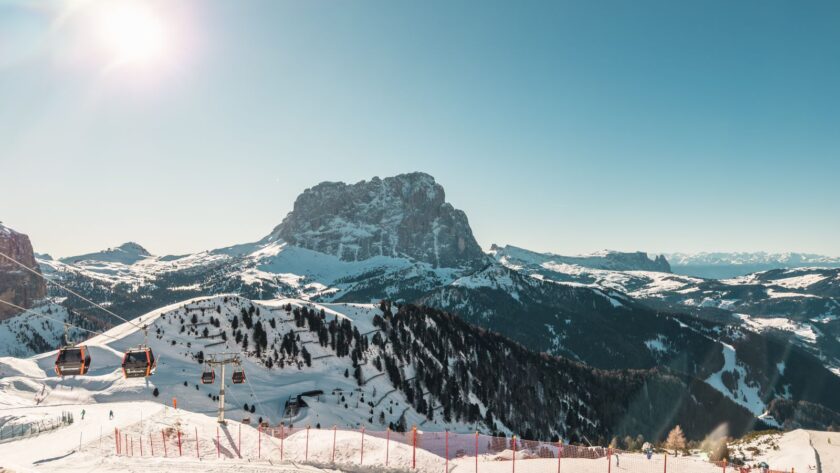
Skiing in the Dolomites is the kind of trip people plan for years. Pale limestone towers above the pistes, long lunches on sunny hut terraces, and one ski pass that covers more slopes than you could ski in a month. For a vegan, there is a catch.
The classic mountain menu in South Tyrol and Trentino is bread dumplings with speck, ravioli filled with spinach and quark, and a fluffy torn pancake made with eggs and milk. Hotel half board rarely has a plant-based plan.
So which Dolomites ski resort suits a beginner, and which one keeps a strong skier busy for a week? How much is a Dolomiti Superski pass for 2026/27, and is a helmet really compulsory for adults now?
Is there a vegan hotel you can ski straight out of? And what do you actually order at a hut when every dish seems to come with cheese? It is all below, from choosing a valley to the Italian and German phrases you will use at lunch.
A quick note before we start. We haven’t skied the Dolomites ourselves yet. We put this together in October 2026 from primary sources. That means the Dolomiti Superski price list, the Italian slope rules, the regional tourist boards and the hotels’ and restaurants’ own websites. Any place where we couldn’t find clear proof of vegan food is left out.
Why go skiing in the Dolomites
Skiing in the Dolomites gives you roughly 1,200 km of pistes in twelve resorts on a single pass. That makes it one of the largest linked ski networks in the world. Almost all of it has snowmaking, so Dolomiti Superski counts on skiable conditions from December to April even in a dry winter.
The Dolomites have been a UNESCO World Heritage Site since 26 June 2009, and the highest peak, the Marmolada (3,343 m), has a lift up to its glacier. You ski across three Italian provinces, South Tyrol, Trentino and Belluno in the Veneto. South Tyrol is mostly German-speaking, Trentino and Cortina speak Italian, and the Ladin valleys (Gherdëina, Badia, Fascia and Fodom) keep their own Ladin language too.
Dolomiti Superski: one pass, twelve resorts
Dolomiti Superski is a network of 12 ski resorts with about 450 lifts, all covered by one shared pass, and it has been running since 1974. The resorts are Cortina d’Ampezzo, Kronplatz (Plan de Corones), Alta Badia, Val Gardena, Alpe di Siusi, Val di Fassa with Carezza, Arabba with the Marmolada, 3 Zinnen Dolomites, Val di Fiemme with Obereggen, San Martino di Castrozza with Passo Rolle, the Gitschberg Jochtal and Brixen (Plose) area, Alpe Lusia with San Pellegrino, and Civetta.
For the 2026/27 season the lift companies invested around €100 million. Kronplatz gets a new 10-seat gondola called “Kronplatz 1+2”, Versciaco near San Candido gets the “Helmissimo” gondola, and Buffaure in Val di Fassa swaps a chairlift for a new gondola. All of this is in the Dolomiti Superski press release of 30 September 2026.
The Sellaronda: a day around the Sella massif
The Sellaronda is the most famous ski circuit in the Dolomites, a full lap of the Sella massif in a single day. It links four Ladin valleys, Val Gardena, Alta Badia, Val di Fassa and Arabba (Fodom), and you can ski it clockwise or anticlockwise.
Technically the Sellaronda only asks for confident red-run skiing. The real challenge is time. Start as soon as the lifts open. Check when the last lift back to your own valley runs, or you will finish the day in an expensive taxi on the wrong side of the mountains.
Dolomites ski resorts: which one to choose
The best Dolomites ski resort for beginners and families is Alpe di Siusi, while Val Gardena and Alta Badia suit skiers who want big mileage on the Sellaronda. Arabba and the Marmolada have the steepest terrain, and Cortina has the town atmosphere and the shops. Use the table to pick your valley, then ski anywhere on the Dolomiti Superski pass.
| Resort | Best for | Where to stay | Good to know |
|---|---|---|---|
| Val Gardena | every level, the Sellaronda | Ortisei, Santa Cristina, Selva | Saslong World Cup run |
| Alpe di Siusi | beginners, families | Compatsch, Seis, Kastelruth | linked to Val Gardena, vegan Paradiso hotel |
| Alta Badia | relaxed and sporty skiers, foodies | Corvara, La Villa, San Cassiano | Gran Risa run, the Vallon above Corvara |
| Val di Fassa | the Sellaronda, families | Canazei, Campitello, Vigo di Fassa | Wine & Dine restaurant with vegan dishes |
| Arabba and Marmolada | strong skiers | Arabba | highest lift point, Punta Rocca |
| Cortina d’Ampezzo | atmosphere, Olympic slopes | Cortina | 120 km of pistes, Olympics 1956 and 2026 |
| Kronplatz | long descents, a real town below | Brunico, Valdaora, San Vigilio | Sylvester and Hernegg runs to Reischach above Brunico |
Val Gardena ski area
Val Gardena (Gröden in German) is the best-known valley in the Dolomites and works for every level. You stay in Ortisei, Santa Cristina or Selva di Val Gardena. Selva sits right on the Sellaronda, while Ortisei is the largest village, with a pedestrian centre and the most shops.
Val Gardena is linked to the Alpe di Siusi plateau. Together they form what Seiser Alm Marketing calls the largest ski area in the Dolomites, with 181 km of pistes and 79 lifts. The Saslong in Val Gardena is a World Cup downhill course. For vegans, Val Gardena works well mainly because of Ortisei, which has supermarkets and more restaurants than a remote hamlet higher up.
Alpe di Siusi ski area for beginners
Alpe di Siusi (Seiser Alm in German) is the largest high-altitude alpine meadow in Europe and the best place in the Dolomites for children and first-timers. The slopes are wide and gentle, and the local tourist board describes them as ideal for children’s first ski days. You reach the plateau by the cable car from Seis up to Compatsch.
Alpe di Siusi also has something no other Dolomites ski area offers vegans. At 2,020 m it has a fully vegan hotel, Paradiso Pure.Living, which gets its own section below.
Alta Badia: skiing for food lovers
Alta Badia, with the villages of Corvara, La Villa and San Cassiano, is where people come as much for the food as for the skiing. It sits right on the Sellaronda, and its runs are mostly blues and reds. The Gran Risa in La Villa hosts a World Cup giant slalom, and the black Vallon run above Corvara links into the Boè run for more than 5 km and about 1,050 m of vertical.
Alta Badia’s gourmet reputation rests on Michelin-starred restaurants whose tasting menus lean on meat, fish and cheese. As a vegan in Alta Badia you will do best with a self-catering kitchen and simple pasta at the huts.
Val di Fassa, Arabba and the Marmolada
Val di Fassa, with Canazei as its main resort, is Trentino’s gateway to the Sellaronda and a good pick for families thanks to accommodation at every price. Canazei also has a restaurant that the valley tourist board lists with vegan dishes. That restaurant is Wine & Dine on Strèda Roma 5, next to the Croce Bianca Hotel, listed in the Michelin guide.
The valley tourist office says diners can choose vegetarian, vegan and gluten-free dishes. There is no menu online, so mention what you eat when you book. It is dinner only, closed on Tuesdays, and reopens for winter on 23 December 2026.
Arabba, in the neighbouring Fodom valley, is the resort for strong skiers who want steep pistes. From Arabba you reach the Marmolada, home of Punta Rocca, the highest point of the whole Dolomiti Superski network you can reach by lift.
Cortina d’Ampezzo
Cortina d’Ampezzo in the Veneto is the most glamorous resort in the Dolomites, with 120 km of pistes across three areas, Tofana, Faloria and Lagazuoi with the Cinque Torri. Cortina hosted the Winter Olympics in 1956 and again in 2026 as part of Milano Cortina. It is a proper town with shops, cafés and nightlife, and one of the most expensive places in the Dolomites to stay.
Kronplatz and Brunico
Kronplatz (Plan de Corones in Italian) is a dome-shaped mountain above the town of Brunico in the Puster Valley. It is the easiest choice if you want to stay in a real town. Two long black runs, the Sylvester and the Hernegg, drop almost 5 km and about 1,300 m from the summit to Reischach (Riscone), just above Brunico. Brunico has a railway station, supermarkets and cafés, so stocking up on vegan basics is far easier than in a small mountain village.
Is skiing in the Dolomites expensive? Ski pass prices 2026/27
Skiing in the Dolomites is at the pricier end of the Alps. A one-day adult Dolomiti Superski pass costs €89 in high season 2026/27, and a six-day pass costs €453. The official Dolomiti Superski press release of 30 September 2026 confirms the figures.
| Dolomiti Superski pass 2026/27 | Price |
|---|---|
| 1 day, adult, high season | €89 |
| 6 days, adult, high season | €453 |
| Season pass, presale | €990 |
| Dolomiti Superski Family, per person per ski day | €43 |
For 2026/27 you can buy the Dolomiti Superski Family pass online for the first time. High season runs from 20 December to 9 January and from 31 January to 20 March. For the rest of the winter, including the pre-season from 28 November, an adult day pass costs €80, as the Trentino daily il Dolomiti reported. If you don’t need the whole network, compare a single-valley pass, which costs less for a smaller area.
Money-saving tip: buy your pass online before you arrive and save the QR code. You collect the pass with it on arrival and skip the ticket-office queue on the first morning, when the whole hotel wants to ski at once.
Ski rules in Italy: helmets and insurance
In Italy every skier and snowboarder must wear a helmet on the pistes, whatever their age, and must also carry third-party liability insurance. Helmets used to be compulsory only for under-18s. A 2025 amendment extended the rule to everyone, so ignore older guides that still quote the age limit. According to the Trentino slope rules, skiing without a helmet can cost you a fine of €100 to €150 and your pass.
Third-party liability insurance (cover for injury or damage you cause to someone else) has been compulsory in Italy since 1 January 2022. If your travel insurance doesn’t include it, you can buy it with your ski pass at the ticket office or online for a few euros a day.
Carry proof, because the checks and fines are the same as for helmets. Alcohol is policed too. A blood alcohol level of 0.5 to 0.8 g/l can bring a fine of €250 to €1,000, the same limits as for driving.
A vegan hotel on the slopes: Paradiso Pure.Living
Paradiso Pure.Living calls itself the first vegan hotel in the Dolomites, and we found no other fully vegan hotel right on the pistes. It stands at 2,020 m on the Alpe di Siusi plateau, at Joch 17 in Castelrotto (Kastelruth). The hotel describes itself as a vegan hotel whose restaurant uses organic produce from sustainable farms. The regional tourist board lists it among the mountain huts of the Seiser Alm ski area.
Getting to Paradiso and what to check before booking
In winter you don’t drive to Paradiso’s door. The hotel runs a transfer from Compatsch, which you reach by the cable car from Seis. For emergencies or special needs it offers an on-request transfer for €25 a ride, or €60 when a snowcat is needed.
In the winter season the minimum stay is 7 nights, arriving and leaving on a Sunday (the Christmas holidays have their own dates). According to the website, you can book shorter stays of 3 to 6 nights online one week before arrival if rooms are still free.
A local tax of €3.50 per person per night is added at check-out, and children under 14 don’t pay it. Paradiso is one of a family of three vegan hotels, alongside LA VIMEA near Merano and Agrivilla I Pini in Tuscany. We compare prices and other fully vegan stays around the world in our guide to vegan hotels.
Omnia: a vegan tasting dinner in the mountains
Omnia Plant-Based Restaurant is the vegan restaurant of the Paradiso hotel, serving a tasting menu in the evening. According to the Seiser Alm tourist board, you need to book a table 24 hours ahead. According to the tourist board, Omnia is closed until 20 December 2026 and open from 21 December to 27 March 2027, so the winter season starts just before Christmas. Omnia is a great pick for the non-vegans in your group too, if they want one mountain dinner they will talk about for years.
How to eat vegan at a Dolomites mountain hut
You can always find a vegan meal at a Dolomites mountain hut, just not under that name. South Tyrolean and Trentino cooking is built on bread, flour, potatoes and vegetables, then adds eggs, milk, butter, cheese and smoked speck. So it helps to know what to skip and what to ask for. We call this method the hut menu decoder.
| Hut dish | What is usually in it | For vegans |
|---|---|---|
| Knödel / canederli (bread dumplings) | stale bread, milk, eggs, often speck, served in broth or with butter and cheese | skip |
| Schlutzkrapfen (half-moon ravioli) | rye and wheat dough, spinach and quark filling, melted butter and Parmesan | skip |
| Kaiserschmarrn (torn pancake) | flour, eggs, milk, sugar, fried in butter | skip |
| Polenta | cornmeal, often with butter or cheese | ask |
| Pasta al pomodoro / Spaghetti mit Tomatensauce | pasta with tomato sauce | usually yes, no cheese |
| Minestrone / vegetable soup | vegetables, pulses, sometimes meat stock | ask about the stock |
| Pommes, Bratkartoffeln | fried or roast potatoes | ask about the fat |
| Insalata mista / Salat | mixed salad | yes, dressing on the side |
What to order at a hut
The safest vegan lunch at a Dolomites hut is pasta with tomato sauce and no cheese. In Italian ask for “pasta al pomodoro senza formaggio”, in South Tyrol “Spaghetti mit Tomatensauce ohne Käse”. Plain dried pasta in Italy (pasta di semola di grano duro) is legally just durum wheat semolina and water, while egg pasta (pasta all’uovo), fresh or dried, contains egg. Our article is pasta vegan and how to order it in Italy explains how to tell them apart.
Add a salad or chips and you eat for the price of an ordinary lunch. Skip the soup unless they confirm the stock is vegetable (brodo vegetale, Gemüsebrühe). Ask straight away whether the kitchen can make something vegan. Big huts by the lifts are used to allergies and special diets, and small family huts appreciate hearing it when you order rather than when the plate arrives.
Bombardino and après-ski
The bombardino is the classic hot drink of Italian ski huts, and vegans need to pass on it. It is hot egg liqueur (such as Vov or Zabov) mixed with brandy or rum, with whipped cream on request. Mulled wine (vin brulé, Glühwein), an espresso or a grappa are safer choices. The same alcohol limit as for driving applies on the slopes.
You don’t need a vegan menu at a Dolomites hut. You just need to know what to skip, and to say “senza formaggio” out loud.
Pocket tip: huts fill up around noon, and a dish cooked separately for a vegan takes longer. Keep a bar or a handful of nuts in your jacket so hunger doesn’t set your pace on the slopes. For more ideas on what to pack, see our guide to vegan backpacking food.
Self-catering: shopping in the valley
An apartment with a kitchen is the cheapest and simplest set-up for a vegan ski week in the Dolomites. Half board in an ordinary hotel or on a tour operator package rarely plans for plant-based guests. Dinner is then often a plate of grilled vegetables while everyone else gets four courses.
Valley villages such as Ortisei, Canazei, Corvara and Brunico have supermarkets with the usual range. In Italian Despar and Eurospar stores, look for the DESPAR Veggie own-brand line. When SPAR introduced the V-Label in 2020, it said every product in the line would carry either the vegan or the vegetarian version of the V-Label, so the packet tells you which is which. Plant milk, tofu, pulses and pasta are easy to find, while vegan cheese and spreads are a smaller selection than in big cities.
Packing tip: bring what is harder to find in the Italian mountains, such as a favourite spread, tempeh or vegan cheese. If you drive, a cool bag covers the first two days until you find the nearest supermarket.
Where to stay in the Dolomites for skiing as a vegan
Where to stay in the Dolomites for skiing depends on whether you want to ski from the door or have shops and restaurants after skiing.
Vegans have three options. The first is the fully vegan Paradiso on Alpe di Siusi, where everything is taken care of. The second is a self-catering apartment in a valley village. The third is a bed and breakfast with dinners out or cooked yourself.
If you book a hotel without a vegan offer, email ahead to say you are vegan and ask what they can serve at breakfast and dinner. An Italian hotel breakfast usually has bread, jam, fruit and cereal, but you may need to ask for plant milk or a spread. Small guesthouses and garni hotels, where the owner cooks, are often happy to adapt. For the rest of the country, region by region, see our guide to being vegan in Italy.
Read next
Driving to the Dolomites through Bavaria? Break the journey with a night in Munich. Our guide to things to do in Munich covers the sights and where to eat vegan.
Getting to the Dolomites
The nearest airport to the Dolomites ski resorts is Bolzano, with direct Sky Alps flights to cities including London, Berlin, Hamburg and Copenhagen. Verona airport is about 150 km from Bolzano and Venice Marco Polo about 270 km, according to the official South Tyrol travel site. From December to March the Cortina Express runs daily from Venice airport to Alta Badia and Dobbiaco.
Driving over the Brenner Pass
From Munich the drive to Bolzano takes just under 3 hours via Kufstein, Innsbruck and the Brenner Pass. You need an Austrian vignette for the A12, a separate section toll for the A13 Brenner motorway, and in Italy the A22 is tolled by distance. A video toll bought in advance lets you use a dedicated lane at the A13 toll plaza at Schönberg.
You must carry high-visibility vests in the car, use dipped headlights outside built-up areas in Italy, and keep to 130 km/h on motorways. From Prague it is about 650 to 700 km, so plan on 7 to 8 hours plus breaks.
On Saturdays, when ski weeks change over, the Brenner is often jammed. If you can, travel on Friday evening or on Sunday, which is also changeover day at the Paradiso hotel.
By train and bus
You can reach the Dolomites by train too. Trains over the Brenner stop at Bressanone (Brixen) and Bolzano, where regional buses run up into the valleys, and Brunico below Kronplatz has its own station. Once you are in a valley you won’t need a car, as ski buses and regional buses link the villages.
Best time for skiing in the Dolomites
The best time for skiing in the Dolomites is mid-January to mid-March, when the snow base is deepest and the days are getting longer. The 2026/27 Dolomiti Superski season starts on 28 November and runs into April, and Dolomiti Superski counts on snowmaking to keep slopes open from December to April.
| Month | Snow and weather | Crowds and prices |
|---|---|---|
| December | season start, mostly man-made snow | quiet until Christmas, then full and most expensive |
| January | coldest, powder days | cheaper pass and fewer people from 10 January |
| February | deepest snow | school holidays and Carnival, busy |
| March | sunshine, soft spring snow in the afternoon | fewer people, cheaper pass from 21 March |
| April | spring, season ends | cheaper, some areas start closing |
For vegans the best window starts at Christmas, when Omnia at the Paradiso hotel reopens on 21 December, and then January. In January the huts are calmer and the cooks have more time to make something off the menu. For February half-term or Easter, book a self-catering apartment early, as the cheaper ones in popular villages like Canazei and Ortisei go fast.
Italian and German phrases for vegans on the slopes
In South Tyrol (Val Gardena, Alta Badia, Alpe di Siusi, Kronplatz) you can order in German or Italian, while in Trentino (Val di Fassa) and Cortina it is mostly Italian. These phrases work at the hut and in the shop.
| English | Italian | German |
|---|---|---|
| I’m vegan (man / woman). | Sono vegano / vegana. | Ich bin Veganer / Veganerin. |
| Is this vegan? | È vegano? | Ist das vegan? |
| without cheese | senza formaggio | ohne Käse |
| without butter | senza burro | ohne Butter |
| without egg | senza uova | ohne Ei |
| without speck | senza speck | ohne Speck |
| Is the soup made with vegetable stock? | Il brodo è vegetale? | Ist die Suppe mit Gemüsebrühe? |
| Is the pasta made with egg? | La pasta è all’uovo? | Sind die Nudeln mit Ei? |
Speck is speck in both languages, so “senza speck” and “ohne Speck” work with any cook. Always ask about soup and pasta, because the stock is often meat-based and fresh pasta is usually made with egg.
Ordering tip: say “Sono vegana, niente carne, pesce, latte, formaggio, uova, burro” (or the German) as soon as you sit down. Once the staff know what you don’t eat, they often suggest a dish that isn’t on the menu.
Is the Dolomites worth it for vegan skiers?
Yes. Skiing in the Dolomites as a vegan is easier than the first hut menu suggests. There is a fully vegan hotel right on the pistes, a restaurant with vegan dishes in Canazei and a supermarket in every valley village.
At the huts you eat well once you know what to skip. If you want zero planning, book Paradiso on Alpe di Siusi. If you want the Sellaronda on a budget, rent an apartment in Val Gardena or Val di Fassa and cook for yourself. Where have you eaten vegan in the Dolomites, at which hut, and what did you order? Tell us in the comments so the list keeps growing.
Frequently asked questions
Is skiing in the Dolomites expensive?
Skiing in the Dolomites is at the pricier end of the Alps. A one-day adult Dolomiti Superski pass costs €89 in high season 2026/27 and a six-day pass €453. You save by skiing outside high season, buying a single-valley pass and choosing self-catering over half board.
What ski resorts are in the Dolomites?
The Dolomiti Superski network has 12 resorts, including Cortina d’Ampezzo, Kronplatz, Alta Badia, Val Gardena, Alpe di Siusi, Val di Fassa with Carezza, Arabba with the Marmolada, 3 Zinnen Dolomites, Val di Fiemme with Obereggen, San Martino di Castrozza, Alpe Lusia with San Pellegrino and Civetta. One pass covers about 1,200 km of pistes.
Do you need a helmet to ski in Italy?
Yes, helmets are compulsory on Italian ski slopes for all ages, not only for under-18s as in the past. Third-party liability insurance is compulsory too, and you can buy it with your ski pass. Breaking either rule can mean a fine of €100 to €150 and losing your pass.
Is there a vegan hotel in the Dolomites?
Yes. Paradiso Pure.Living on the Alpe di Siusi plateau, at 2,020 m, describes itself as the first vegan hotel in the Dolomites and sits in the Seiser Alm ski area. Its Omnia restaurant serves a vegan tasting dinner, and winter stays run Sunday to Sunday with a 7-night minimum.
Where to stay in the Dolomites for skiing?
For beginners and families, stay on or near Alpe di Siusi. For the Sellaronda, pick Selva or Ortisei in Val Gardena, Corvara in Alta Badia or Canazei in Val di Fassa. For town life, choose Cortina or Brunico below Kronplatz.
Newsletter
Get our free e-books
Join the newsletter and download Our Vegan Christmas Kitchen straight away, 10 recipes for Czech cookies, gingerbread and vánočka. Then once a month, new places from the vegan map and new articles. Unsubscribe with one click.