The lunch box comes home almost full. The banana is flattened at the bottom of the bag, the sandwich has gone soggy where the tomato sat against the bread, and the apple has one bite out of it and has turned brown at the edges. Most vegan school lunch ideas you find online stop at the recipe, which is genuinely the easy part. The hard part is the five hours in between, in a bag propped against textbooks in an overheated corridor.
We came at this from a different direction. For years we have packed food for long train journeys, early flights, all-day hikes and ferry crossings, in situations where there is no fridge, no microwave and nowhere to buy anything vegan for the next six hours. You learn fairly quickly which foods hold up and which ones turn into an unappetising mess by mid-morning. A school bag is the same problem in a smaller container.
So what actually survives a morning without refrigeration? How much food does a child need before the energy crash arrives at ten o’clock? What do you pack when the school is nut-free and you have just lost the easiest source of plant protein in the cupboard? And what can you grab from a shop on the way in on the mornings when nothing goes to plan? We will go through it in order, starting with the physics of the box, because that is the part that decides whether anything else you do matters.
One thing up front. We do not have children ourselves. This article is not built on what we observed with our own five-year-olds, it is built on the rules that apply to any food packed for a long stretch without a fridge, on sources you can check yourself, and on a lot of practice packing meals for travel. Where we say we found something out the hard way, we mean on a train, not at the school gates.
The five-hour problem: what survives in a school bag
This is the heart of the whole thing and the part most recipe round-ups skip entirely. Lunch does not spend twenty minutes in the bag. It leaves your kitchen at half past seven and gets opened at half past twelve, and in between it sits squashed against a pencil case in a bag that has been on a radiator, in a cloakroom, or in the sun by a classroom window. The temperature inside is roughly classroom temperature, around 22°C (72°F), even in winter, and near a window it climbs well above that.
A school bag is not a fridge. It behaves like the opposite of one.
And here is the thing that needs saying plainly, because almost every lunch box article quietly ignores it. Food safety guidance says perishable food should not sit out of refrigeration for more than two hours, dropping to one hour when the air is above 32°C (90°F). The reason is that bacteria multiply fastest in the danger zone between 4°C and 60°C (40°F to 140°F), doubling in number in as little as twenty minutes. A school morning runs to more than twice the safe window. That leaves two honest options. Either you build the box from things that do not need chilling, or you put a cool pack in it. Hoping for the best is not a third option.
Food fails in a lunch box in four distinct ways. It goes soggy (bread soaking up juice from tomato or cucumber), it oxidises and browns (avocado, banana, apple), it gets crushed (soft rolls, ripe fruit) or it simply spoils (plant yoghurts, anything dressed in mayo, tofu left unchilled for hours). A vegan box has one small advantage over a conventional one, since it contains no eggs and no dairy. That does not make it shelf-stable, though. Hummus, cooked pulses, tofu and plant yoghurts all need temperature control just as much as their dairy equivalents do. Plant-based is not the same thing as ambient.
| Fine without chilling | Only with a cool pack | Leave at home |
|---|---|---|
| Nut and seed butters | Hummus and bean dips | Anything dressed in mayo |
| Nuts, seeds, dried fruit | Plant yoghurt | Anything fried or battered |
| Firm fruit (apple, pear, satsuma) | Avocado (with lemon, or it browns) | Soft bread with wet vegetables |
| Carrot, pepper and cucumber sticks | Smoked tofu and tempeh | Loose banana in a bag |
| Wholegrain bread, flatbreads, crackers | Cherry tomatoes (whole yes, halved no) | Last night’s warm leftovers |
| Oat cookies, muffins, banana bread | Courgette and carrot slices (can go damp) | Cut melon |
| Homemade and shop-bought bars | Wraps, depending on the filling | Anything needing a spoon and no lid |
A few specific tricks that work reliably. Spread the fat layer (hummus, nut butter, bean dip) right to the edges of the bread, because it forms a genuine barrier against moisture from the vegetables. Pack juicy vegetables separately and let your child add them, or skip them in the sandwich altogether and send them alongside as sticks. Drop sliced apple into water with a squeeze of lemon for a couple of minutes before it goes in the box and it stays pale for hours. Send bananas whole and ideally in a hard container, because there is no saving one that has travelled loose.
Tip: one cool pack changes everything
A small gel pack costs very little and shifts that entire table one column to the left. With one in the box you can send hummus, plant yoghurt, smoked tofu and avocado spread. Without one, avoid those all year round rather than only in summer, because a heated classroom in February is warmer than a mild day outdoors. A frozen bottle of water packed alongside does the same job and thaws into a cold drink by break time.
The school rules that shape a vegan lunch box
Before you plan a single meal, find out what the school actually allows, because one policy in particular hits vegan boxes harder than anyone expects. Nut allergy is among the most serious food allergies in childhood and reactions can be triggered by very small traces, so a great many schools operate either a nut-free or a nut-aware policy. The distinction matters. A nut-free school bans nuts and nut products outright from packed lunches. A nut-aware school does not ban them, but asks families to think carefully and usually keeps nut products away from particular tables or particular children.
Here is why this lands so hard on a plant-based box. Peanut butter and almond butter are the default protein and fat in most children’s lunches, and in a vegan lunch they are doing even more of the work, because there is no cheese and no yoghurt pot to fall back on. Take them away and a box that looked balanced yesterday is suddenly bread, fruit and not much else. This is the single most common reason a vegan child ends up hungry by the middle of the afternoon, and it is entirely fixable once you know it is coming.
One school policy, and the box loses its backbone.
The fix is seeds and pulses. Sunflower seed butter is the closest match to peanut butter, in texture and in behaviour. It spreads the same way, it forms the same moisture barrier against soggy bread, and it carries around 3 g of protein per tablespoon, so two tablespoons give you roughly 6 g. Most nut-free policies accept it. Leave it in its labelled jar or write on the container, though, because staff who see a child eating something that looks exactly like peanut butter will reasonably ask.
- Sunflower seed butter as the direct swap for peanut butter, in sandwiches, on oat cakes or as a dip for apple slices
- Pumpkin seed butter if you can find it, darker and stronger tasting, good mixed into a sweeter spread
- Hummus and other pulse dips, the most reliable protein in the whole category, with a cool pack
- Roasted chickpeas for crunch, which travel perfectly and scratch the same itch as crisps
- Soy yoghurt and edamame, both high in protein and both needing chilling
- Tahini, excellent nutritionally, but check first, because sesame is itself a major allergen and some schools restrict it too
Two other school realities are worth checking at the same time. Assume there is no fridge and no microwave available to your child unless someone has told you otherwise, because in most schools there is not one for pupils. And find out how long they actually get to eat. A supervised lunch period is often twenty minutes or less once queuing and settling are taken out, which is the real reason ambitious boxes come home full. A meal a child cannot finish in fifteen minutes is not a meal, it is a packed lunch that becomes an afternoon of hunger.
Tip: how to raise it with the school
Do not open with the fact that your child is vegan and the school will have to deal with it. Ask three specific, practical questions instead. Is the school nut-free or nut-aware, is there anywhere cool a lunch box can be left, and how long do the children actually have to eat? You will get useful answers to all three, and you will have started the conversation as a parent solving a logistics problem rather than as a parent making a point. If your child eats school meals on some days, ask separately what the meat-free option contains, since a vegetarian option very often has cheese or egg in it.
How to build vegan school lunches that last until the afternoon
The most common reason a lunch box comes back half eaten, or a child is starving an hour later, is identical for vegans and non-vegans. The meal is almost entirely carbohydrate. A roll, an apple, a juice carton. Fast energy, fast crash, hunger by the next lesson.
Protein and fat are missing. Nearly every time.
On a plant-based diet the problem is slightly more pronounced, because fruit and bread are the path of least resistance and protein has to be put in on purpose. A lunch box that works has four components. A complex carbohydrate as the base, a protein, a fat, and fruit or vegetables alongside. Leave one out and the whole thing runs out of road earlier in the day.
| Component | Why it belongs there | Plant sources for the box |
|---|---|---|
| Complex carbohydrate | Slow energy release, fuel for concentration | Wholegrain bread, oats, bulgur, couscous, potatoes |
| Protein | Keeps hunger away for hours, steadies energy | Chickpeas, lentils, beans, tofu, tempeh, hummus, seed butters |
| Fat | Slows digestion, carries vitamins A, D, E and K | Nuts, seeds, avocado, tahini, olive oil in a dip |
| Fruit or vegetables | Fibre, vitamins, and something that looks appealing | Carrot, pepper, cucumber, apple, pear, berries, satsuma |
Translated into practice it looks like this. Instead of a plain roll, send a wholemeal roll with chickpea spread and carrot sticks. Instead of an apple on its own, send the apple with a handful of almonds. Instead of a sweet bar, send oat cookies with seed butter to dip. Each time you have added protein and fat, and each time you have bought yourself hours rather than minutes before the next hunger.
If you want a spread that works for the whole family, including anyone at the table who is not vegan, our chickpea spread that tastes like egg mayo takes ten minutes and makes enough for several days of sandwiches. Avocado hummus made from eight ingredients does a similar job with more flavour, just remember it needs the cool pack and an extra squeeze of lemon to stay green.
A lunch that comes home uneaten is rarely a bad recipe. It is usually a good recipe packed in the wrong container.
Ten easy vegan school lunches you can pack in five minutes
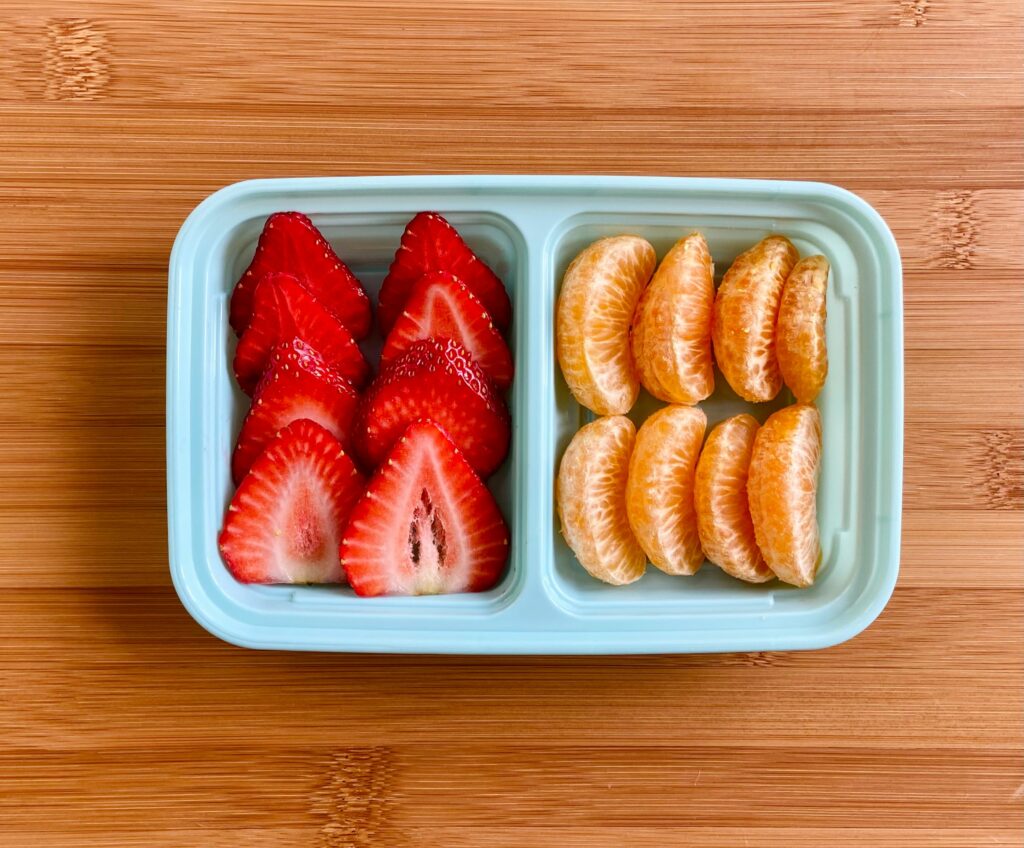
No extra cooking, no getting up half an hour earlier. These are combinations built on the four-component rule above, roughly ordered from quickest. Anything containing hummus, tofu or cooked pulses assumes a cool pack goes in with it.
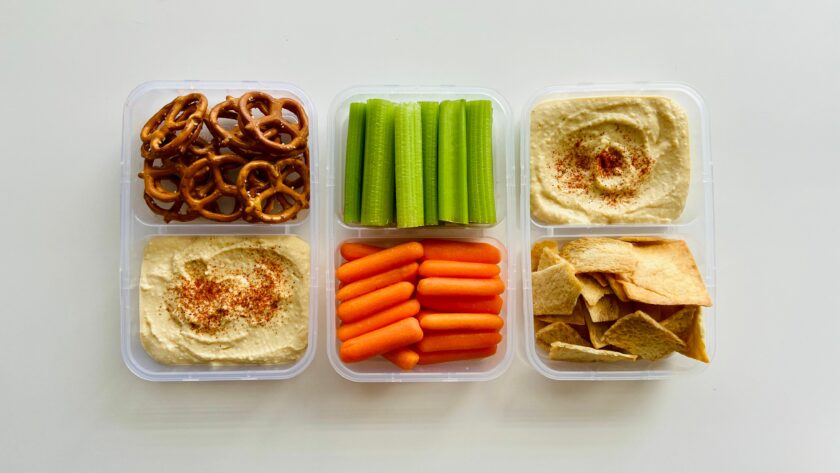
- Wholemeal roll with hummus, carrot and pepper cut into sticks, and a small handful of sunflower seeds.
- Wrap with smoked tofu, lettuce and seed butter instead of mayo, rolled tightly in baking paper so it holds together.
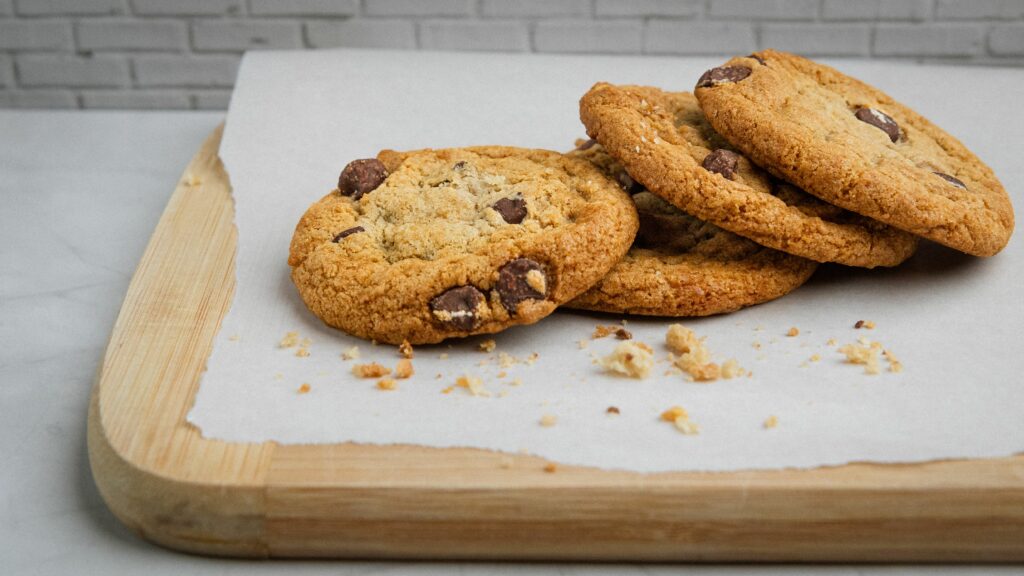
- Oat cookies with almond butter in a small pot for dipping, plus an apple and a satsuma.
- Bulgur or couscous salad with chickpeas, cucumber and olive oil, which is just as good cold five hours later.
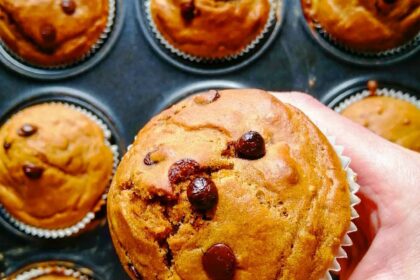
- Banana bread and walnuts, the reliable one, since it does not squash and children read it as dessert.
- Rice cakes with seed butter and the banana packed separately so the rice cakes stay crisp.
- Muffin and vegetable sticks, the sweet and savoury pairing that works best with younger children.
- Chickpea pancakes with spinach cut into strips, which taste surprisingly good cold.
- A homemade bar, a pear and a couple of squares of dark chocolate as a reward at the end.
- Yesterday’s potato cakes with hummus, the best way to use leftovers without them looking like leftovers.
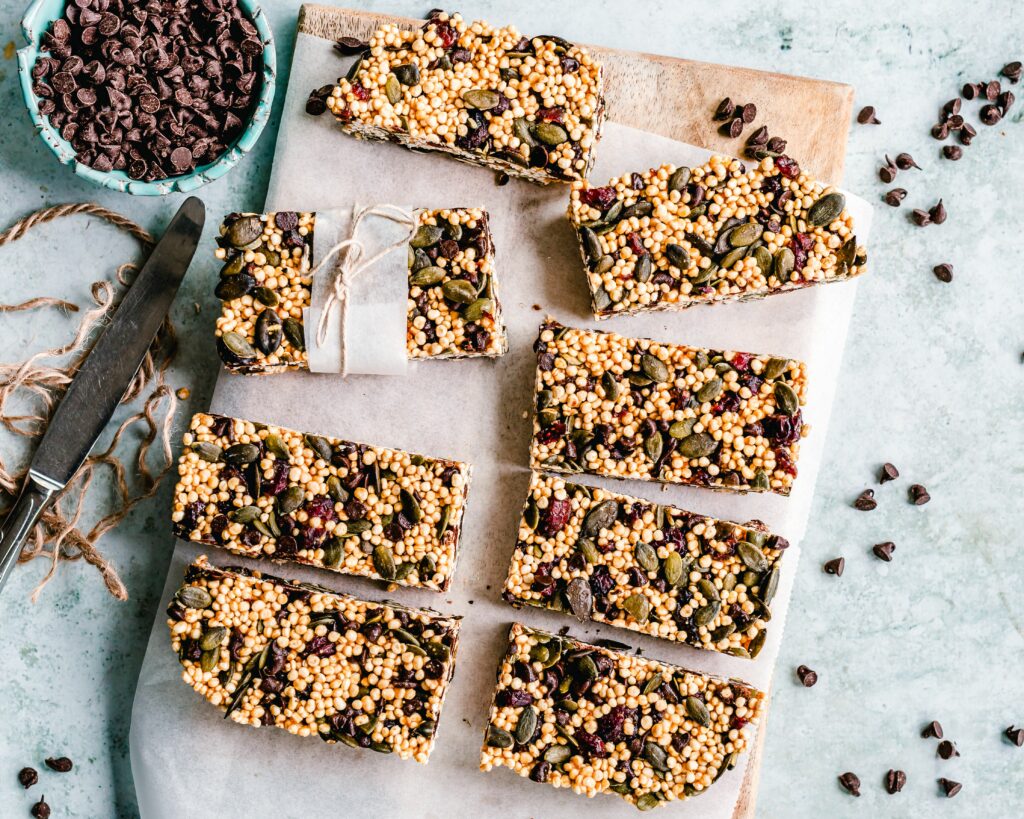
Several of these are built on recipes we already have. The ones that travel best are no-bake protein bars, which keep in a tin for several days, banana bread with chocolate and protein, and chickpea pancakes with spinach, which happen to be gluten-free and high in protein, so they solve two problems at once for anyone looking for gluten free vegan school lunch ideas. For the bread itself, overnight oat buns are the least effortful option, since the work happens the evening before and the morning job is slicing and filling.
Tip: one hour on Sunday, five calm mornings
The parents who manage this without stress nearly all do the same thing. On Sunday they bake one batch of cookies or muffins, blend a double quantity of dip, and cut vegetables into jars of water in the fridge. The morning job then becomes assembling rather than making, and it takes four minutes. An hour on Sunday buys back five rushed mornings, which is the best exchange rate in the whole of family cooking.
Shop-bought vegan school lunch box ideas for the bad mornings
There is no point pretending anyone bakes every morning. Sometimes you stop at a shop and you need something that is definitely plant-based and that your child will definitely eat. The range has improved enormously in the last few years, but labels still need reading, because a few categories are much less predictable than they look.
Our list of accidentally vegan snacks shows which biscuits, sweets and crisps from an ordinary shop pass.
| Category | What to look for | The catch |
|---|---|---|
| Cereal and fruit bars | Oat or date bases, ideally with added seeds or protein | Honey turns up constantly in this aisle, so read every bar rather than assuming the range |
| Raw or date bars | Dates plus nuts or seeds, nothing else needed | Hold their shape in a bag well, but check for added whey protein in sports versions |
| Plant yoghurts | Soy versions for protein, fortified with calcium and B12 where possible | Only with a cool pack, otherwise leave them at home entirely |
| Dips and spreads | Small pots of hummus, jars of nut and seed butter | The best protein-to-effort ratio on this list, and the safest bet overall |
| Plant milks | Versions fortified with calcium and vitamin D, ideally B12 too | Organic ranges are frequently unfortified, so check rather than assume |
| Bread and bakery | Wholegrain loaves, rye bread, rice cakes, plain flatbreads | Sweet bakery is where butter, milk powder and whey hide |
| Dark chocolate | Read the ingredients, not the cocoa percentage | Milk protein turns up in dark chocolate more often than people expect |
The fastest signal on a shelf is a certification logo, and the most widely used one internationally is the V-Label. Certification is voluntary and plenty of perfectly vegan products never bother with it, so its absence tells you nothing at all. One detail catches people out, though. The V-Label certifies vegetarian products as well as vegan ones. Since the 2023 redesign the vegan version has a yellow background and the vegetarian version a green one, but older packaging is still in circulation on which both were yellow. Read the word on the label rather than trusting the colour.
Bakery counters deserve their own warning. Sweet pastries, croissants and iced buns almost always contain butter, milk powder, whey or egg, even when the dough looks plain. Plain white and rye loaves are usually fine, but not reliably, because milk powder and animal fats are permitted in ordinary bread recipes in many places and turn up especially often in multigrain and enriched loaves. Asking at the counter is sensible, with one important limitation. For unpackaged food sold loose, the seller is generally required to declare allergens rather than the full recipe. Milk and egg are allergens, so you will get a straight answer on those. Honey, gelatine and animal fats are not allergens and nobody has to tell you about them.
Nutrients to watch in a vegan child’s lunch
This is the section for every parent of a vegan child, including the many who are not vegan themselves and are simply respecting a decision their child has made. One lunch box will not fix or ruin a diet on its own, but it is one of three or four eating occasions in a day, so it is worth using well.
Vitamin B12 is the one nutrient that cannot be solved with good menu planning. It is essentially absent from plant foods, so it has to come from fortified products or a supplement. The Vegan Society’s guidance for 11 to 18 year olds is refreshingly concrete. Fortified foods eaten at least twice a day providing at least 3 µg in total, or a daily supplement of at least 10 µg, or a weekly one of at least 2000 µg. Any of the three works. For younger children, fortified foods plus a supplement is the usual recommendation, because relying on how much fortified milk a child happens to drink on any given day is a fragile plan. We went into the detail in our article on what vitamin B12 is and where to get it.
Calcium in children is best handled through fortified plant milks and yoghurts, which typically supply around 120 mg per 100 ml, similar to cow’s milk. Green vegetables help too. Kale is one of the better sources at roughly 150 to 250 mg per 100 g depending on the variety, and calcium from low-oxalate greens such as kale and broccoli is absorbed far better than calcium from spinach. Leafy greens on their own are still not a realistic plan for a growing child eating school lunches, though. Check the carton, because organic ranges are often deliberately unfortified and the difference between two cartons on the same shelf can be the entire calcium contribution of the day.
Iron from plant sources (pulses, seeds, wholegrains) is absorbed less efficiently than iron from meat, but vitamin C eaten in the same meal improves absorption substantially. That is the actual reason to put a pepper or a satsuma next to a chickpea sandwich, and not simply for the colour. Protein, on the other hand, is usually less of a problem than parents fear, provided pulses, tofu, nuts and seeds appear regularly rather than occasionally. Our rundown of the best plant-based protein sources covers the amounts. For a teenager specifically, protein bagels with 15 g each solve the size problem better than any sandwich we have found.
One thing not worth working around. Children on a vegan diet should have regular check-ups, and ideally input from a dietitian who works with plant-based diets. This is not a comment on veganism, it is the same sensible caution that applies to any growing child with a restricted intake, and it means small problems get caught while they are still small. The Vegan Society’s nutrition resources are a good starting point for the reading, though they do not replace an actual consultation.
Tip for parents who are not vegan themselves
If your child made this decision and you are still finding your feet, you do not need to convert the entire household. Three things cover most of what actually matters. Sort out a B12 supplement, buy fortified plant milk rather than unfortified, and get a pulse, a nut or a seed into every lunch box. Everything else is refinement, and you can learn it gradually while your child eats perfectly well in the meantime.
Five things that surprised us about packing food
Shop-bought mayonnaise is not the risky part of a lunch. Its vinegar content and low pH mean pathogens barely multiply in the jar itself. The risk is what it gets mixed into, meaning potato and pasta salads, and homemade mayo made with raw egg. In a vegan kitchen the egg problem disappears entirely, but a pasta salad dressed with plant mayo still belongs in a chilled box, because the salad is the hazard rather than the dressing.
Fat is the best waterproofing there is. A layer of hummus or nut butter spread right to the crusts behaves like a membrane and keeps the juice from tomato or cucumber out of the bread. It is the same principle used in commercially made sandwiches, and it is why a sandwich with a proper spread survives the morning while one with only salad and tomato is a wet disappointment by eleven.
Browning fruit is down to one specific enzyme. Polyphenol oxidase reacts with oxygen in the air, and acid from lemon or lime juice slows the reaction considerably, partly by pushing the pH below the enzyme’s optimum and partly by acting as an antioxidant. A short soak in acidulated water works far better than a splash of juice over the top, which is the version most people try and then abandon.
Sunflower seed butter can turn baked goods green. The chlorogenic acid in sunflower seeds reacts with alkaline baking soda and the crumb comes out with a distinctly green tinge. It is completely harmless and it tastes exactly the same, but a green muffin is not a muffin any child will eat in front of their classmates. Adding a little lemon juice or vinegar to the batter prevents it.
Children do not eat what they do not recognise. It sounds obvious and it is still the most common reason a box comes home full. A new food needs to be offered repeatedly, at home, with no audience. Tempeh seen for the first time in a school hall at lunchtime goes in the bin. The identical tempeh, already familiar from a Saturday dinner, gets eaten without comment.
Healthy vegan school lunches by age
A six-year-old and a fifteen-year-old need completely different boxes, and not only in size. Younger children get shorter breaks, have less developed fine motor skills and are far more likely to eat only what looks familiar. Older children are thinking about how the food looks in front of everyone else, and often want something they can finish quickly on the way to the next lesson.
The box that works at six fails at fifteen, and for the opposite reason.
| Age | What to account for | What works |
|---|---|---|
| 5 to 7 | Short break, needs one-bite pieces, must be able to open the containers alone | Cut vegetables, small cookies, fruit pieces, a compartment box |
| 8 to 11 | Bigger appetite, and comparison with classmates begins | Wraps, filled rolls, bars, something sweet at the end |
| 12 to 15 | Substantially higher energy needs, food often eaten while walking | Larger portions, sandwiches, grain salads, a double serving of protein |
| 16 and over | Buying their own food, so the packed lunch competes with the shop | Agreeing on what they will take, or it stays in the bag untouched |
With the youngest children one small thing helps more than it should. A compartment box beats a single large container, because the child can see every part of the meal at once instead of digging through it. With older children the opposite rule applies, in that the less assembly required, the higher the chance it gets eaten. A finished wrap in paper beats a box of components that have to be put together at a crowded table. For a vegan school lunch for a teenager, portion size is usually the real problem rather than variety, and doubling the protein is the fastest fix.
When your child is the only vegan in the class
This part has nothing to do with food safety and everything to do with whether the box comes back empty. A child who is the only one in the room eating differently is managing a social situation as well as a meal. They do not want to explain themselves, they do not want to be the odd one, and they very much do not want anyone feeling sorry for them about a biscuit.
A few things help. Pack food that looks ordinary, so a sandwich that reads as a sandwich and a cookie that reads as a cookie, rather than unfamiliar ingredients that invite questions. Add something shareable now and then, because sharing food is currency among children and a vegan cookie that classmates ask for and like does more for a child’s confidence than any amount of explaining. And let your child decide how much they want to talk about it, since some are delighted to explain veganism to anyone who asks and others just want to eat their lunch in peace.
If you are a parent who is not vegan and this has all landed in your kitchen fairly recently, our overview of what veganism actually means might be useful. It is not written to persuade anybody of anything, it is written so you can get your bearings quickly when the subject suddenly becomes practical.
The most common mistakes
- A box that is all carbohydrate. Bread, fruit and juice look healthy, but the energy is gone within the hour. Always add protein and fat.
- Packing too much. A generous box feels caring, but a child has fifteen minutes. A smaller portion that gets finished beats a large one that gets two bites.
- Relying on unfortified plant milk. Organic and homemade versions usually contain no added calcium or vitamin D. For children, the fortified carton is the better choice.
- Putting off the B12 supplement. This is not something a varied diet solves. Sort it out at the start rather than eventually.
- Trying new food on a Monday morning. Test new things at home at the weekend. Only food that has already been eaten and approved goes in the bag.
- Using a soft bag. A rigid box with a proper lid saves more lunches than any recipe. Without one, the banana never stood a chance.
- Assuming plant-based means shelf-stable. Hummus, tofu and plant yoghurt need chilling exactly like their dairy counterparts do.
Vegan school lunches are not really about complicated recipes, and they are certainly not about convincing anyone of anything. They are about logistics, a rigid box, an extra source of protein, and knowing which school rules you are working around before you start. Once the system is set up, packing takes four minutes in the morning and the box comes back empty, which is the only measure of success that counts.
If you are after more ideas for what to pack, our carrot salad with tofu and no eggs keeps in a container for several days and gets eaten by children who otherwise walk straight past vegetables. What works in your house? Tell us in the comments what has actually survived the school bag, because we collect tips from parents gladly.
Read next
The same rules, over much longer distances. In How to Travel Vegan (Even If Your Partner Isn’t) we cover what survives a full day on a train or a plane, how to shop in a country where you know neither the brands nor the language, and how to eat well when the people you are travelling with are not vegan.
Frequently asked questions
What vegan school lunch lasts all morning without a fridge?
Wholegrain bread, nut and seed butters, nuts, seeds, dried fruit, firm fruit such as apples and satsumas, and cut raw vegetables all keep perfectly well at room temperature. Oat cookies, muffins, banana bread and bars also hold up. Hummus, bean dips, tofu and plant yoghurts are perishable foods, so they should only go in the box with a cool pack. Food safety guidance says perishable food should not be out of refrigeration for more than two hours, and a school morning runs to twice that.
What should a vegan school lunch contain to keep a child full?
Four components. A complex carbohydrate (wholegrain bread, oats, bulgur), a protein (chickpeas, lentils, tofu, seed butters), a fat (nuts, seeds, tahini, avocado) and fruit or vegetables alongside. Bread with fruit alone provides fast energy that runs out within an hour. Adding protein and fat extends the feeling of fullness by several hours, which is usually the difference between an empty box and one that comes home half eaten.
What can I pack if my child’s school is nut-free?
Sunflower seed butter is the closest substitute for peanut butter, with around 3 g of protein per tablespoon, and it is accepted under most nut-free policies. Keep it in its labelled jar so staff can see what it is. Other options are hummus and other pulse dips, roasted chickpeas, soy yoghurt, edamame and pumpkin seed butter. Check on tahini before you rely on it, because sesame is a major allergen in its own right and some schools restrict it too.
Do vegan children need a vitamin B12 supplement?
Yes. Vitamin B12 is essentially absent from plant foods, so it has to come from fortified products or a supplement. The Vegan Society advises 11 to 18 year olds to either eat fortified foods at least twice a day totalling at least 3 µg, or take a daily supplement of at least 10 µg, or a weekly one of at least 2000 µg. For younger children, combining fortified foods with a supplement is usually recommended, since intake from fortified products varies with how much a child happens to eat that day. Regular check-ups and input from a dietitian familiar with plant-based diets are also sensible.
Is shop-bought bread vegan?
Plain savoury bread such as white loaves, rye bread and baguettes usually is, though milk powder and animal fats are permitted in ordinary bread recipes and appear fairly often in multigrain and enriched loaves. Sweet bakery is the real problem, since pastries, croissants and iced buns very often contain butter, milk powder, whey or egg. For unpackaged bakery items the seller generally has to declare allergens rather than the full recipe. Milk and egg are allergens so you will get an answer on those, but honey and animal fats are not.
What are good vegan school lunch ideas for a teenager?
Portion size matters more than variety at this age, because energy needs rise sharply and food is often eaten quickly between lessons. Substantial sandwiches, protein bagels, grain salads with chickpeas and a double serving of protein all work better than a box of small components. Anything that has to be assembled at the table loses out to whatever is available in the school shop, so a finished wrap in paper beats a compartment box. It is also worth simply agreeing with them on what they will actually take.
Newsletter
Get our free e-books
Join the newsletter and download Our Vegan Christmas Kitchen straight away, 10 recipes for Czech cookies, gingerbread and vánočka. Then once a month, new places from the vegan map and new articles. Unsubscribe with one click.