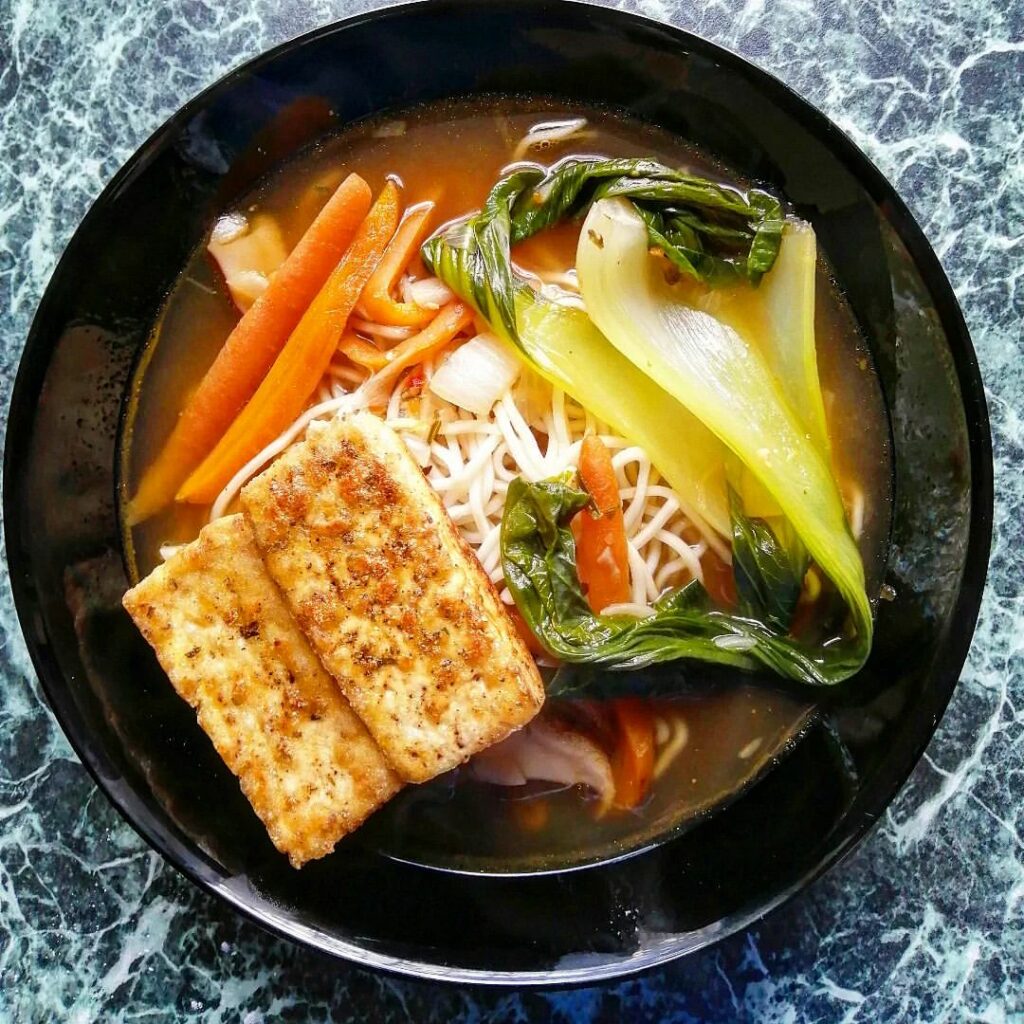
Vegan miso ramen is one of those meals that warms you up, fills you up and delights all your senses at once. A fragrant broth infused with miso paste, crispy pan-fried tofu, silky noodles and fresh vegetables come together in a bowl packed with umami flavours that you can make at home in under an hour. Japanese ramen is one of the most popular street foods in the world, and this vegan version proves you don’t need any bones or meat for a perfect broth.
How do you work with miso paste so it keeps its probiotics? Can you make ramen without shiitake mushrooms? Which noodles work best? And how do you get tofu truly crispy? You’ll find answers to everything in this article, along with tips for variations and full nutritional information.
Miso ramen is one of the highest-protein soups in our roundup of vegan soups, with 18 g of protein per serving.
Why you’ll love this recipe
This ramen combines simple preparation with restaurant-quality results.
- Deep umami flavour – the combination of miso paste, soy sauce, sesame oil and shiitake mushrooms creates a rich broth that tastes like it came from a Japanese restaurant.
- Crispy pan-fried tofu: tofu coated in cornstarch and pan-fried adds protein and a texture you’ll love.
- Packed with nutrients: carrot, pak choi, mushrooms and ginger all in one bowl. Each serving is loaded with vitamins and minerals.
- Customisable: works with any Asian noodles, you can add whatever vegetables you have and adjust the heat to your taste.
- Probiotics from miso: the miso paste is added at the very end, so it retains its live cultures that support digestion.
This bowl of ramen is proof that homemade Asian cooking doesn’t have to be complicated, just a few quality ingredients and the right technique.
Interesting facts about ramen and miso
Ramen as we know it today has a surprisingly short history. It arrived in Japan from China only at the end of the 19th century and was originally called “shina soba” (Chinese noodles). It wasn’t until after World War II, when cheap wheat flour flooded the Japanese market, that ramen became a massively popular dish. Today Japan has over 24,000 ramen restaurants and ramen is considered the country’s unofficial national dish.
Planning to try ramen in Japan itself? Our guide to whether Japan is vegan friendly includes a fully vegan ramen shop inside Tokyo Station.
Miso paste is a fermented paste made from soybeans that has been produced in Japan for over 1,300 years. The fermentation process takes anywhere from a few weeks to several years, with longer fermentation producing darker, more intense miso. There are three main types: white (shiro), yellow (shinsu) and red (aka). For ramen, white or yellow miso is most commonly used, as it has a milder, sweeter flavour.
Miso’s nutritional profile is also impressive. One tablespoon of miso paste contains approximately 2 g of protein and 12% of the daily value of manganese. Thanks to fermentation, miso is rich in probiotics, particularly the strain Aspergillus oryzae, which supports gut microbiome health. The important thing is not to boil miso, as high temperatures destroy the probiotic cultures. That’s why in this recipe it’s added to the finished broth just before serving.
Health benefits of vegan miso ramen
This bowl of ramen isn’t just delicious. Thanks to its combination of ingredients, it offers several real health benefits.
Miso paste is a source of probiotics that support digestive health. Studies published in Food Science and Technology confirm that regular consumption of fermented soy products can improve nutrient absorption and support the immune system. Miso also contains antioxidants and isoflavones that may help protect cells.
Shiitake mushrooms are among the most nutritionally dense mushrooms in the world. They contain lentinan, a polysaccharide that supports immune function. Four dried shiitake mushrooms provide roughly 40% of the daily value of vitamin D (after UV exposure). They’re also a source of B vitamins, copper and selenium.
Ginger and garlic together form a powerful combination. Ginger contains gingerol with anti-inflammatory effects and helps with nausea. Garlic is rich in allicin, a compound with antibacterial and antiviral properties. Both ingredients also support circulation and help the body fight off colds.
Nutritional values
One serving of vegan miso ramen (including tofu) contains approximately these values.
| Nutrient | Amount per serving |
|---|---|
| Calories | ~380 kcal |
| Protein | 18 g |
| Carbohydrates | 42 g |
| Fat | 14 g |
| Fibre | 5 g |
Approximate values per serving. Actual amounts may vary depending on specific ingredients and quantities used.
Vegan miso ramen
Ingredients
- 750 ml vegetable broth
- 125 g noodles any Asian noodles
- 1 handful of shiitake mushrooms soaked for at least 1 hour
- 2 carrots cut into strips
- 1 pak choi leaves separated
- 4 cloves of garlic minced
- 1 onion diced
- herb salt to taste
- black pepper to taste
- soy sauce to taste
- sesame oil to taste
- miso paste 1 tsp per bowl, added at the end
- fresh ginger grated, to taste
Pan-fried tofu:
- 1 block tofu pressed and sliced
- cornstarch for coating
- herb salt to taste
- black pepper to taste
- soy sauce to taste
Instructions
- Dice the onion and mince the garlic. Sauté until golden. Sprinkle with grated ginger, pour in the vegetable broth and add the shiitake mushrooms.
- Cut the carrots into strips and separate the pak choi leaves. Add them to the broth after about 30 minutes of simmering. Season to taste with herb salt, pepper, soy sauce and sesame oil.
- Cook the noodles according to the packet instructions. Any Asian noodles work well.
- When the vegetables are tender, turn off the heat and stir in a teaspoon of miso paste per bowl. Do not boil the miso.
- Slice the tofu into about 6 pieces, season with salt, pepper and soy sauce, coat in cornstarch and pan-fry until golden and crispy.
- Place the cooked noodles in a deep bowl, ladle the broth over them and top with the crispy tofu. Serve immediately.
Tips and variations for vegan miso ramen
Ramen is inherently a flexible dish and you can adapt it based on what you have at home.
- Without shiitake mushrooms: substitute with oyster mushrooms or button mushrooms. The flavour will be slightly different but the broth will still be excellent.
- Spicy version: add a teaspoon of chilli paste (gochujang or sriracha) to the broth for extra heat.
- With coconut milk: add 100 ml of coconut milk for a creamier, Thai-inspired version.
- Different noodles: udon, soba, rice noodles or classic ramen noodles all work. Each type gives the ramen a slightly different texture.
- Storage: store the broth separately from the noodles (otherwise the noodles absorb all the liquid). The broth keeps in the fridge for 3-4 days and can be frozen for up to 2 months.
For the perfect finishing touches, add a few drops of chilli oil, bean sprouts, sliced spring onion and toasted sesame seeds on top.
What to serve with miso ramen
Ramen is a complete meal on its own, but a few additions can take it to the next level.
Gyoza (Japanese dumplings), edamame or a simple cucumber salad with a sesame oil and rice vinegar dressing all pair brilliantly with ramen. If you want even more protein, try our recipe for vegan oyster mushroom “chicken”, which you can add on top instead of tofu. For a lighter pairing, try ramen alongside some peanut sauce fried rice as a side.
Ramen is traditionally served immediately after preparation, as the noodles gradually swell in the broth. Serve in deep bowls and eat with chopsticks and a spoon.
Frequently asked questions
Is miso paste vegan?
Most miso pastes are naturally vegan, as they’re made from soybeans, rice or barley, salt and koji culture. However, some speciality varieties may contain fish stock (dashi), so always check the label. In most supermarkets you’ll find vegan miso pastes from brands like Clearspring or Hikari.
Why shouldn’t you boil miso paste?
Miso paste contains live probiotic cultures created during fermentation. High temperatures (above 60°C / 140°F) destroy these cultures, meaning you lose the main health benefits of miso. That’s why miso should always be added to the finished, slightly cooled broth. If you’re not concerned about probiotics, you can add miso earlier and the flavour will remain.
What noodles are best for ramen?
Traditional ramen noodles are wheat-based and slightly wavy. For a gluten-free option, try rice noodles or soba noodles (made from buckwheat). Udon noodles are thicker and chewier, while soba noodles have a nutty flavour. All varieties work well, it simply comes down to personal preference.
How do you make crispy tofu for ramen?
The key is to first thoroughly dry the tofu (ideally wrap it in a tea towel and press it under a weight for 15 minutes), cut it into slices, season with salt and spices, coat in cornstarch and pan-fry in a little oil until golden on both sides. The cornstarch creates a thin crispy crust that stays crunchy in the broth for the first few minutes.
Can you make vegan miso ramen ahead of time?
The broth yes, the noodles and tofu preferably not. You can make the broth a day ahead and store it in the fridge. But cook the noodles fresh just before serving, as they swell in the broth and lose their texture. Tofu is best freshly fried, though you can reheat it in the oven at 180°C (350°F) for 5 minutes.
Vegan miso ramen is a dish that looks impressive, tastes incredible and can be made in an ordinary kitchen with readily available ingredients. All you need is quality miso paste, a few types of vegetables and a bit of patience. Once you make it at home, you’ll understand why ramen is one of the most beloved foods in the world. If you enjoy Asian cooking, try our vegan kimchi fried rice or light chickpea curry next. And if you loved this ramen, share the recipe with your friends.
Newsletter
Get our free e-books
Join the newsletter and download Our Vegan Christmas Kitchen straight away, 10 recipes for Czech cookies, gingerbread and vánočka. Then once a month, new places from the vegan map and new articles. Unsubscribe with one click.