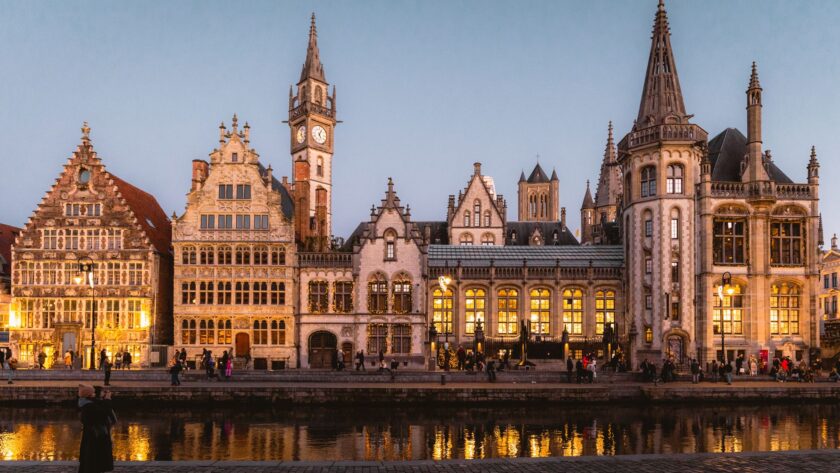
Ghent lives in Bruges’ shadow, and it really shouldn’t. There are plenty of things to do in Ghent that Bruges can’t match. It has a moated castle in the middle of town and a Gothic cathedral holding one of the most famous paintings in Europe. Add two quaysides lined with guild houses and 270,000 people who keep the place awake after dark. Most visitors give it a few hours on a day trip from Brussels and leave wishing they had stayed the night.
For us, Ghent has one more draw. This is where Thursday Veggie Day (Donderdag Veggiedag) started in 2009, a weekly meat-free day that other cities later copied. The local tourist board now calls Ghent the “veggie capital of Europe”. The old town has a fully vegan pizzeria, a vegan bistro with its own plant-based grocery and a chip shop that makes vegan tartare sauce.
So what are the best things to do in Ghent if you only have a day or two? Is Ghent or Bruges better for a short trip? How do you get there by train from London or Prague, and what do you need to know before driving into the low emission zone? And where can you eat vegan in a way that keeps your meat-eating friends happy too? It’s all below, with prices in euros.
To be upfront: we haven’t been to Ghent yet, so this isn’t a trip diary. In October 2026 we read the menu of every place we recommend on its own website, and we checked prices and opening hours on the official city, cathedral and rail operator sites. Where sources disagree, we say so.
Is Ghent worth visiting?
Ghent is worth visiting, especially if you want medieval sights without the coach-tour crowds. The sights sit in a compact centre and you can see most of them on foot in a day. Ghent is Belgium’s third-largest city after Brussels and Antwerp, with about 270,000 inhabitants at the end of 2024.
Ghent is not an open-air museum, though. Its university dates from 1816, and students are everywhere, on the quays, in the cafés and in the alley where the city tolerates graffiti. The city feels lived-in on a Tuesday afternoon, not only on a Saturday.
Ghent is also easy to reach. Brussels is about half an hour away by train and Bruges is about the same distance in the other direction. That makes Ghent a good base for a long weekend in Belgium, with day trips on the side.
How many days do you need in Ghent?
One full day in Ghent covers the main sights. Two days is ideal, because you can add a museum, a canal boat tour and an evening walk once the towers are lit. A third day works well for a day trip to Bruges or Antwerp.
If you’re planning to see both cities, sleep in Ghent, not in Bruges. Ghent is bigger, has more places to stay and still has restaurants open after nine in the evening.
Ghent on our vegan map
16 places, 13 fully vegan. Tap a pin to see the details.
Loading the map…
- 100% vegan
- Vegetarian
- Vegan options
See every place from this article on our vegan map.
Best things to do in Ghent: the main sights
If time is short, the best things to do in Ghent are the Gravensteen castle, St Bavo’s Cathedral with the Ghent Altarpiece, the Belfry, the Graslei and Korenlei quays and the view from St Michael’s Bridge. All of them are within fifteen minutes’ walk of each other.
Gravensteen, the Castle of the Counts
The Gravensteen, the castle of the Counts of Flanders, has stood in the centre of Ghent since 1180 and still has its moat. It opens daily from 10:00 to 18:00, with last admission at 16:40. It is closed on 24, 25 and 31 December and 1 January.
An adult ticket costs €15, children under 12 go free, and the audio guide is included. The Gravensteen’s official ticket page advises booking ahead, and prices are the same online and at the desk. With a CityCard Gent you don’t need to book.
The ramparts give one of the best views over the rooftops of the old town. If you’re arriving by train, look at the Belgian railways’ Discovery Ticket, which the castle says combines entry with 40% off your train fare.
St Bavo’s Cathedral and the Ghent Altarpiece
St Bavo’s Cathedral opens daily except 1 January, and entry to the nave is free. You pay only for the Ghent Altarpiece, the Adoration of the Mystic Lamb by the van Eyck brothers, completed in 1432. A 25-minute altarpiece-only visit costs €12.50, the 60-minute augmented reality tour costs €16, and children under 12 pay €8.
Here’s something other guides don’t mention yet. According to the St Bavo’s Cathedral website, the third and final restoration phase of the altarpiece started on 3 May 2023.
During the work, seven panels in the cathedral are replaced by high-quality colour photos, and the restoration is due to finish in spring 2027. If seeing every original panel matters to you, consider waiting until after that.
The altarpiece comes with a detective story too. In 1934 the Just Judges panel was stolen, and it has never been found. A copy hangs in its place.
The Belfry and St Nicholas’ Church
The Belfry of Ghent is 91 metres tall, the tallest belfry in Belgium, and one of the Belfries of Belgium and France on the UNESCO World Heritage list. A gilded dragon has sat on top since 1377. Entry costs €13, and there’s a lift from the first floor, so you don’t have to climb every step to reach the walkway with views over the whole centre.
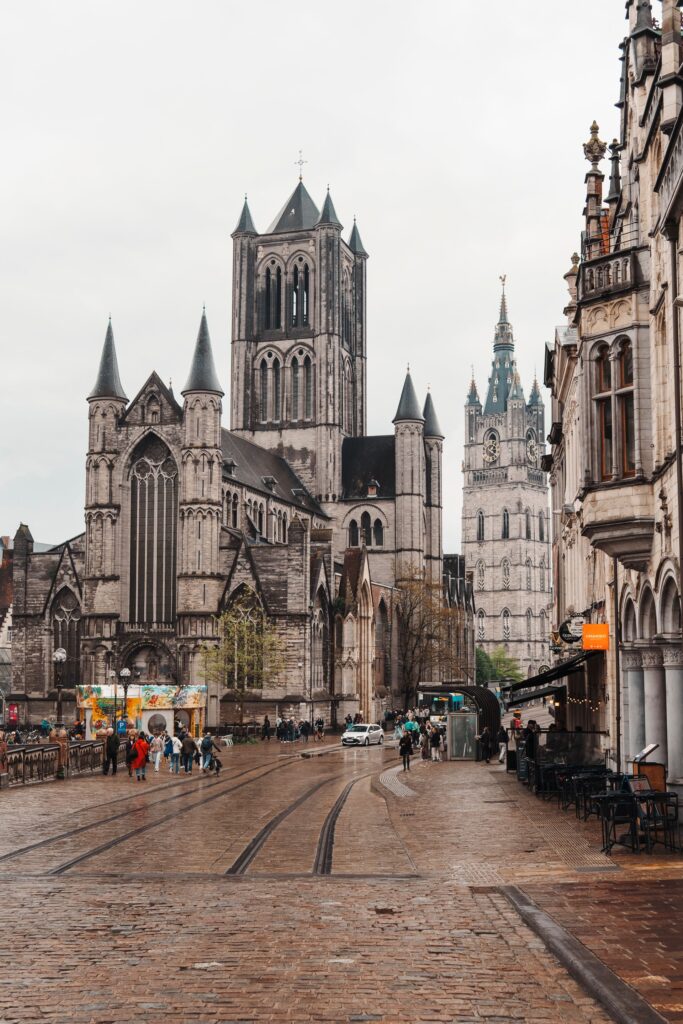
The Belfry, the cathedral tower and St Nicholas’ Church make up the row of three towers on every Ghent postcard. St Nicholas’ Church stands right next door on Korenmarkt, and it’s the natural starting point for a walk down to the river.
Graslei, Korenlei and St Michael’s Bridge
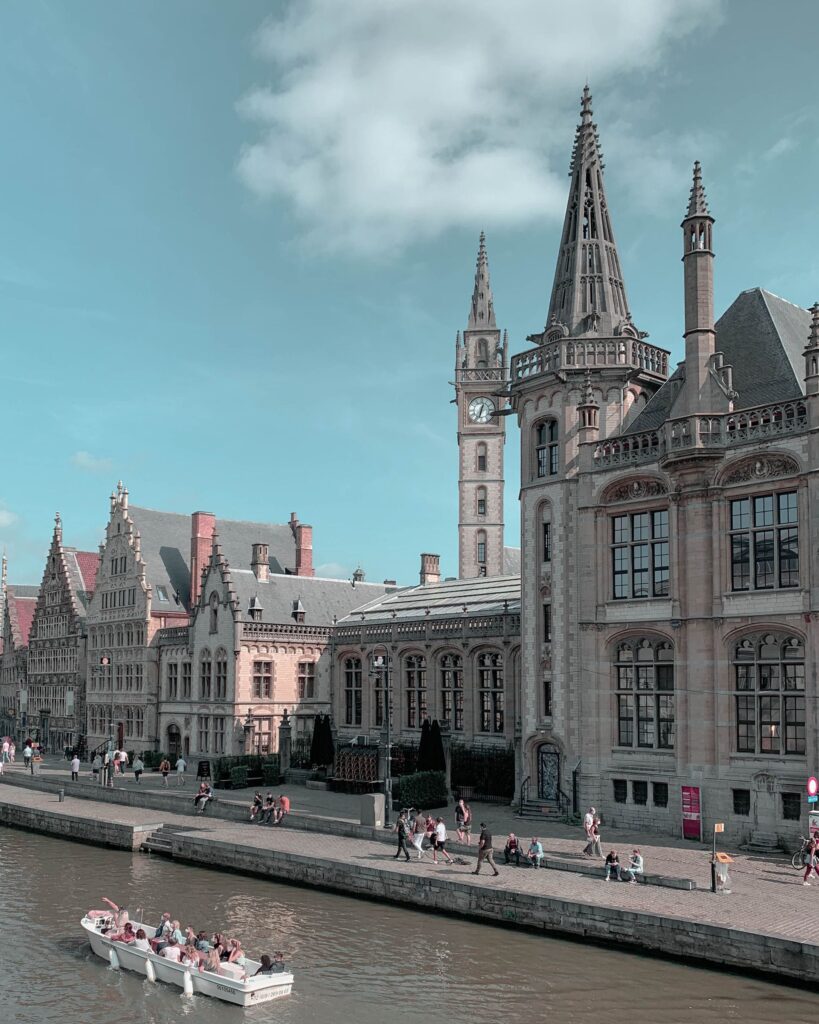
Graslei and Korenlei are the two facing quays on the river Leie, where Ghent’s medieval port used to be. Today they’re lined with guild houses, and on warm evenings students and visitors sit along the water’s edge.
St Michael’s Bridge is the best viewpoint in Ghent. From the middle you see all three towers lined up, both quays and the Gravensteen in the distance. Boats run by Rederij Dewaele leave from Korenlei all year round, according to Visit Gent. A tour costs €11, it’s covered by the CityCard, and Lonely Planet puts canal tours at 45 minutes to an hour.
Patershol, Vrijdagmarkt and Graffiti Street
Patershol is a medieval quarter of narrow cobbled lanes just behind the Gravensteen. Today it’s mostly restaurants, and it’s the quietest place in the centre for an evening stroll.
Vrijdagmarkt (Friday Market) is one of Ghent’s largest squares, with a statue of Jacob van Artevelde in the middle and cafés and Belgian beer bars all around.
Werregarenstraatje, just off Korenmarkt, is the alley where the city allows street artists to paint. It looks different every time, and it’s the quickest way to understand that Ghent isn’t just a backdrop for photos.
Ghent’s UNESCO beguinages
Beguinages are enclosed courtyards of small houses where religious women lived without taking formal vows. Thirteen Flemish beguinages were added to the UNESCO World Heritage list in 1998, and two of them are in Ghent. They are the Small Beguinage (Klein Begijnhof) and the Large Beguinage in Sint-Amandsberg.
They’re homes, not museums, so keep your voice down, because people still live in the houses. The Small Beguinage is close to the centre, while Sint-Amandsberg is easier by tram or bike.
Ghent museums and the CityCard
Ghent has three museums worth your time. The MSK (Museum of Fine Arts) and S.M.A.K. (contemporary art) are both in Citadelpark. At the MSK you can watch restorers working live on panels of the Ghent Altarpiece from Tuesday to Friday. STAM, the Ghent city museum, is in the former Bijloke abbey, and its showpiece is a giant aerial photo of the city that you walk across.
If you plan to see a lot, the CityCard Gent can pay off. According to Visit Gent, it costs €49 for 48 hours and €55 for 72 hours. It covers the main monuments and museums, public transport and €10 off the Ghent Altarpiece. The clock starts at first use, not at purchase.
One detail for families. Children and young people up to 18 get into most Ghent museums free, so the CityCard is usually not worth it for them.
Do the maths: the Gravensteen (€15), the Belfry (€13) and a boat tour (€11) add up to €39. Add the €10 altarpiece discount and you’re at €49, exactly the price of the 48-hour card. Every museum and tram ride after that is pure saving. For a single day with just two sights, skip it.
Things to do in Ghent in one day: a walking plan
You can do Ghent in one day on foot, in a single loop, without rushing. Start in the cathedral in the morning, when the altarpiece queue is shorter, and finish by the river after dark.
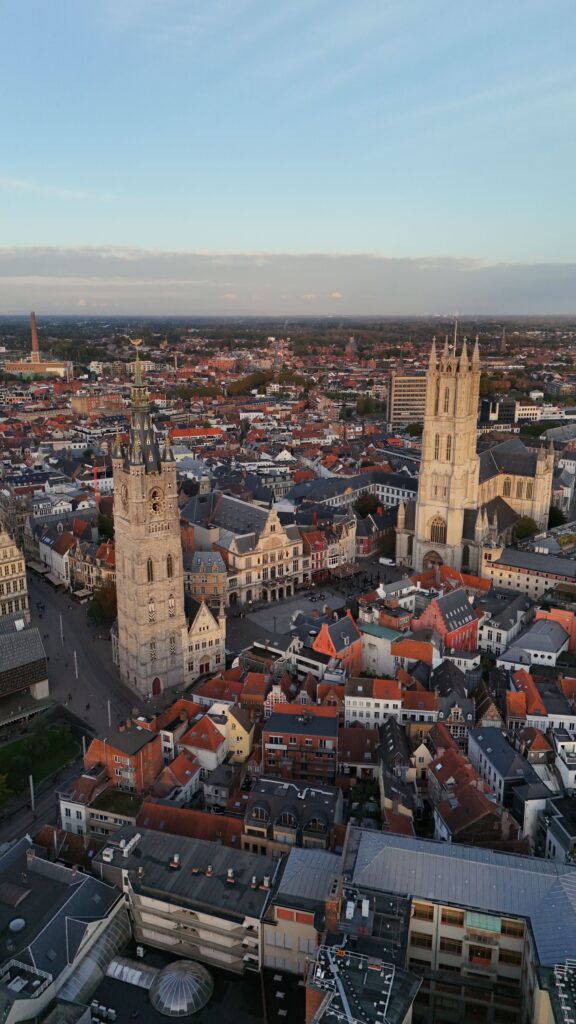
Morning: St Bavo’s Cathedral and the Ghent Altarpiece, then the Belfry and a look at St Nicholas’ Church. Stop for breakfast at O’yo on Sint-Baafsplein, right opposite the cathedral.
Midday: St Michael’s Bridge, Graslei and Korenlei and Graffiti Street. A canal boat from Korenlei fits in here too. Walk on to Plant a Pizza on Geldmunt, a minute from the Gravensteen, for a vegan pizza lunch.
Afternoon: the Gravensteen (last entry 16:40), then Patershol and Vrijdagmarkt. On the way, drop into Knol & Kool on Heilige Geeststraat, a vegan bistro with its own plant-based shop.
Evening: dinner at Le Botaniste (open until 21:30) or Greenway (until 21:00). Finish back on St Michael’s Bridge, because the lit towers and quays are at their best after dark.
Bruges is beautiful, but Ghent is somewhere you could actually live. And you can eat very well there without meat.
Ghent or Bruges: which is better?
Ghent or Bruges? If you have one day and want a fairytale medieval centre, go to Bruges. If you want a city that’s alive after dark, more places to eat and fewer tourists per square metre, choose Ghent. They’re about half an hour apart by train, so you can easily do both.
| Ghent | Bruges | |
|---|---|---|
| Size | about 270,000 people, university city | about 120,000 people |
| UNESCO | the Belfry and two beguinages | the entire historic centre |
| Feel | student city, lively at night | romantic, quiet in the evening |
| Thursday Veggie Day | started here in 2009 | – |
| Where to sleep | more choice, good base for day trips | smaller choice, pricier hotels according to comparison sites |
| By train from Brussels | about 30 minutes | about an hour on the fast trains |
Our advice for vegans is simple. Stay in Ghent and do Bruges as a day trip. In Ghent you have fully vegan places on hand, including on Thursday evening, when the city traditionally eats meat-free. We haven’t checked menus in Bruges yet, so we won’t name places there that we haven’t verified.
If it’s the Christmas market you’re after, Ghent has one advantage. From 2026 the Ghent Winter Festivities (Gentse Winterfeesten) run until the end of the Christmas school holidays, where they used to end on 31 December. The 2026 edition runs from Thursday 3 December 2026 to Sunday 3 January 2027.
Vegan Ghent: why it’s called the veggie capital
Ghent is called the veggie capital of Europe because of Thursday Veggie Day (Donderdag Veggiedag), a campaign that started here in 2009. It asks people to skip meat and fish one day a week. It’s voluntary, and nobody is told what to eat.
The most visible result is in schools. According to Visit Gent, a meat-free dish appears on the menu in Ghent’s schools every Thursday. Many other cities in Belgium and abroad later took up the campaign.
The “veggie capital of Europe” title is mostly one Ghent gives itself. Visit Gent says the city has proportionally more vegan and veggie places to eat than many other big cities. You’ll also see the claim online that Ghent has the most vegetarian restaurants per head in Europe. We couldn’t find a source for that, so treat it as a legend, not a statistic.
What this means for travellers is practical. Ordinary restaurants in Ghent are used to guests who don’t eat meat. Vegetarian dishes are on almost every menu. Vegan ones you need to ask for, but staff usually know what you mean.
Vegan restaurants in Ghent
Eating vegan in Ghent is easy once you know which places are fully plant-based and which just have vegan options. The table shows what we found on each place’s own website in October 2026.
| Place | Where | What it is | What to order |
|---|---|---|---|
| Plant a Pizza | Geldmunt 49 | 100% vegan pizzeria | a classic margherita with cashew mozzarella |
| Knol & Kool | Heilige Geeststraat 30 | vegan bistro and plant-based grocery | brunch or lunch, snacks for the train |
| Le Botaniste | Hoornstraat 13 | plant-based organic bistro and wine bar, daily 11:30–21:30 | Tibetan Mama bowl, chili sin carne |
| Greenway | Nederkouter 42 | plant-based restaurant, daily 11:00–21:00 | pita kebab (€12.90), vegan stoofvlees (€15.90) |
| O’yo | Sint-Baafsplein 12 | mostly vegan breakfast café | vegan pancakes, toasts |
| Madam Bakster | Brabantdam 142 | plant-based bakery, no refined sugar | cake and coffee, Wednesday to Sunday |
| De Frietketel | Papegaaistraat 89 | chip shop with vegan snacks | fries with vegan tartare sauce |
| Epiphany’s Kitchen | Burgstraat 10 | plant-based base, meat as an add-on | gluten-free dishes, order vegan |
Plant a Pizza and Knol & Kool: fully vegan classics
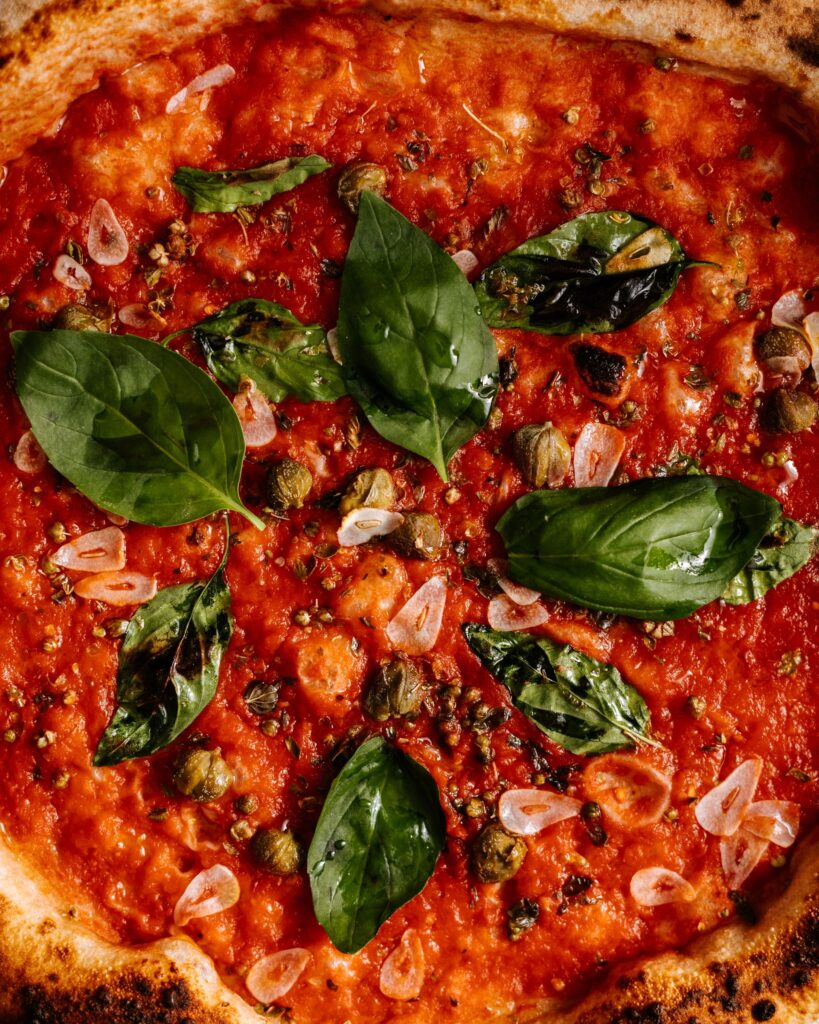
Plant a Pizza at Geldmunt 49, next to the Gravensteen, says it’s the first fully plant-based pizzeria in Belgium. It opened in 2021 and makes classics like margherita, four cheeses and Provola & Pepe with smoked cashew provola and black pepper, all with plant-based cheeses. There are “meat” pizzas with seitan too, and the dough rises for at least 36 hours.
Plant a Pizza is our top pick for a mixed group. The menu is deliberately classic, so the friend who would never choose a vegan restaurant will happily order here.
Knol & Kool at Heilige Geeststraat 30 calls itself “beestig vegan”, which loosely means seriously vegan. It’s a bistro for brunch, lunch and dinner, attached to Ghent’s first fully plant-based superette, where you can stock up for the journey. It opens Wednesday to Sunday. The kitchen serves Wednesday to Friday 11:00–15:00 and 17:30–20:30, from 10:00 on Saturday, and only until 15:00 on Sunday.
Le Botaniste and Greenway: lunch and dinner in the centre
Le Botaniste at Hoornstraat 13 is a Belgian chain of plant-based organic bistros with a wine bar. It opens daily from 11:30 to 21:30 and doesn’t take reservations, so arrive early. The menu has bowls like the Tibetan Mama (brown rice with a coconut peanut curry), Pasta Bolo, chili sin carne and a vegetable tajine. For dessert there’s a brownie with cashew cream.
Greenway at Nederkouter 42 is Ghent’s veggie pioneer, founded in the late 1990s. It now sells plant-based products in Belgian supermarkets too, but the restaurant is still going, open daily from 11:00 to 21:00 except public holidays. Every dish on the menu we read is plant-based.
At Greenway, order the Dirty Wedges with vegan stoofvlees for €15.90. Stoofvlees is the Flemish beef and beer stew, made here without meat, so you get to taste a local classic as a vegan. A pita kebab or falafel pita costs €12.90.
Breakfast, cake and chocolate in Ghent
O’yo at Sint-Baafsplein 12, opposite the cathedral, is a breakfast and lunch café that describes itself as “mostly vegan”. A few dishes contain Greek yoghurt or egg; the rest are plant-based, including gluten-free pancakes with maple syrup and toasts with tofu ricotta. It opens 9:00–17:00 on weekdays and until 18:00 at weekends.
Madam Bakster at Brabantdam 142 is a bakery where every dessert is plant-based and made without refined sugar. The coffee bar opens Wednesday to Sunday, 10:00–18:00. Cakes are made to order only, but the coffee bar serves plant-based sweets with your coffee.
You can’t leave Belgium without chocolate. Holy Cow Chocolate at Lange Kruisstraat 7 sells only plant-based products, from cocoa nibs to creamy pralines, according to Visit Gent. We couldn’t find that stated on the shop’s own website, so ask before you buy.
De Frietketel and Epiphany’s Kitchen for mixed groups
De Frietketel at Papegaaistraat 89 is the most vegetarian-friendly chip shop in Ghent according to the local guide Time to Momo, and Visit Gent recommends it for its wide vegan range. The fries and snacks are cooked in palm oil, and there’s a wide range of vegan snacks. The homemade tartare sauce comes in a vegan version too.
Epiphany’s Kitchen at Burgstraat 10 is often listed as 100% vegan. According to its own website, that’s no longer true. The kitchen is entirely gluten-free and every base dish is plant-based, but you can add fish, meat or cheese to any of them. It’s a good choice for a group where everyone eats differently; as a vegan, just watch your order.
What’s missing from our list: older lists recommend Komkommertijd and its vegan buffet. Its Visit Gent page now redirects elsewhere and we couldn’t find current information, so we don’t recommend it. Epiphany’s Kitchen is still described as 100% vegan on Visit Gent, but the restaurant’s own site offers meat and fish as add-ons.
Belgian food: what’s vegan and what isn’t
Belgian classics lean heavily on meat, butter and cream, but you can still try a few as a vegan. According to Visit Gent, the locals’ favourite order at a chip shop is large fries with beef stew sauce and mayonnaise. Neither is vegan.
| Dish | Vegan? | What to watch for |
|---|---|---|
| fries (friet) | sometimes | depends on the frying fat; ask about the oil |
| stoofvlees (carbonnade) | traditionally no | beef in beer; Greenway does a vegan version |
| waterzooi | no | Ghent’s creamy stew with chicken or fish |
| cuberdon (neuzeke) | often | traditionally made with gum arabic, but recipes vary |
| Belgian waffle | usually no | butter, eggs and milk in the batter |
| chocolate and pralines | depends | milk chocolate isn’t; look for dark or plant-based |
| beer | often | some beers are fined with animal products, ask |
Fries tip: the mayonnaise served with Belgian fries contains egg. At the stand, ask “Is de saus veganistisch?” (Is the sauce vegan?) and “Bakken jullie in plantaardige olie?” (Do you fry in vegetable oil?). If they aren’t sure, have ketchup, or go straight to De Frietketel.
The cuberdon is a purple cone-shaped sweet that Ghent people call a “neuzeke”, a little nose. The traditional recipe uses gum arabic rather than gelatine. Recipes vary between makers, though, so check the label or ask.
How to get to Ghent
The easiest way to get to Ghent is by train to Brussels and then half an hour on a Belgian train to Gent-Sint-Pieters. From London that means the Eurostar, from Prague the European Sleeper night train. Flights land at Brussels Airport, and drivers need to sort out Ghent’s low emission zone before they arrive.
| How | When | How long | From |
|---|---|---|---|
| Eurostar London → Brussels-Midi | several times a day | about 2 hours | depends on date |
| European Sleeper Prague → Brussels | Tuesday, Thursday, Sunday | overnight, departs 18:00, arrives late morning | €59.99 (shared compartment) |
| European Sleeper Brussels → Prague | Monday, Wednesday, Friday | overnight, departs about 18:00 | €59.99 |
| Train Brussels → Gent-Sint-Pieters | several times an hour | about 30 minutes | Belgian rail fare |
By train from London: the Eurostar
The Eurostar from London St Pancras to Brussels-Midi takes about two hours. According to the rail guide Seat61, Eurostar stopped selling “Any Belgian Station” tickets on 31 March 2025. You now need a Eurostar ticket to Brussels plus a separate Belgian train ticket to Ghent. From Brussels-Midi, InterCity trains to Ghent take about half an hour.
By night train from Prague
The European Sleeper night train runs from Prague to Brussels three times a week, on Tuesday, Thursday and Sunday. It leaves Prague main station at 18:00 and runs via Dresden, Berlin, Amsterdam and Antwerp. On the late-October 2026 timetable it reaches Brussels-Midi at 10:27 the next morning, though times vary slightly by date. A berth in a shared compartment costs from €59.99, and the return to Prague runs on Monday, Wednesday and Friday.
By car: the low emission zone and where to park
Where to park in Ghent? The simplest option is a P+R car park on the edge of the city, where parking is free, and then a tram or bus into the centre. The P+R car parks are outside the low emission zone, so they work even if your car isn’t allowed into the centre.
The whole of central Ghent inside the ring road is a low emission zone (LEZ). A foreign-registered car that meets the standard must be registered once, free of charge, according to the City of Ghent.
You must register no later than the day after you enter the zone, but processing can take up to 14 days, so do it in advance. You’ll need your registration document showing the Euro emissions standard. Dutch-registered cars are the exception and don’t need to register.
If your car doesn’t meet the standard, you can buy a day pass or a temporary permit. The cheapest fix, though, is parking at a P+R and taking public transport in.
Getting around Ghent
The centre of Ghent is walkable, and Korenmarkt is roughly half an hour on foot from Gent-Sint-Pieters station. Trams and buses are run by De Lijn. The tram line along Veldstraat to Korenmarkt, the busiest in Flanders, is being completely rebuilt from April 2026, and according to VRT it should be finished by summer 2029. Until then, trams run on diversions. Older articles that send you on tram 1 from the station straight to Korenmarkt are out of date, so check your route in the De Lijn app.
Public transport is included in the CityCard Gent. If you’re staying inside the old town, you probably won’t need a ticket at all, because everything is walkable.
Where to stay in Ghent
Stay in the historic centre around Korenmarkt and Patershol, or near Gent-Sint-Pieters station. The centre costs more, but everything is on foot and you don’t need to travel back in the evening. Near the station you save money and you’re on the train to Bruges or Brussels in minutes.
Visit Gent lists hotels, hostels, B&Bs, campsites and even a yacht marina. If you’re after a fully vegan hotel, there isn’t one in Ghent. The ones we’ve verified elsewhere in Europe are in the card below.
Want to stay in a vegan hotel?
There are only a handful of fully vegan hotels in Europe. Our list of the ones we’ve verified is in 25 fully vegan hotels around the world.
If you book in the centre, ask about parking. Most hotels are inside the low emission zone, so a foreign-registered car needs to be registered before you drive to the door.
How much does a weekend in Ghent cost?
A weekend in Ghent costs less than one in Bruges or Amsterdam, mostly thanks to accommodation and food. Entry prices are similar to the rest of western Europe.
Budget €15 for the Gravensteen, €13 for the Belfry, €11 for a boat tour and €12.50 to €16 for the Ghent Altarpiece. The CityCard costs €49 for 48 hours. A main course at Greenway runs €12.90 to €15.90, and the night train from Prague starts at €59.99 each way. The quays, the beguinages, Graffiti Street and the cathedral nave are free.
Where to save: the cheapest vegan lunch in Ghent is a pita at Greenway or a cone of fries with vegan tartare sauce at De Frietketel. For dinner, Plant a Pizza is good value because pizzas are easy to share. Fill a water bottle at your accommodation, since restaurants charge for water.
Best time to visit Ghent
The best time to visit Ghent is May to September, when the days are long and you can sit by the river. The busiest stretch is the second half of July, because the Gentse Feesten, a ten-day city festival of street music and theatre, runs from 17 to 26 July 2026, and it’s back in July every year.
In winter, the Christmas market is the draw. The Gentse Winterfeesten fill Sint-Baafsplein, Korenmarkt, Botermarkt, Emile Braunplein and other squares, and drew 2.5 million visitors in 2024. From 2026 they run until the end of the Christmas school holidays, and according to the city the 2026 edition runs from Thursday 3 December 2026 to Sunday 3 January 2027.
For eating well at Christmas markets without meat, see our guide to the best Christmas markets in Europe for vegans.
For vegans it doesn’t matter when you go, because the places on our list are open year-round. Just watch the closing days. Knol & Kool and Madam Bakster are closed on Monday and Tuesday, and Knol & Kool changes its hours during the Gentse Feesten.
What language do they speak in Ghent? Vegan phrases
People in Ghent speak Dutch, in its local Flemish variety. Ghent is in Flanders, the Dutch-speaking part of Belgium, and unlike Brussels, French isn’t an official language here. In the centre, though, you’ll usually get by fine in English.
Vegan in Dutch is “veganist” (the person) and “veganistisch” (the adjective). On menus you’ll also see “plantaardig”, meaning plant-based, and “vegetarisch”, which means vegetarian, not vegan.
| English | Dutch (Flemish) |
|---|---|
| I’m vegan. | Ik ben veganist. |
| Is this vegan? | Is dit veganistisch? |
| Without meat, fish, dairy and egg. | Zonder vlees, vis, zuivel en ei. |
| Is there butter or milk in this? | Zit hier boter of melk in? |
| Do you fry in vegetable oil? | Bakken jullie in plantaardige olie? |
| Thank you. | Dank u wel. |
Is Ghent worth it for vegans?
Ghent is worth it for vegans, and in our view more so than Bruges. Not because it has the most vegan restaurants in the world, which is more legend than fact. It’s because you can eat vegan in the centre without planning, from pizza to stoofvlees to chocolate, and locals treat it as completely normal. Add a castle, an altarpiece and two quays you can cover on foot in two days.
Our advice is simple. Arrive by train, sleep in Ghent and do Bruges as a day trip.
If you’re carrying on, see our guide to things to do in Amsterdam and where to eat vegan, or where to eat vegan in Paris. If you’re coming via the Eurostar, our list of the best vegan restaurants in London makes a good first stop. Have you been to Ghent? Which plant-based place would you add to our list?
Frequently asked questions
Is Ghent worth visiting?
Yes, Ghent is worth visiting. It has the Gravensteen castle, St Bavo’s Cathedral with the Ghent Altarpiece, the Belfry and the Graslei and Korenlei quays, all within fifteen minutes’ walk. It’s less touristy than Bruges and, as a university city, stays lively in the evening.
Which is better, Ghent or Bruges?
Bruges is better for a single day if you want a fairytale centre. Ghent is better for an overnight stay, because it’s bigger, livelier and has more places to stay and eat. They’re about half an hour apart by train, so the best plan is to sleep in Ghent and visit Bruges as a day trip.
How many days do you need in Ghent?
One day is enough for Ghent’s main sights. Two days is ideal, because you can add a museum, a canal boat tour and an evening walk. A third day works well for a day trip to Bruges or Antwerp.
What language is spoken in Ghent?
Ghent speaks Dutch, in its local Flemish variety. Ghent is in Flanders, the Dutch-speaking part of Belgium. In the centre and in restaurants you can usually get by in English too.
Is Ghent vegan friendly?
Yes, Ghent is one of the easiest cities in Belgium for vegans. Thursday Veggie Day has run here since 2009, and the centre has a fully vegan pizzeria (Plant a Pizza), the vegan bistro Knol & Kool, Le Botaniste and the plant-based restaurant Greenway. Just watch out for fries with mayonnaise and Belgian waffles, which usually aren’t vegan.
Newsletter
Get our free e-books
Join the newsletter and download Our Vegan Christmas Kitchen straight away, 10 recipes for Czech cookies, gingerbread and vánočka. Then once a month, new places from the vegan map and new articles. Unsubscribe with one click.