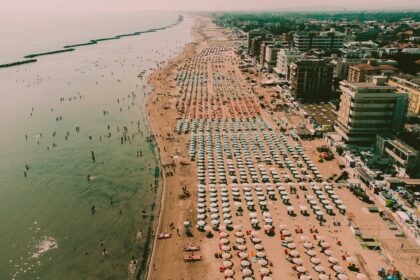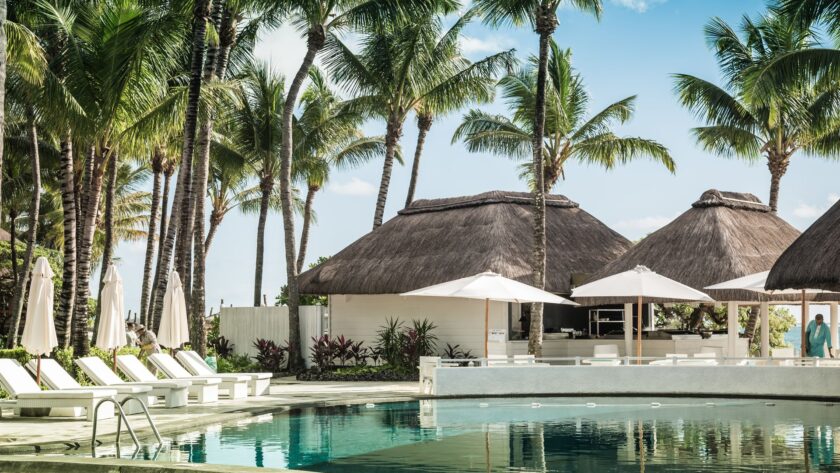
Being vegan at an all-inclusive resort sounds like it should be easy. There is food everywhere, all day, already paid for. Then you actually get there, and by day three you realise you have eaten the same plate of potatoes and grilled vegetables five times. We know the feeling, because that is exactly what happened to us on a week in Greece.
So what does an all-inclusive buffet really offer someone who does not eat animal products? Can you build a plate that fills you up and still tastes like a holiday? What should you email the hotel before you fly, and why do most people never bother? Where exactly is the butter hiding? And when should you stop fighting the buffet and go eat in town instead? We are going through all of it, honestly, without pretending resort food is something it is not.
This is not another list of vegan resorts you would have to rebook your whole holiday to use. This is a guide for the hotel you have already paid for. If you haven’t booked yet, the other route is a hotel with a fully vegan kitchen.
What a week of all-inclusive actually looked like for us
We stayed at Azure Resort & Spa in Tsilivi on Zakynthos, a five-star hotel with a buffet restaurant, an à la carte restaurant and several bars. We were there at the turn of May and June 2026. The hotel was clean, the staff were lovely and check-in was quick. The food was a different story.
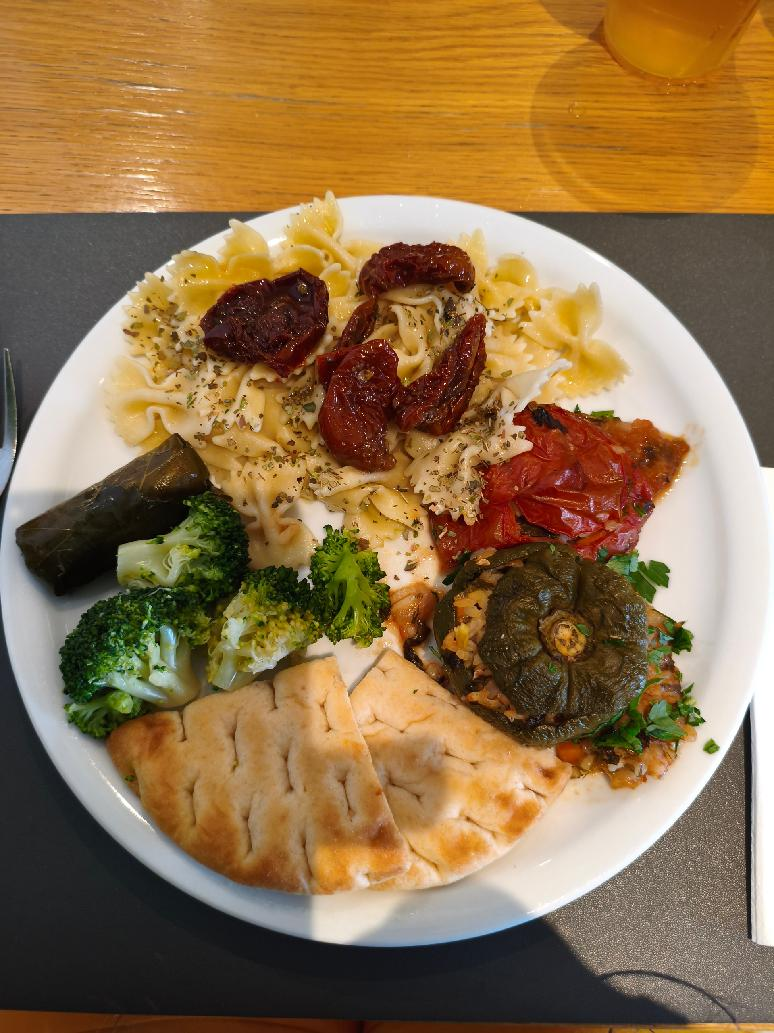
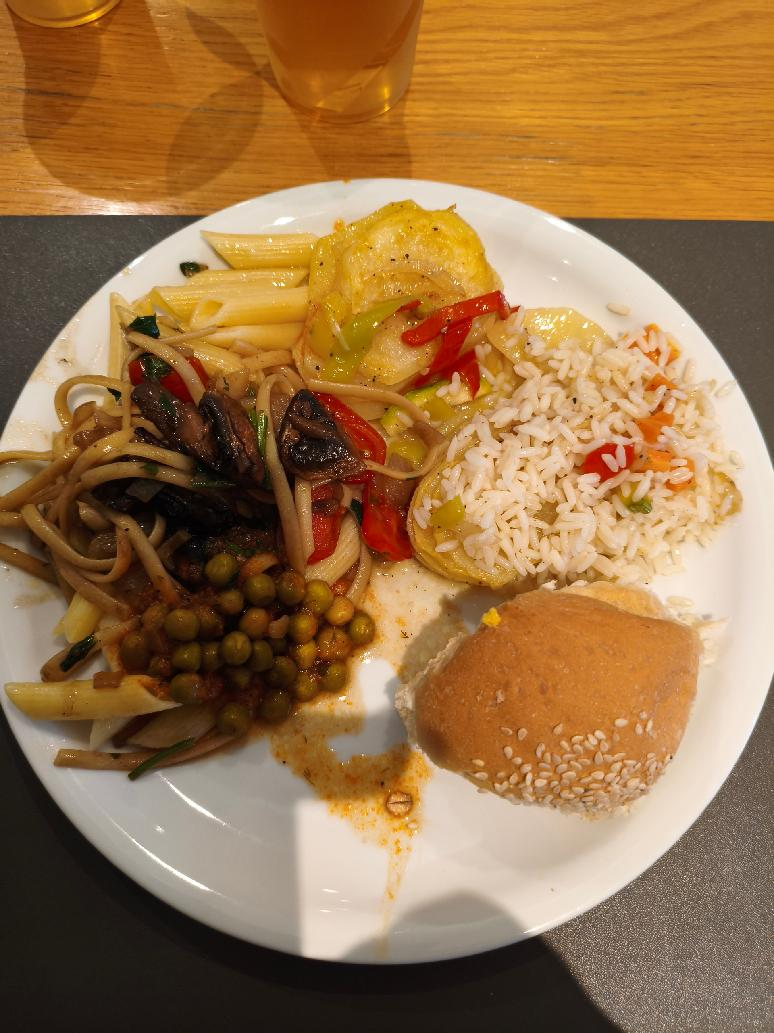
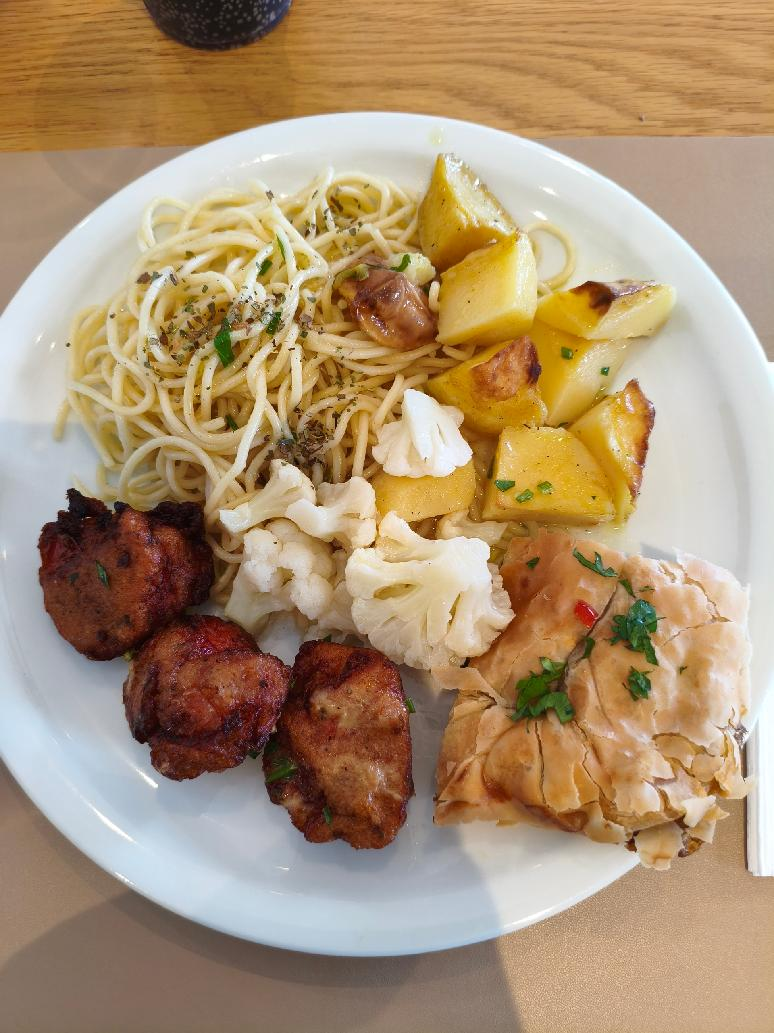
There was always something to eat at the buffet. That matters, and we want to be fair about it, because we were never hungry. But there were few vegan options, so we improvised and built a plate from whatever worked. Garlic mushrooms and potatoes turned up almost every single day, and by the end of the week we could have made them ourselves with our eyes closed. Around that there were salads, bread, olives, fruit, rice and stewed vegetables. You can eat perfectly well. You just will not remember it as the food highlight of your trip.
The desserts were the worst part. A long table of tempting sweets and not one of them vegan. We solved it our own way and went out for something sweet instead. If desserts are the reason you book all-inclusive in the first place, know now that this part of your holiday is going to happen outside the hotel.
The mistake we made: we never asked
Here is the part most articles about vegan holidays leave out, because it does not flatter the writer. In a full week, we never once asked the kitchen for vegan food. Not by email before we arrived, not at the table, not at the buffet. We took what was there and quietly sorted the rest out in town.
Looking back, that was a waste, because what other travellers report points the other way. Resort chefs cook off-menu all the time, since they spend every day handling allergies, gluten-free diets and religious restrictions for guests from all over the world. A vegan is not an exotic problem, just another note on the order. One vegan who asked the chefs directly at a Turkish all-inclusive describes being brought roasted vegetables in tomato sauce and lentil soup cooked especially for her, and soya milk at breakfast on request from the waiting staff. None of it was ever visible on the buffet.
The worst thing that happens is they say no. The best thing that happens is a hot meal cooked for you alone. That is a very good risk-to-reward ratio for a question you could ask on your first morning.
Email the hotel before you go
The most useful thing you will ever do for your holiday food happens weeks before you pack. Contact the hotel directly. Not the tour operator, not a note buried in the booking form, but the reception email address, where the reply comes from somebody who sees the kitchen every day.
Be specific and be plain. The word vegan means different things in different countries, and in plenty of places it is understood as “no meat” while cheese and butter quietly stay in. Spell out what you do not eat, which is meat, fish, dairy, eggs and honey, and ask whether the kitchen can prepare plant-based meals. Ask about plant milk at breakfast in the same message, because hotels often have it and simply do not put it out.
If you booked through a tour operator or a travel agent, send the dietary request there too, but do not treat it as done. Operators do pass requests on, yet the journey from booking system to hotel to kitchen is long and details fall out of it along the way. Treat the agent as your backup and the hotel as your main channel. Ask both and the odds of the kitchen knowing you exist before you land go up sharply.
What to actually ask them
- Can the kitchen prepare food without meat, fish, dairy, eggs and honey? The list works better than the label, which is interpreted differently everywhere.
- Is there plant milk at breakfast? Hotels frequently keep it at the coffee bar without ever putting it on the buffet. You just have to ask.
- Are the vegetables cooked in butter or in oil? The single most common hidden trap on any buffet.
- Are there vegan desserts, or at least fruit and sorbet? The weakest spot in every resort. Better to know in advance.
- Can meals be arranged off the buffet? This is the question that unlocks hot food cooked for you.
- Is there a plant-based option in the à la carte restaurant? The best food in the hotel is often hiding in there.
How to read a hotel buffet
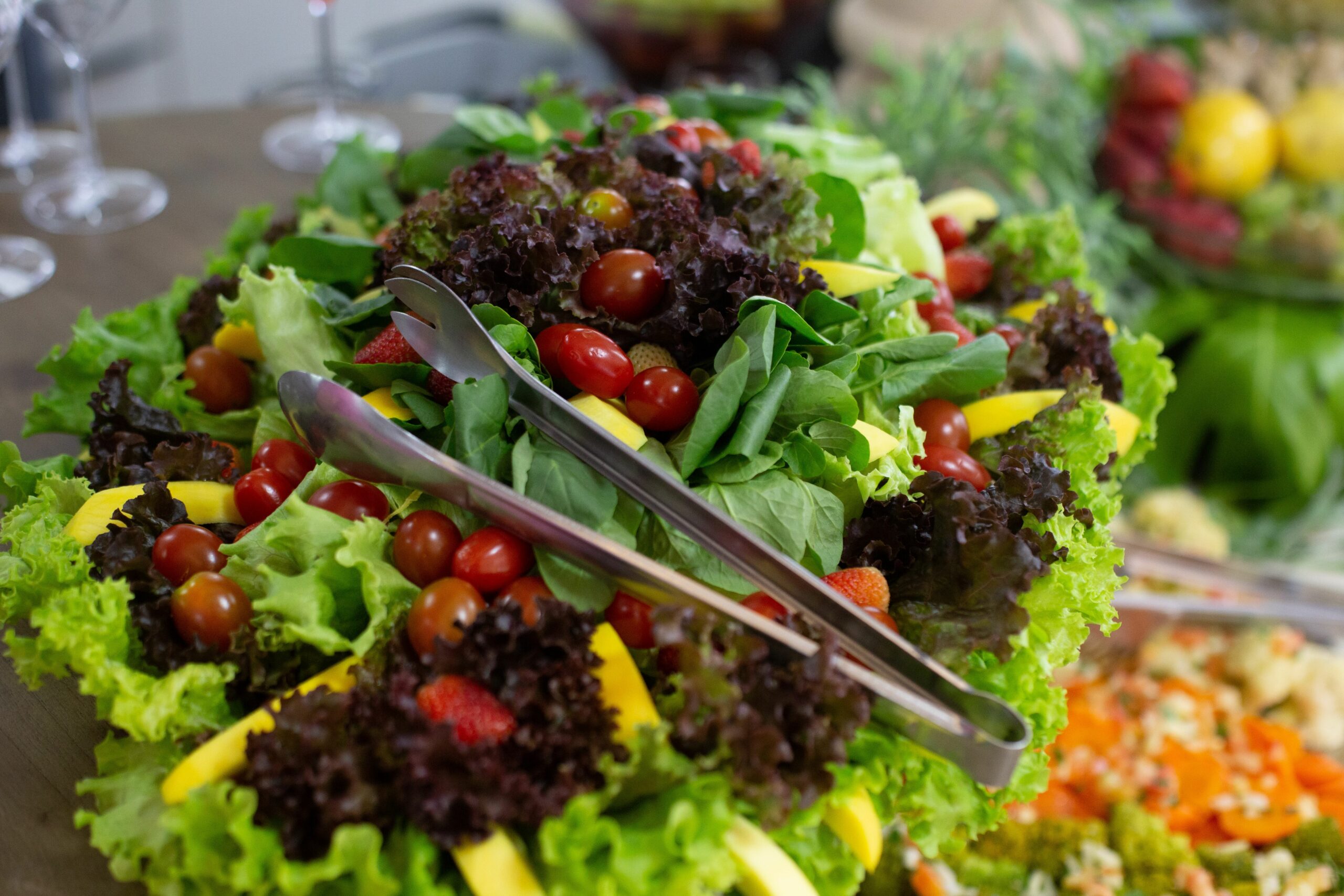
A buffet looks like endless choice, but it runs on one inconvenient principle. Most of the food that looks plant-based is not. Nobody is trying to catch you out, it is simply how hotel kitchens cook at volume. Butter makes vegetables glossy, cream makes soup velvety, and egg holds pastry together under a heat lamp.
Cooked vegetables are the biggest trap of all. Resort kitchens routinely finish them in butter even when the dish looks completely innocent on the tray. The vegan traveller in Turkey we mentioned found exactly this, and had to request a portion cooked in oil instead. The same applies to mashed potato, rice cooked in stock, and pastry brushed with egg.
The second trap is the little label. Buffet signs are not written by the person who cooked the food, and the translation is often somebody’s best guess. On that same Turkish stay, a dessert marked with vegan symbols turned out to contain milk, which only came to light when she asked the chef. Treat the label as a hint, not a guarantee, and when it matters, ask at the source.
| Buffet station | Reliably plant-based | Where it goes wrong |
|---|---|---|
| Salads | Vegetables, olives, pulses, oil and vinegar | Ready-made dressings (yoghurt, honey), cheese scattered on top |
| Bread | White bread, baguettes, pita, toast | Croissants and pastry (butter), anything glazed with egg |
| Hot vegetables | Grilled vegetables in oil, if the chef confirms it | Finished in butter, cream stirred into the sauce |
| Sides | Boiled potatoes, plain rice, couscous, undressed pasta | Rice and mash cooked in stock or butter |
| Soups | Vegetable, tomato, bean | Meat or chicken stock as the base, cream to finish |
| Fruit and nuts | Almost everything | Only honey, which hides in nut mixes and fruit salads |
| Desserts | Fruit, and sorbet (though even sorbet sometimes contains egg white or milk, so ask) | Effectively the whole station. Butter, milk, eggs, gelatine |
Breakfast, lunch and dinner: what actually works
Breakfast is your easiest meal
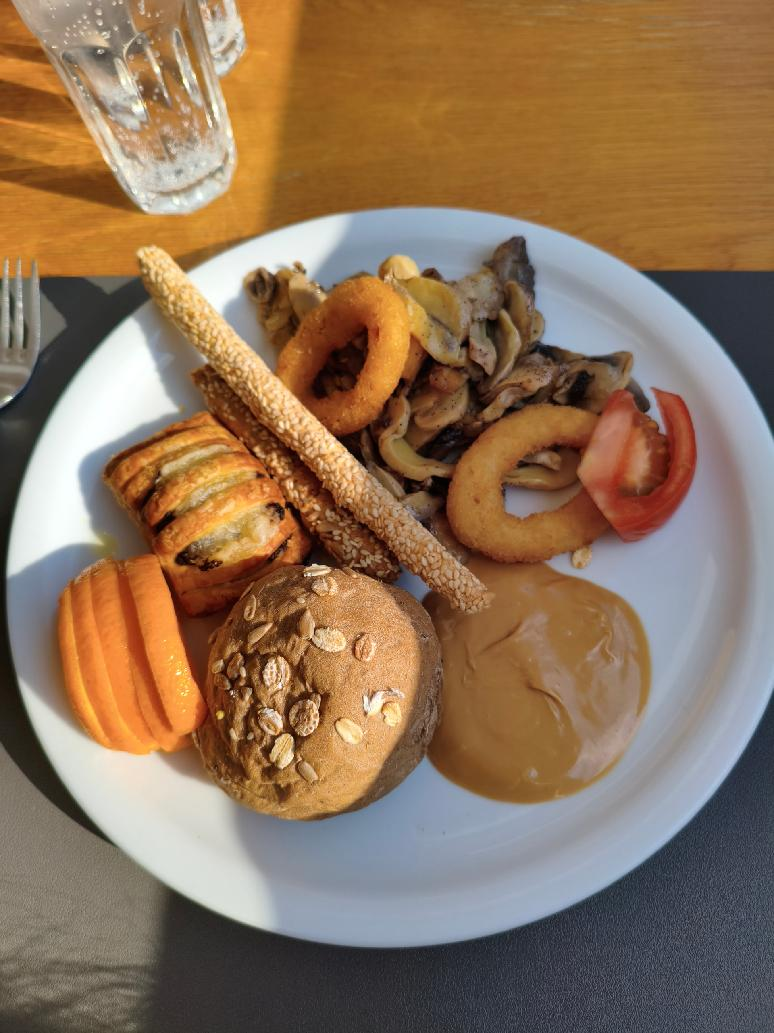
The morning buffet is surprisingly good news for a vegan. You will almost always find bread, tomatoes, cucumber, olives, hummus, jam, peanut butter, cereal, fruit and nuts. In Greece, add good olive oil to that list, and bread with tomato, oil and salt beats most breakfasts you make at home.
Plant milk is the one thing you may have to hunt for. Hotels often stock it for coffee and never bring it to the fridge display. Ask at the coffee machine or ask a server, because other travellers report that kitchens will bring it out on request even when it is nowhere on the buffet. If yours will not, buy a carton in the local supermarket and keep it in your room fridge.
Lunch is best kept light
Midday at a resort is hot, and the buffet leans towards salads, bread, fruit and cold dishes, which happens to suit a vegan perfectly. Build a big salad with pulses, add bread and hummus, olives and fruit. This meal never disappoints and it leaves you properly hungry for a dinner somewhere better.
Dinner is the hard one
The evening buffet is built on meat, fish and cheese. A vegan usually ends up with a side dish, some stewed vegetables and a salad, which is precisely the combination that becomes a rut by day three. We knew that rut intimately. It was called garlic mushrooms and potatoes.
There are only two ways out. Either you arrange something with the kitchen and get a meal cooked off the buffet, or you treat dinner as your reason to leave the hotel. Both beat a fifth plate of potatoes. We took the second option and we do not regret it, because the best food of the entire holiday was eaten outside the resort gates.
Desserts are the weakest link
No clever tactic fixes this one. Hotel pastry is built on butter, cream, eggs and gelatine, and a vegan version shows up rarely, though a few chains are starting to run properly labelled vegan sections. In a full week at Azure we did not find a single vegan dessert. Fruit and the occasional sorbet were all that was left.
The fix is simple and, honestly, quite lovely. Treat dessert as your excuse for an evening walk. In Tsilivi we found Démodé Bites (still listed on plenty of maps under its older name, Demode Sweets), where they make vegan loukoumades, the Greek fried dough balls, in a sweet version with chocolate and cherry sauce. The standard ones are drenched in honey, so ask for the vegan version specifically. They cost around 7.50 euros and we went back for them again and again. It was one of the best things we bought on the whole island, and the hotel was never going to give us anything like it.
When to stop fighting the buffet and eat out
This is the most important advice in this article, and the reason you will not read it elsewhere is that it does not sell resorts. All-inclusive is a safety net for a vegan, not the highlight of the trip. It will feed you, save you money and guarantee you never go hungry. But the best thing you eat in that country will almost certainly be outside the hotel.
On Zakynthos that was literally true. The best vegan pizza we have ever eaten, anywhere, came from Esme’s Beer Garden in Tsilivi, a few minutes’ walk from the hotel. No buffet is ever going to hand you that, however hard it tries.
Not every trip out of the gates works, mind you. Tsilivi also has Wine and Roses, a Greek and Mexican family restaurant that brings you a separate vegan menu if you ask, which sounded perfect, and it let us down. Around 48 euros for a burrito, tacos and two beers bought us small portions, frozen vegetables and plain rice. We mention it because a vegan menu is not a guarantee of good food, not even out in town.
In the Mediterranean the odds are with you, because the local cooking leans plant-based already. Greek gigantes beans, briám, fava, stuffed peppers without cheese, dolmades without meat, hummus, falafel, Italian pasta aglio e olio, pizza marinara. None of this is a vegan substitute for anything. It is what people there have always eaten, and a taverna will do it better and cheaper than you can assemble from a buffet tray.
Plan it deliberately. Pick two or three evenings when you skip the hotel dinner entirely and find places in advance. Eat at the buffet the rest of the week and you will not feel you are missing anything.
Where all-inclusive is easier, and where it is harder
Destinations are not equal, and the deciding factor is not how developed the country is. It is whether the local kitchen already cooks plants. Where the food tradition runs on pulses, vegetables and olive oil, a vegan finds a footing on the buffet almost immediately. Where it runs on meat and dairy, it is a struggle no matter how many stars the hotel has.
Greece is the only place we have done all-inclusive ourselves, so the rest of this table comes from what other travellers report and from what the local cooking is built on.
| Destination | How a vegan fares at the buffet |
|---|---|
| Greece | Good. Gigantes beans, fava, briám, stuffed peppers (ask about the cheese), olives and olive oil are all native to the cuisine. Desserts and repetitive hot dishes are the weak spot |
| Turkey | Very good. Meze, hummus, pulses and roasted vegetables are standard. Lentil soup is everywhere, but ask before you order, because it is often made with chicken stock and finished with chilli butter |
| Egypt | Good. Ful medames, koshari, tahini and falafel are plant-based at heart. Check the fat though, because samna (ghee) is common in Egyptian kitchens and ful often arrives with butter on top |
| Croatia | Weaker. The cooking leans on fish, meat and cheese. Blitva with potatoes, pasta and salads will carry you |
| Spain and the Canaries | Average. Plenty of fried vegetables and potatoes, but plant milk and alternatives are easy to buy locally |
On long-haul trips where there is almost nothing to eat outside the hotel, choosing the resort matters even more. We show how that works in practice in our guide to vegan Punta Cana. Cape Verde works the same way, and we compare Sal and Boa Vista in our guide to Cape Verde all inclusive for vegans.
Timing matters too. In peak season the hotel is full, the buffet is at its largest and your odds of finding a plant-based dish go up, but the kitchen is under pressure and has less time for individual requests. Out of season the spread is smaller, yet the chef has room to cook for you and the staff will remember your face. If you get to choose, May, June and September are the best compromise for a vegan. For winter sun the Canary Islands work too, and in our Tenerife write-up we name a resort where the buffet labels its vegan dishes. Fuerteventura is a similarly quiet winter option. If you prefer mountains to beaches, vegan Madeira is another mild winter escape. For a more exotic winter, Zanzibar’s buffets are smaller and heavy on fish, but local cooking is full of beans in coconut milk. Our article on vegan Zanzibar explains how to eat well there.
Travelling with non-vegans? This works for everyone
Most people do not go all-inclusive alone. You are there with a partner, with parents, with children, or with friends who eat meat and have no interest in negotiating your dinner. The good news is that the dishes that rescue your holiday are dishes everyone at the table enjoys. Nobody has to feel awkward and you do not have to explain yourself.
Hummus with warm pita, olives, grilled vegetables in olive oil, Greek gigantes beans in tomato sauce. These are not substitutes or compromises. They are food people in these countries have eaten forever, and they are the plates that empty first regardless of who at the table is vegan. When you go out in the evening, order a few of them for the middle of the table and let everyone dig in. It is the least preachy form of persuasion we know, because it works on flavour rather than argument.
What to pack so the buffet cannot catch you out
This is not about carrying a week of food in your suitcase. It is about having a few things that rescue a morning with no plant milk, or a late evening when the buffet has closed and you are hungry. All of it fits in a corner of your case and weighs almost nothing.
| What | Why you will be glad you did |
|---|---|
| Nuts and seeds | Turn a plate of salad leaves into a meal with actual protein in it |
| Protein bars | Late nights, day trips, whole days on the beach |
| Instant porridge | Saves breakfast when the hotel has nothing but bread |
| Dried fruit | Something sweet on the days the dessert table has nothing for you |
| Vitamin B12 supplement | Easy to forget on holiday, and B12 is the one nutrient a vegan has to get from a supplement or fortified foods |
| A dietary requirements card | Hand it to the chef and the language barrier stops being your problem |
Getting there without going hungry
The holiday starts at the airport, and that is where people go hungry for no reason at all. Most airlines offer a special vegan meal under the code VGML, the international designation for a meal free of all animal products. You order it in advance, usually at least 24 to 48 hours before departure, and some carriers want longer. On flights where a meal is already included in the fare, it costs nothing extra. You simply have to ask for it. How to order it, which airlines skip it on short flights and why you should never tick AVML is all in our guide to ordering a vegan airline meal.
On budget airlines that sell food on board, do not count on VGML at all and bring your own. Sandwiches, fruit, nuts and bars all pass security without trouble as long as you keep liquids within the limit. We have written up what travels well and what does not in our guide to vegan food for travelling.
Four things worth knowing before you go
Breakfast is the safest meal of the day. That sounds backwards, because most people picture a morning buffet built on eggs, cheese and bacon. But a vegan can live very well on bread, olive oil, tomatoes, fruit and cereal, and that is a certainty the evening buffet never offers.
Chefs treat vegan food as a challenge more than a nuisance. Resort kitchens handle allergies, gluten-free diets and religious restrictions every day, so exceptions are routine. Travellers who spoke up describe staff going out of their way and visibly enjoying it. Turn up with a smile and a question rather than a complaint.
A “vegan” label is not proof. There is a documented case of a dessert marked vegan that contained milk, discovered only when the guest asked the chef directly. Labels are not written by the kitchen, and translations wander. Check at the source.
There is butter on the vegetables far more often than you would guess. Grilled and stewed vegetables get finished in butter because it makes them glossy and stops them drying out under the lamp. It is the most common hidden trap on the buffet, and also the one a single question solves.
Saying you are vegan when you do not speak the language
Staff almost everywhere recognise the word vegan, but they do not all define it the same way. In many countries it is understood as food without meat, with cheese and butter quietly exempt. So it pays to be able to list what you do not eat, and to have a few phrases ready in the local language. The table below covers three of the most popular all-inclusive destinations.
| What you want to say | Greek | Turkish | Croatian |
|---|---|---|---|
| I am vegan | Είμαι βίγκαν (íme vígan) | Ben veganım | Ja sam vegan (a woman says: Ja sam veganka) |
| No meat or fish | Χωρίς κρέας και ψάρι (chorís kréas ke psári) | Etsiz ve balıksız | Bez mesa i ribe |
| No milk, cheese or eggs | Χωρίς γάλα, τυρί και αυγά (chorís gála, tirí ke avgá) | Sütsüz, peynirsiz ve yumurtasız | Bez mlijeka, sira i jaja |
| Without butter, please | Χωρίς βούτυρο, παρακαλώ (chorís vútiro, parakaló) | Tereyağsız, lütfen | Bez maslaca, molim |
| Does this have butter in it? | Έχει βούτυρο; (échi vútiro?) | İçinde tereyağı var mı? | Ima li maslaca? |
Croatia also has one magic word, posno. It means fasting food, free of meat, dairy and eggs, and staff understand it instantly, bakeries included. One catch, posno can still include fish, so say bez ribe as well.
So is all-inclusive worth it for a vegan?
It is, as long as your expectations are the right ones. If you are travelling with family, or with a partner who wants all-inclusive, or you mainly want a pool and the certainty that food is always available, it works perfectly well. You will not go hungry and you will save yourself a hundred small decisions. For the rest of the trip, from airports to apps, see our advice on travelling vegan when your partner isn’t.
But if food is the reason you travel, book half board or breakfast only and spend the difference in local restaurants. In Greece, Italy, Croatia and Turkey, the money you save on full board buys food far more interesting than anything a hotel will put on your plate. Our own verdict is not complicated. The buffet fed us. The tavernas are what we remember. On Corfu, for example, a hotel near Kerkyra puts several vegan restaurants in Corfu Town within easy reach.
All-inclusive will not let you down as a vegan, as long as you do not ask more of it than it can give. It feeds you, it removes the hassle and it leaves your energy for the things that matter, which are the sea, the rest, and a dinner out that finishes with a bag of warm loukoumades. Ask the kitchen on your first day, because we did not, and we still wish we had.
Frequently asked questions
Can you eat vegan at an all-inclusive resort?
Yes, you will not go hungry. Every buffet has salads, bread, fruit, pulses, rice, potatoes and cooked vegetables. The problem is not quantity but variety, because the vegan options repeat quickly. Expect to build your own plate, and save the best meals for restaurants outside the hotel.
Should I tell the hotel I am vegan before I arrive?
Yes, and email the hotel directly rather than relying on your tour operator alone. Spell out what you do not eat (meat, fish, dairy, eggs, honey), because the word vegan is interpreted differently around the world. Ask about plant milk and about meals off the buffet at the same time. Resort kitchens deal with dietary requirements daily and will often make you something extra.
Are the vegetables at a hotel buffet vegan?
Not always. Grilled and stewed vegetables are often finished in butter so they stay glossy and do not dry out. Rice and mashed potato may also be cooked in butter or stock. Ask the chef directly and request a portion cooked in oil, which most kitchens are happy to do.
What if there are no vegan desserts at the hotel?
This is the most common gap in all-inclusive and there is no real way around it, because hotel pastry runs on butter, cream, eggs and gelatine. Stick to fruit and sorbet at the hotel (asking first, as sorbet occasionally contains egg white or milk) and go into town for something sweet, where plant-based ice cream is increasingly easy to find. Packing dried fruit or a few bars helps too.
How do I order a vegan meal on a flight?
Use the code VGML, the international designation for a vegan meal free of all animal products. Request it in your booking in advance, with most airlines requiring at least 24 to 48 hours before departure. On budget airlines that sell food on board, do not rely on it and bring your own supplies.
Is half board better than all-inclusive for vegans?
If food is a big part of why you travel, yes. Breakfast is the meal a buffet does best for a vegan and dinner is the one it does worst. Half board or breakfast only leaves you both the appetite and the money for local restaurants, where plant-based cooking is usually far more interesting than the hotel’s.
Have you been all-inclusive as a vegan? Tell us in the comments whether the hotel looked after you or whether you ate potatoes for a week. We would love to know how it compares in other countries.
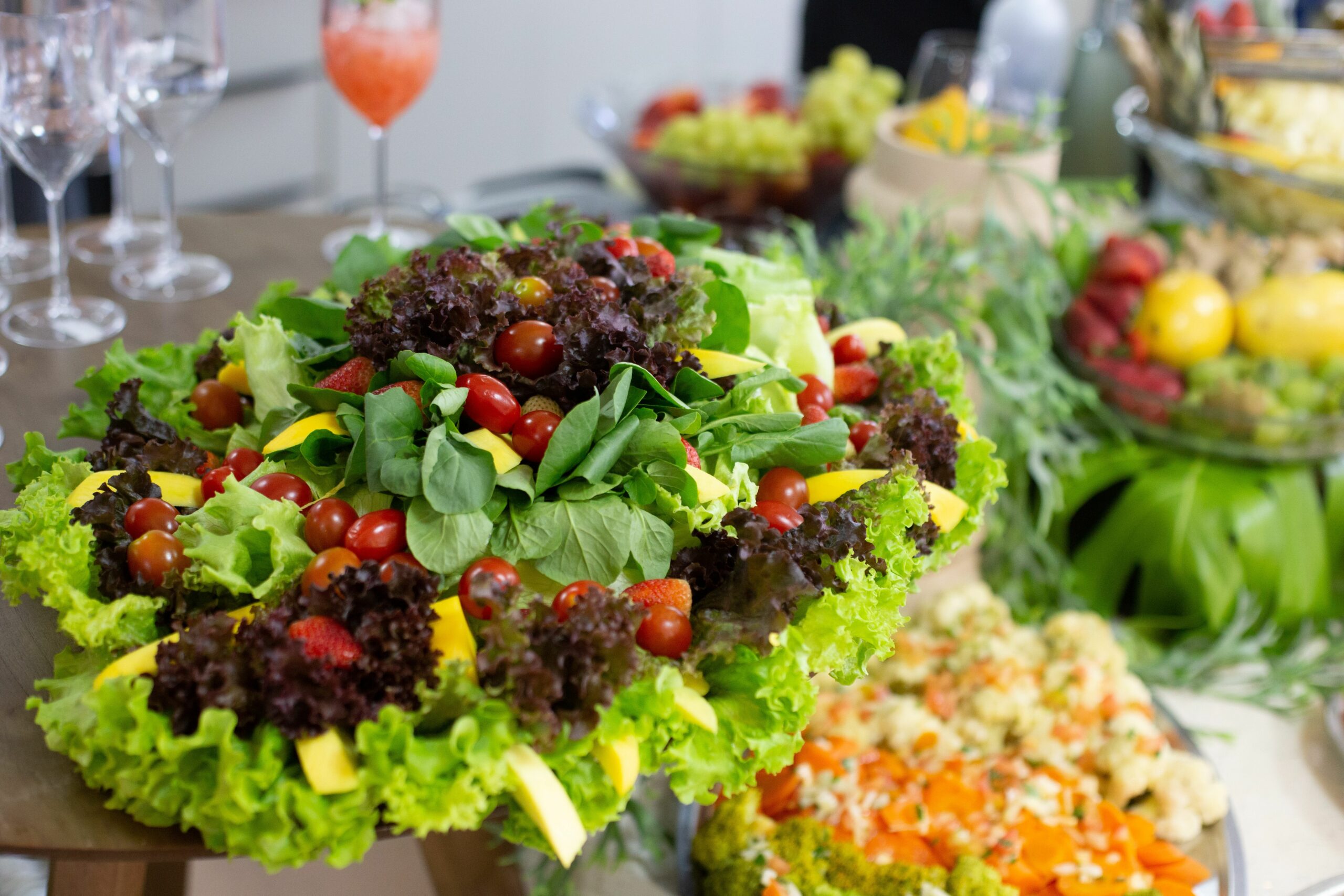
Featured photo: Lelani Badenhorst, Pexels.
Newsletter
Get our free e-books
Join the newsletter and download Our Vegan Christmas Kitchen straight away, 10 recipes for Czech cookies, gingerbread and vánočka. Then once a month, new places from the vegan map and new articles. Unsubscribe with one click.