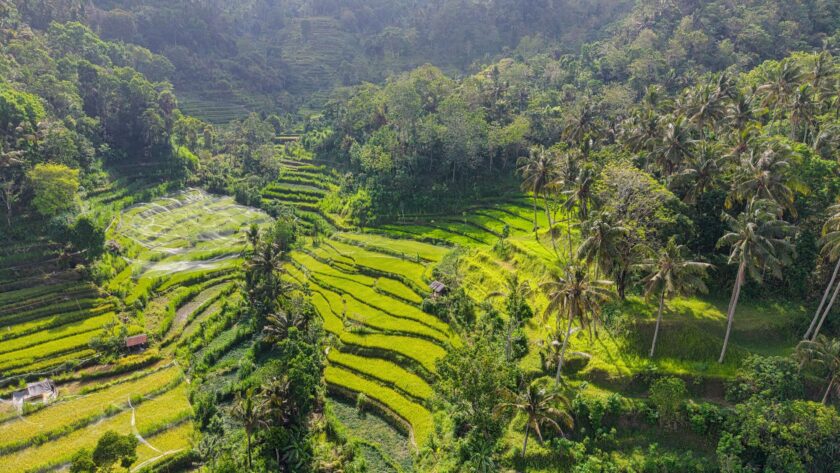
The best time to visit Bali is a question with two answers, and most guides only give you one. There is the weather answer (dry season, sunshine, fewer crowds). Then there is the food answer, which matters a lot more if you don’t eat meat, fish, eggs or dairy, or travel with someone who doesn’t. Japan gets the same two-part treatment in our article on when to visit Japan as a vegan.
Bali is one of the easiest places in the world to eat plant-based. Ubud has whole streets of vegan cafés, and tempeh, the fermented soybean cake you might know from the supermarket chiller, comes from Indonesia. But there is also a little spoon of shrimp paste waiting in sauces you would never suspect.
So when should you go to avoid the rain and the crowds? Is Bali expensive once you add the visa and the tourist levy? Ubud or Canggu?
What can you safely order at a local warung where nobody has heard the word “vegan”, and which dishes hide shrimp paste? And what about all-inclusive resorts in Nusa Dua? You’ll find every answer below, with prices in rupiah and a rough conversion into euros and pounds.
We haven’t made it to Bali together yet, so this is a carefully researched article, not a trip diary. In October 2026 we read every restaurant’s own website and menu. We checked the visa rules against official government pages and took the date of Nyepi from the official Indonesian holiday calendar. Places whose vegan menu we couldn’t confirm from their own pages are not in here, even if other sites still recommend them.
Best time to visit Bali, month by month
The best time to visit Bali is May, June and September. These months fall in the dry season, the sun is out, and the summer-holiday crowds have either not arrived yet or already gone home. The dry season runs roughly from April or May to October, the wet season from November to March or April. Sources disagree on the exact edges by about a month, because the weather shifts from year to year.
Bali is warm all year. According to Virgin Australia, average temperatures sit between 20 and 32 °C, and the coast usually hovers around 30 °C. Up in the hills around Ubud, and especially on Mount Batur, evenings are noticeably cooler, so pack a light jumper even in August.
| Month | Weather | Crowds and prices | Worth knowing |
|---|---|---|---|
| January to March | wet season, short heavy showers mostly in the afternoon | cheapest from mid-January to March | Nyepi in March, the whole island stops for 24 hours |
| April | transition, less rain | medium | prices climb after Easter |
| May and June | dry and sunny | still reasonable | ideal for Ubud and the beaches |
| July and August | dry | peak season, highest room rates | book popular Canggu cafés ahead |
| September | dry | crowds leave | one of the best months |
| October | end of the dry season | medium | first rains late in the month |
| November and December | wet season | very expensive around Christmas | book Christmas and New Year early |
Nyepi, the day the whole island goes silent
Nyepi is the Balinese New Year, and in 2027 it falls on Monday 8 March, according to the official list of Indonesian public holidays. In Bali it is the Day of Silence. For 24 hours, from 6am to 6am, nobody goes out, lights stay off, cars stop and even the international airport closes.
Restaurants are shut and tourists stay in their hotels. You can move freely inside your hotel, but nobody is allowed onto the beach or the street.
For a vegan, the practical side is simple. Buy food the day before, or stay somewhere that cooks for guests. The evening before Nyepi brings processions of giant ogoh-ogoh figures, which are later burned, and that is one of the most memorable nights of the Balinese year.
Nyepi tip: If your flight lands or leaves between 7 and 9 March 2027, double-check the times. During the 24 hours of Nyepi, Denpasar airport handles no arrivals or departures, so one day can shift your whole plan.
The best time to visit Bali on a budget
The best time to visit Bali on a budget is mid-January to March, once the New Year crowds have gone. It is the wet season, but rain in Bali rarely lasts all day. A typical pattern is one heavy shower in the afternoon or at night, with clear mornings. Ubud is at its greenest and quietest.
The downside is for day trips that depend on the sea or the sky. Boats to Nusa Penida, sunrise hikes up Mount Batur and dives are sometimes cancelled.
Bali on our vegan map
12 places, 7 fully vegan. Tap a pin to see the details.
Loading the map…
- 100% vegan
- Vegetarian
- Vegan options
See every place from this article on our vegan map.
Is Bali expensive?
Bali is not expensive once you’ve landed. The flight is the big cost, while daily life is often cheaper than around the Mediterranean. A meal at a vegan café in Ubud costs about €4 to €6, and lunch at a warung or a vegan buffet costs even less. In October 2026 one euro was worth about 20,000 rupiah (one pound about 24,000), according to the Czech National Bank, so menu prices look scary but aren’t.
| Item | Price in rupiah | Roughly in euros |
|---|---|---|
| Visa on Arrival (VoA or e-VoA) | 500,000 IDR | about €25 |
| Bali tourist levy (Love Bali) | 150,000 IDR | about €7.50 |
| Vegan buffet at Sawobali, Ubud | about 75,000 IDR | about €3.70 |
| Zesty Chickpea Omelet at Zest Ubud | 88,000 IDR | about €4.40 |
| Margherita pizza with vegan mozzarella at Alchemy | 105,000 IDR | about €5.20 |
| Peaceful Benedict at I Am Vegan Babe (plus 16% tax and service) | 98,000 IDR | about €5.60 with tax |
We took the restaurant prices from each place’s own menu in October 2026. The conversion uses the Czech National Bank rate of 23 October 2026 and will be different by the time you travel.
Is Bali cheap for a vegan?
Bali is cheap for a vegan, because tofu, tempeh, rice and vegetables are among the cheapest ingredients on the island. Plan on roughly €35 to €50 a day per person for a guesthouse, food and a scooter or driver, if you split your meals between warungs and vegan cafés. With a villa and dinners at nicer restaurants, it is closer to €80 to €125 a day.
Menu tip: Tourist menus in Bali often carry a small line at the bottom saying “+ tax & service”. I Am Vegan Babe in Canggu, for example, says it adds 16% to its prices, so read the small print before you add up the bill.
How to get to Bali, and what to sort out before you fly
There are no direct flights to Bali from the UK or the EU, so you always change planes. From London, a one-stop flight takes roughly 17 to 19 hours in total, usually via the Gulf or Southeast Asia. From Prague, the usual routes go through the Gulf (Abu Dhabi, Doha, Dubai), Istanbul or Asian hubs such as Singapore, Kuala Lumpur and Taipei, and take about 15 to 20 hours. Turkish Airlines flies nonstop from Istanbul to Denpasar in about 12 hours and 40 minutes.
You land at Ngurah Rai International Airport in Denpasar, in the south of the island. From there, a taxi or a Grab ride takes one to two hours to Canggu or Ubud, depending on traffic.
Do you need a visa for Bali?
Yes, most visitors need a visa for Bali, but it is easy to get. Citizens of dozens of countries, including the UK, the US and EU countries, qualify for a Visa on Arrival. You can buy it at the airport or apply in advance for an e-VoA on the official Indonesian immigration portal. According to the Czech Foreign Ministry, it costs 500,000 IDR and is valid for 30 days, and you can extend it once by another 30 days. Check your own nationality on the immigration portal before you book.
Your passport must be valid for at least six months from the day you arrive and have at least two blank pages. You also need a return or onward ticket to show at immigration. With less than six months left on your passport, immigration has the right to refuse you entry, so check it before you buy flights.
The Bali tourist levy and the All Indonesia form
Since 14 February 2024, every foreign visitor to Bali pays a tourist levy of 150,000 IDR. The easiest way is to pay before you travel on the official Love Bali website or app, and the voucher arrives by email. Since 1 October 2025, every traveller arriving in Indonesia by air must also fill in the electronic All Indonesia arrival form. You can complete it at most three days before you land, and you show the QR code it generates at the airport.
Airport tip: Sort out the Love Bali levy, the e-VoA and the All Indonesia form at home. After fourteen hours in the air you’ll be glad to show three QR codes and walk straight out.
Is Bali vegan friendly?
Yes, Bali is one of the easiest places in the world for a vegan holiday, especially in Ubud, Canggu and the areas around them. Those two areas have dozens of fully vegan cafés and restaurants, and even in ordinary places the staff understand the word vegan. Outside the tourist centres the choice is smaller, and you’ll get by on tofu, tempeh, rice and vegetables from local warungs, as long as you know what to ask.
Hindu doesn’t mean vegetarian
Meat is very much on the menu in Bali, even though most people are Hindu. Only beef is rarely eaten.
Balinese cooking is built on pork, chicken and seafood. The island’s most famous dish, babi guling, is roast suckling pig, and lawar is a mix of coconut, spices and vegetables with meat and often raw blood. If someone tells you the Balinese are vegetarian, they are mixing them up with Hindu communities in India.
Three traps on the plate (terasi, eggs and krupuk)
The biggest trap for a vegan in Bali is called terasi. It is a fermented shrimp paste that goes into sambal and into the peanut sauce for gado gado. The second trap is egg, which goes into almost everything, from fried rice to noodles and salads. The third is krupuk, crunchy crackers that look like crisps but are often made from prawns (krupuk udang).
You don’t need to worry about finding vegan food in Bali. What you need to worry about is the little spoon of shrimp paste hiding in a sauce you’d never suspect.
So at an ordinary warung, always say you don’t want meat, fish, egg or terasi. You’ll find the phrases in the table below. At the fully vegan places later in this article, none of this is your problem.
Tempeh, Indonesia’s gift on every street corner
Tempeh is fermented soybeans pressed into a firm cake, and according to historical evidence it was first made in Bayat, near Klaten in Central Java, and eaten around 1700. In Bali it is cheap and everywhere.
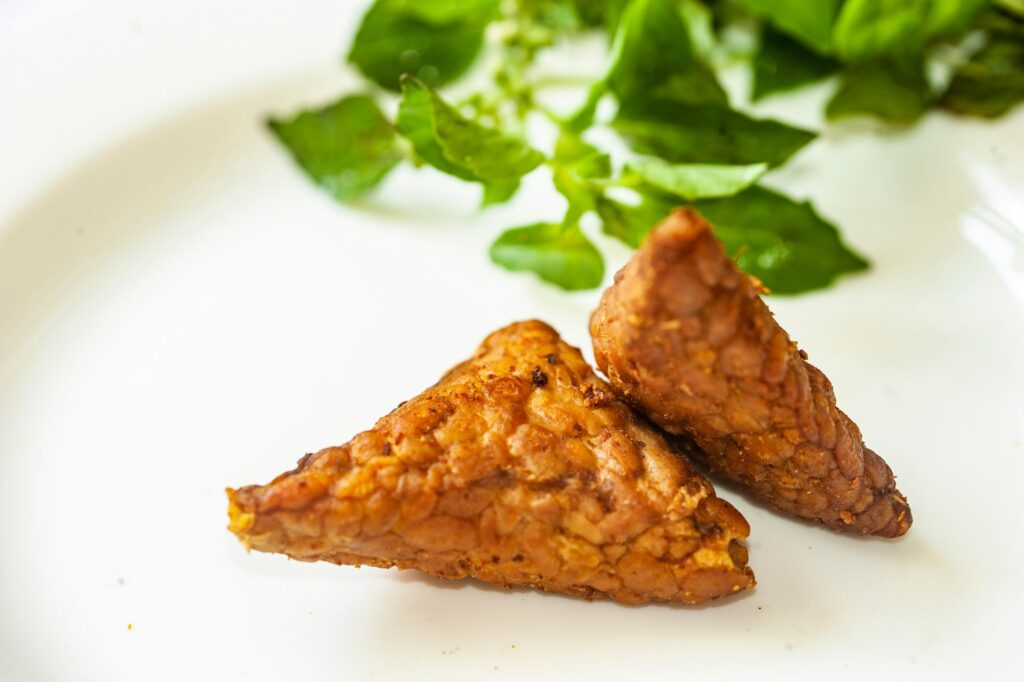
Tempe goreng (fried tempeh) and tahu goreng (fried tofu) are on every warung counter and are almost always free of animal products, so just ask about the sauce. If tempeh has never won you over at home, try it fresh in Bali. Back home, you can make our rice noodles with broccoli and tempeh.
What to eat in Bali: Indonesian dishes that are vegan or easy to adapt
Indonesian cooking has plenty of dishes that are vegan from the start, or need just one thing left out. The safest choice is anything with tempeh or tofu, rice and vegetables. With fried rice and noodles, always ask about the egg, and with salads in sauce, ask about terasi.
Dishes to order at a warung
- Gado gado is a vegetable salad with tofu, tempeh and lontong rice cakes in peanut sauce. Order it without egg and without krupuk, and ask whether the sauce contains terasi.
- Tempe goreng and tahu goreng are fried tempeh and tofu, the perfect side for anything.
- Nasi campur is a plate of rice with several small portions. At vegan buffets such as Sawobali in Ubud it is fully plant-based, and at an ordinary warung you simply point at what you want.
- Nasi goreng and mie goreng are fried rice and fried noodles. They often come with a fried egg on top and chicken or prawns, so order them with tofu or tempeh and no egg.
- Fruit from rambutan to mangosteen and dragon fruit costs pennies at any market, and a young coconut (kelapa muda) gets cracked open for you on the street.
Good news for non-vegans travelling with you. Gado gado with tempeh and a proper peanut sauce is a crowd-pleaser, and nobody eating it feels they are missing out. The same goes for the vegan burgers and pizzas in Ubud, which come in enormous portions.
Useful phrases in Indonesian
People in Bali speak Balinese, but everybody understands Indonesian (bahasa Indonesia), and it is enough in restaurants. English works in tourist areas, and these phrases help in village warungs.
| English | Indonesian | Say it roughly like |
|---|---|---|
| I’m vegan. | Saya vegan. | sa-ya vegan |
| No meat, please. | Tanpa daging, ya. | tan-pa da-ging, ya |
| No fish or prawns. | Tanpa ikan dan udang. | tan-pa ee-kan dan oo-dang |
| No egg. | Tanpa telur. | tan-pa te-loor |
| No shrimp paste. | Tanpa terasi. | tan-pa te-ra-see |
| No milk. | Tanpa susu. | tan-pa soo-soo |
| Is there meat in it? | Ada daging? | a-da da-ging |
| Thank you. | Terima kasih. | te-ree-ma ka-see |
Phrase tip: The most useful words are “tanpa terasi”. You’ll see meat and egg on the plate, but not shrimp paste in the sambal. Save the table on your phone and just show it at the warung.
Ubud or Canggu? Where to stay in Bali as a vegan
The best base for a vegan is Ubud, because it has the highest concentration of fully vegan places on the island. Canggu comes second, and it is the better pick if you want a beach and surf. Many people split their Bali holiday between the two, since the drive takes about an hour and Ubud has no beach.
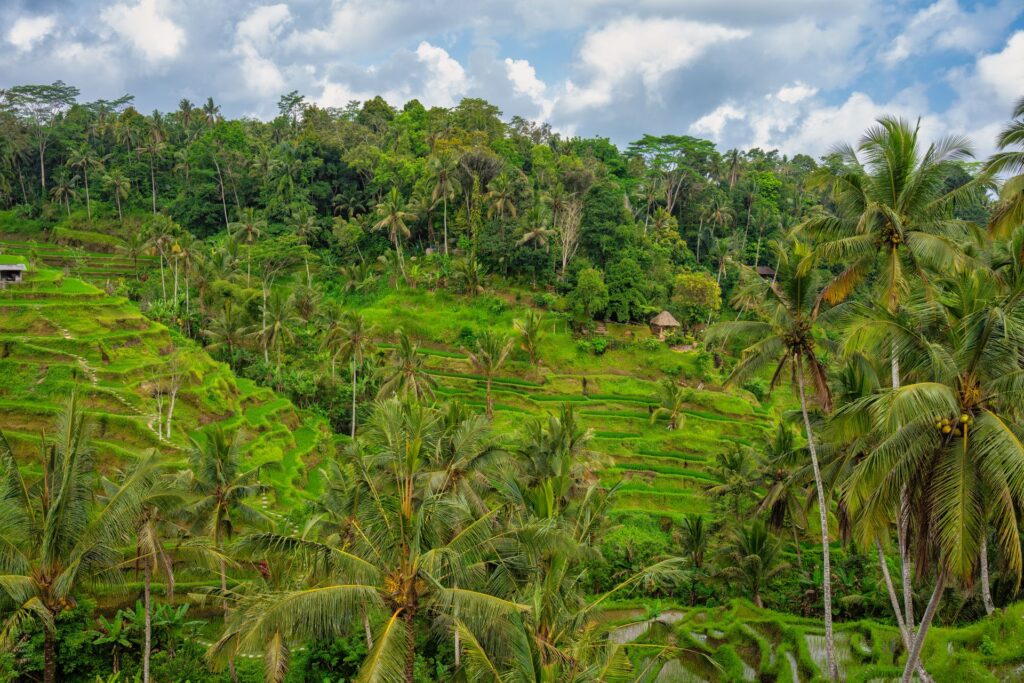
Ubud for rice fields, yoga and vegan cafés
Ubud sits inland among rice fields and jungle and is Bali’s spiritual and cultural centre. Around the Penestanan neighbourhood and Jalan Raya Penestanan Kelod there are so many plant-based cafés that you could eat somewhere new every day. Ubud suits a calmer holiday with yoga, trips to the rice terraces and evenings without nightclubs. Places to stay range from simple family guesthouses to villas with a pool above the valley. For a fully vegan stay, Harmony Hill has two private villas in a Balinese village about 30 minutes from Ubud, with a chef who cooks only plant-based food. They are on our list of 25 fully vegan hotels around the world.
Canggu for beach, surf and long brunches
Canggu, on the southwest coast, is a beach and surf town where breakfast is long and good. Around Jalan Tanah Barak and Jalan Pantai Batu Bolong you’ll find vegan and vegetarian cafés side by side. It is busier than Ubud, with more traffic and more nightlife. Canggu is one of the pricier parts of the island, so expect to pay more for accommodation than in Ubud.
The south (Uluwatu, Sanur and Nusa Dua)
Uluwatu, on the Bukit Peninsula, is all cliffs, surf and sunsets, while Sanur on the southeast coast is quieter. Nusa Dua is the area of large resorts, and most all-inclusive packages go there, to Sanur or to the east coast. For a vegan, the south is the hardest part of Bali, because fully vegan places are few, although we list a couple of exceptions below.
Where to eat vegan in Bali: places we checked
We checked every place on this list against its own website or menu in October 2026. For each one we say whether it is fully vegan or vegetarian with vegan dishes.

Vegan restaurants in Ubud
Zest Ubud at Jalan Raya Penestanan Kelod 8 is a fully vegan café and restaurant surrounded by greenery, open daily from 8am to 10pm. According to its own menu everything is vegan, and most dishes come in a gluten-free version. For breakfast, have the Zesty Chickpea Omelet for 88,000 IDR, and for dinner the coconut “calamari”.
Alchemy at Jalan Penestanan Kelod 75 is a plant-based restaurant with raw and cooked food, smoothie bowls, carrot cake and pizza with homemade vegan mozzarella. It is open daily from 7:30am to 9:30pm. Note that a few drinks on the menu (such as the Tangy Turmeric Tonic) contain honey, so if you avoid honey, read the descriptions.
Moksa in Sayan, just outside central Ubud, cooks from its own permaculture garden. It is open daily from 9am to 9pm, with last orders at 8:30pm. Order the Moksa Sampler for 95,000 IDR, a tasting plate of five dishes from mini lasagne to a gado gado roll. The menu offers the muesli with honey or coconut syrup and lists a “grilled halloumi” salad, so ask the staff whether the halloumi is plant-based.
Wild Vegan at Jalan Sugriwa 16 in central Ubud is a fully vegan restaurant. It cooks with whole foods and herbs inspired by Balinese jamu tradition and puts no white sugar in its desserts. It is a good choice if you are staying in the centre and don’t want to travel out to Penestanan.
Sayuri Healing Food at Jalan Sukma Kesuma 2 is a vegan café and a culinary school in one. It is open daily from 8am to 11pm and describes its raw desserts as arguably the best in town. If you’d like to take a vegan cooking class in Bali, the courses are listed on its website.
Sawobali at Jalan Sukma Kesuma 19 in Peliatan is one of the cheapest vegan meals in Ubud. It is a fully vegan buffet of local dishes with tempeh, noodles, beans and vegetables, where visitors report paying about 75,000 IDR upfront and eating for about an hour. It has no website of its own, so check the opening hours on a map app, and bring cash.
Vegan places in Canggu
I Am Vegan Babe at Jalan Tanah Barak 49 is a fully vegan restaurant, open daily from 7am to 10pm since 2018. It serves hearty comfort food, pancakes, plant-based “eggs”, burgers and cakes. The Peaceful Benedict costs 98,000 IDR, and 16% tax and service is added to the bill.
Alchemy Canggu at Jalan Tanah Barak 1a is the Canggu branch of the Ubud original, with the same 7:30am to 9:30pm hours. It is handy when you want a salad, a smoothie bowl or a slice of cake in Canggu.
The Shady Shack at Jalan Tanah Barak 57 is a vegetarian café, open since 2016, daily from 8am to 10pm. It isn’t fully vegan, but its own website says it focuses on vegan and vegetarian wholefoods and has vegan desserts. It is a good pick when you are with a group where not everybody is vegan.
Oma Jamu Vegan in Canggu is a popular vegan warung with a buffet of Indonesian dishes, vegetables, tofu, tempeh and porridge for breakfast. It has no website of its own, so check prices and opening hours when you get there.
Sanur and Uluwatu
KooD (Kolaborasi Untuk Desa) in Sanur is, according to its own website, a 100% plant-based self-service canteen. It doesn’t fry its food, uses no white sugar and is open daily from 7am to 9pm, until 9:30pm at weekends. For anyone staying in Sanur or Nusa Dua, it is the nearest sure thing.
Alchemy Uluwatu at Jalan Pantai Bingin 8 is Alchemy’s third branch, right in the Bingin surf area, open daily from 7:30am to 10pm.
| Place | Area | Status | What to order |
|---|---|---|---|
| Zest Ubud | Ubud, Penestanan | fully vegan | Zesty Chickpea Omelet |
| Alchemy | Ubud, Canggu, Uluwatu | plant-based, a few drinks with honey | pizza with vegan mozzarella, carrot cake |
| Moksa | Ubud, Sayan | plant-based, ask about honey and halloumi | Moksa Sampler |
| Wild Vegan | Ubud, centre | fully vegan | desserts with no white sugar |
| Sayuri Healing Food | Ubud | vegan café and school | raw desserts |
| Sawobali | Ubud, Peliatan | fully vegan buffet | nasi campur from the buffet |
| I Am Vegan Babe | Canggu | fully vegan | Peaceful Benedict |
| The Shady Shack | Canggu | vegetarian with vegan dishes | vegan desserts |
| Oma Jamu Vegan | Canggu | vegan warung | Indonesian buffet |
| KooD | Sanur | fully plant-based | self-service menu, nothing fried |
All-inclusive in Bali: does it work for vegans?
All-inclusive in Bali works for vegans only if you arrange it before you book. Resort buffets in Nusa Dua and Sanur are built around fish, chicken and eggs. Email the hotel first and ask whether it can cook vegan meals every day, and keep the reply. Large resorts usually have vegetarian food, but vegetarian isn’t vegan, so ask directly about milk, eggs and terasi. The same advice applies to planning a vegan trip to the Maldives, where one resort kitchen feeds you all week.
We explain how to choose a hotel and what to write in our article on how to eat vegan at an all-inclusive resort. Bali has one big advantage here. You don’t have to rely on the hotel buffet every day, because Grab or Gojek will deliver vegan food from a restaurant to your reception. Half board with dinners out often makes more sense than full all-inclusive.
What to do in Bali (when you’re not eating)
What to do in Bali comes down to rice terraces, temples and the cliffs of the south. The best-known sights are far apart, so plan one area per day.
Ubud and around
In Ubud, walk through the Tegallalang rice terraces, along the Campuhan Ridge Walk and into the Monkey Forest, a sacred forest with temples and macaques. The monkeys steal glasses, phones and food, so zip up your bag and leave snacks at the hotel. Not far from Ubud is the water temple of Tirta Empul, where Balinese people bathe ritually in the springs.
The south and west
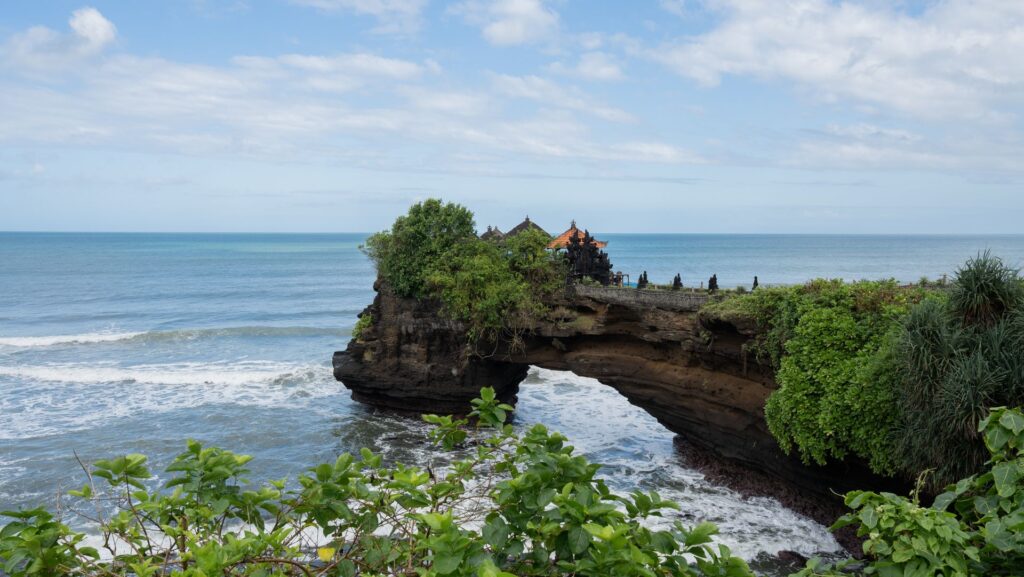
In the south, head to Uluwatu temple on the cliff above the ocean, ideally for sunset. On the west coast, not far from Canggu, Tanah Lot temple stands on a rock in the sea. For a full day trip, take a fast boat from Sanur to Nusa Penida, and for sunrise, climb Mount Batur.
Read next: Is Thailand vegan friendly?
Thinking about Thailand instead of Bali, or combining both in one trip? Read how to eat vegan in Thailand, including the word jay and why you should always ask about fish sauce.
Local customs and practical tips for vegans
The most important local custom is about offerings. On pavements, in shops and on car dashboards you’ll see small palm-leaf baskets with flowers, rice and an incense stick, called canang sari. Don’t step on them, walk around them. Cover your shoulders and knees in temples, and you can usually borrow a sarong at the entrance.
What is Bali belly, and how to avoid it
Bali belly is the nickname for the stomach upsets that catch out many visitors to Bali. Drink only bottled or filtered water, including for brushing your teeth, and be careful with ice in drinks at small stalls. A vegan diet is, if anything, an advantage here, because you skip the riskier raw meat, fish and seafood. Pack oral rehydration sachets in your first-aid kit.
Food for the journey and getting around
Getting to Bali takes a full day, so bring your own food on the plane even if you’ve ordered a vegan meal. For more on planning food and travel together, read our article on how to travel vegan. The easiest way around the island is the Grab and Gojek apps, or a driver hired for the day. Scooters are cheap, but traffic is chaotic and Bali drives on the left.
Is Bali worth it?
Bali is worth the long journey, and even more so for vegans. Few places in the world pack so many fully vegan restaurants into so small an area as Ubud and Canggu, and few places have tempeh this cheap and this good.
The honest catch is that outside those two areas you’ll need a few Indonesian words and a question about terasi. If you are heading to an all-inclusive in Nusa Dua, check the hotel first. You’ll do best in May, June or September, with your stay split between Ubud and the beach. Save at least one evening for a vegan buffet at a warung.
Have you been to Bali? Which vegan warung or café did you love most? Tell us in the comments and we’ll gladly check it for our next update.
Frequently asked questions
What is the best time to visit Bali?
The best time to visit Bali is May, June and September. It is the dry season, and the summer crowds have either not arrived or already left. July, August and Christmas are the most expensive, while mid-January to March is the wet season but the cheapest. If winter suits you better, December to March is dry season on Sri Lanka’s south-west coast. More ideas are in our guide to winter sun destinations.
Is Bali vegan friendly?
Yes, Bali is one of the most vegan-friendly places in Asia, especially Ubud and Canggu with dozens of fully vegan restaurants. At ordinary warungs, ask about egg and terasi, the shrimp paste that often goes into sambal and peanut sauce.
Is Bali expensive?
Bali is not expensive once you arrive. The flight is the main cost, and daily life runs at roughly €35 to €50 per person for a guesthouse, food and transport. Add the Visa on Arrival at 500,000 IDR (about €25) and the tourist levy at 150,000 IDR (about €7.50).
Do you need a visa for Bali?
Yes, most visitors need a visa, but citizens of many countries, including the UK, the US and EU countries, can get a Visa on Arrival at the airport or an e-VoA online. It costs 500,000 IDR and lasts 30 days, and you can extend it once by 30 days. Your passport must be valid for six months from arrival.
Ubud or Canggu?
Ubud wins for food and calm, with the most vegan cafés on the island. Canggu is better for beaches and surfing. Most people combine both, as the drive between them takes about an hour.
Newsletter
Get our free e-books
Join the newsletter and download Our Vegan Christmas Kitchen straight away, 10 recipes for Czech cookies, gingerbread and vánočka. Then once a month, new places from the vegan map and new articles. Unsubscribe with one click.