Seville is the kind of city that makes people rearrange their itinerary. Andalusia’s capital sits on the Guadalquivir river, its streets are lined with orange trees, a twelfth-century minaret still stands as the cathedral bell tower, and on a warm evening you will hear a guitar through an open window somewhere in the old town. It is also a city that can flatten you in August, when temperatures regularly climb past 40°C and the streets empty out by lunchtime.
We have not been to Seville yet and we are not going to pretend otherwise. What we have done is work through the climate records, the official ticket prices, current menus and recent reviews, and put together a guide that is practical and honest in the two places where most Seville articles go soft. On the weather, because “go in spring or autumn” is far too vague for this particular city. And on the food, because Andalusian cooking has a quality almost nobody writes about.
So what should you actually do in Seville with two or three days? When should you go so the heat does not ruin it? What needs booking in advance, and how much does it cost? Does Seville have a beach, or not? And can you eat well there if you do not eat animals? Everything below is arranged so you can plan straight from it
What is Seville famous for, and is it worth visiting?
Seville is the capital of Andalusia and Spain’s fourth-largest city, with just under 700,000 people. It sits inland in the southwest, about 80 kilometres from the Atlantic, on the Guadalquivir, the only navigable river in Spain. That river is the reason the city exists in the form it does. Ships left from here for the Americas in the sixteenth century, Seville held a monopoly on colonial trade for a period, and the money from it is visible on almost every corner.
For a visitor that translates into three practical things. The historic centre is unusually large and unusually intact. The major sights are not scattered across the region, they are packed into an area you can cross on foot in twenty minutes. And the architecture is layered, with Moorish, Gothic and Renaissance work stacked on top of each other, often inside a single building.
Seville is also one of the birthplaces of flamenco, most strongly associated with the Triana district across the river. And if the name rings a bell from a jar in your kitchen cupboard, that is not a coincidence. The bitter Seville oranges growing along the streets are the classic ingredient in British marmalade. They are harvested roughly from December to February and they are unpleasant eaten raw, which a fair number of visitors discover the hard way.
Is it worth visiting? If you like walkable historic cities, warm evenings and eating in small places, yes, and it is probably the easiest of Spain’s big cities for a first trip. If you want a beach holiday, no, and we explain why further down. For a wider comparison of Spanish destinations, we put one together in Is Spain Vegan Friendly?
Seville on our vegan map
13 places, 3 fully vegan. Tap a pin to see the details.
Loading the map…
- 100% vegan
- Vegan options
- Sanctuaries & charities
See every place from this article on our vegan map.
When to visit Seville, and why September is not the answer
Most guides say “spring or autumn” and stop there. For Seville that is not precise enough, and it can cost you the trip. This is one of the hottest cities in Europe, and summer here is not merely uncomfortable, it is unusable. In July and August temperatures regularly pass 40°C and being outside in the afternoon is not realistic.
The important part is that the heat does not stop at the end of August. September daytime highs sit around 32°C, every day, all month. If you book September expecting mild autumn weather, you will be surprised. The real change comes in October, when highs drop to roughly 27°C and nights to about 15°C. You pay for that in rain, because October brings more than twice September’s rainfall, around 72mm spread across roughly ten days.
| Period | Daytime temperature | Rainfall | Who it suits |
|---|---|---|---|
| December–February | around 17°C, nights near 5°C | wettest part of the year | lowest prices, Seville orange season |
| March–April | 20–24°C | occasional showers | excellent for walking, but Semana Santa and Feria push prices up |
| May | around 28°C | close to dry | the last comfortable month before the heat |
| June–August | 34°C to well over 40°C | essentially none | only if you have no choice |
| September | around 32°C by day, 19°C at night | low, around 31mm | still hot, but quieter and cheaper |
| October | around 27°C by day, 15°C at night | around 72mm across ~10 days | the best balance on the data |
| November | around 21°C | wet | quiet, empty monuments, low prices |
One more thing about timing. Seville has two enormous annual events that completely change the city. Semana Santa, the Holy Week processions, and Feria de Abril, the April fair with dancing and marquees, which starts roughly two weeks after Easter. Both are remarkable, but accommodation prices multiply, the city is packed and some monuments run restricted hours. If that is not what you came for, avoid those two weeks.
Things to do in Seville, and what they cost
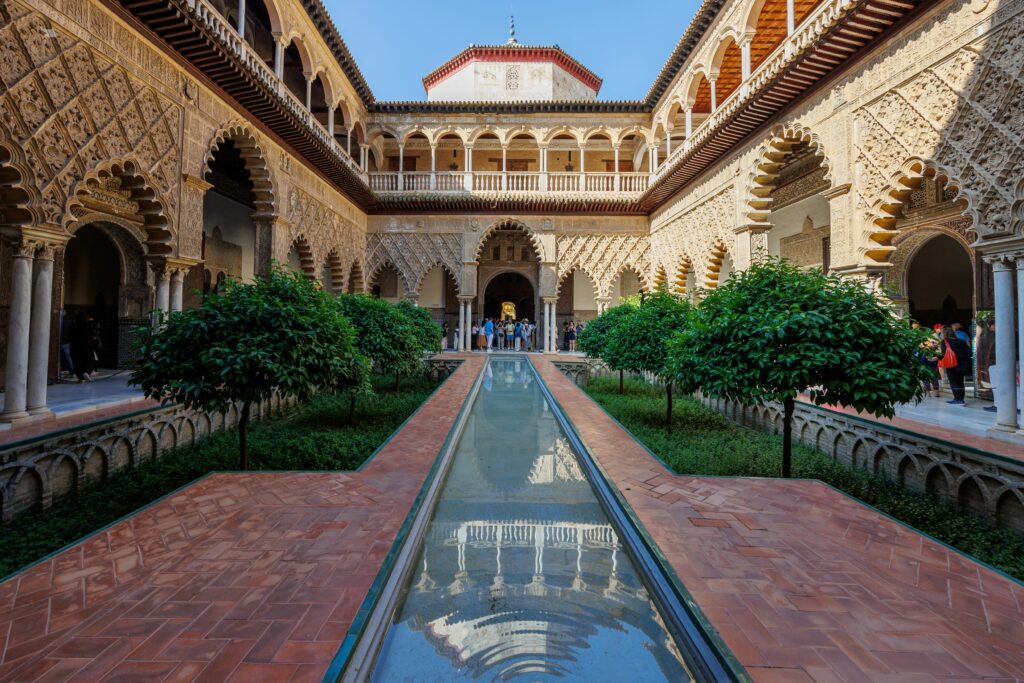
The Real Alcázar is the best thing in the city, and if you only had time for one place, go here. It is a royal palace built and rebuilt from the tenth century onward, and the Spanish royal family still uses the upper floor when they are in town, which makes it the oldest European palace still in use. The style is Mudéjar, meaning Moorish craftsmanship carried out for Christian rulers, so you get endless tilework, carved wooden ceilings and cool interior courtyards. The gardens are enormous and worth an hour on their own.
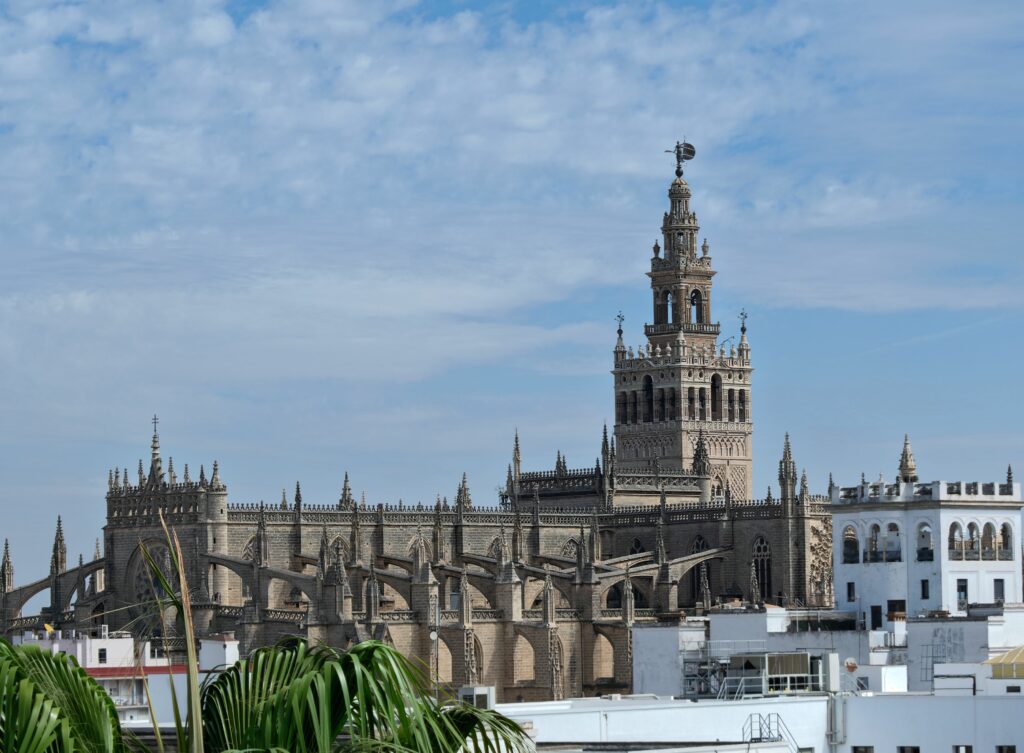
Seville Cathedral is the largest Gothic cathedral in the world by volume. It was built on the site of a mosque, and rather than demolish the minaret they converted it into the bell tower. That tower is La Giralda, and instead of stairs it has a ramp, because a rider on horseback once needed to get to the top. Inside the cathedral is the tomb of Christopher Columbus, carried by four figures representing Spanish kingdoms. The cathedral, the Giralda, the Alcázar and the Archivo de Indias were inscribed together as a UNESCO World Heritage Site in 1987.
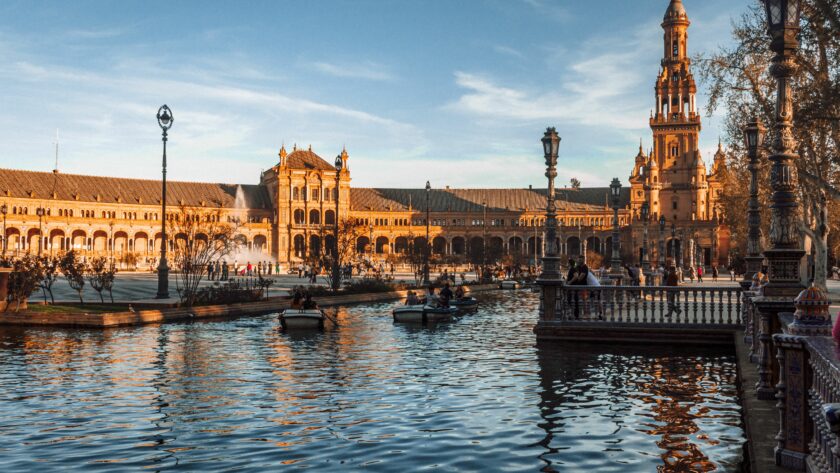
Plaza de España is the one you have seen in photographs. A vast semicircular plaza with a canal, bridges and tiled alcoves, each dedicated to a Spanish province. It is not from some distant century, it was built for the 1929 Ibero-American Exposition. It sits inside the Parque de María Luisa, which has shade and quiet, something you will value more than expected around midday. Entry is free.
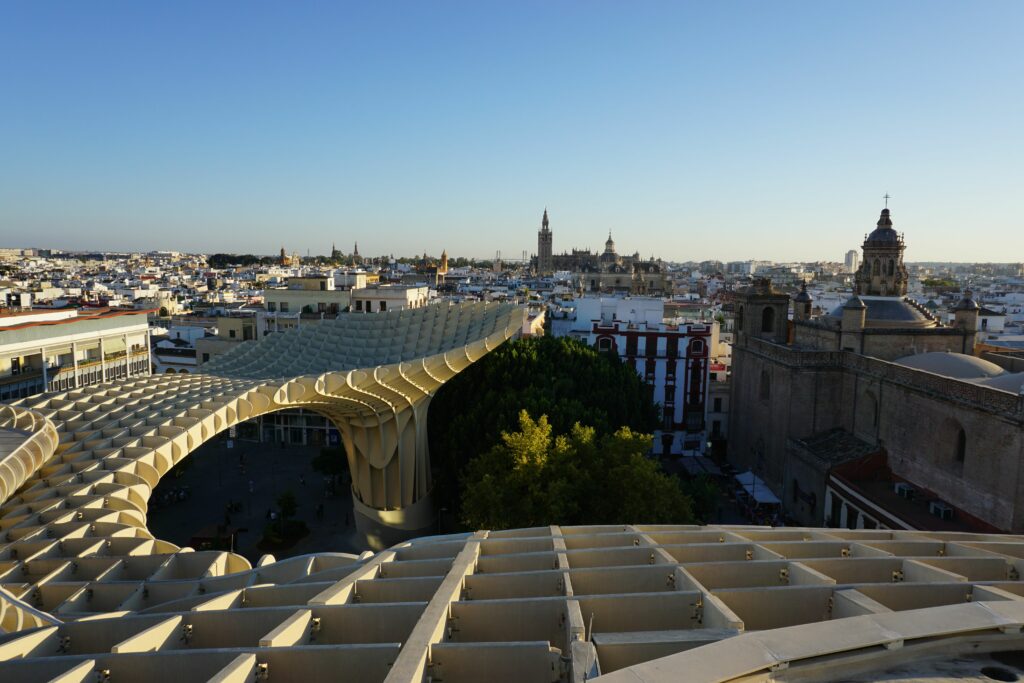
Barrio de Santa Cruz is the old Jewish quarter, immediately next to the cathedral. It is a knot of whitewashed lanes, some so narrow two people struggle to pass, opening onto courtyards full of plants. Wandering it without a plan is the nicest free thing you can do in Seville. Las Setas, by contrast, is entirely modern, a huge wooden structure over Plaza de la Encarnación with a walkway on top and a light show after dark.
Triana, across the river, was the district of ceramicists, sailors and flamenco families, and it still feels different from the centre. There is the Mercado de Triana, streets of ceramic workshops, and bars where music happens in the evening. It is ten minutes on foot from the centre over the Isabel II bridge and worth it for the view back across the water alone.
| Sight | 2026 entry | Time needed | Book ahead? |
|---|---|---|---|
| Real Alcázar | €15.50 standard | 2–3 h with gardens | Yes, slots sell out |
| Cathedral and Giralda | €14, €13 online | 1.5–2 h | Recommended |
| Cathedral including rooftops and extra routes | €21, €20 online | 3 h | Yes |
| Plaza de España | Free | 1 h | No |
| Barrio de Santa Cruz | Free | 1–2 h | No |
| Las Setas viewpoint | Price varies, check on site | 1 h | No |
| Triana and Mercado de Triana | Free | Half a day | No |
| Parque de María Luisa | Free | 1–2 h | No |
Do not skip the booking step: Both the Alcázar and the cathedral sell timed-entry tickets, and in high season they sell out days ahead. In spring and around Easter it is common for the next day to be gone entirely. Buy directly from the official Alcázar site and the cathedral site, because resellers charge multiples of face value. The cathedral ticket is also a euro cheaper online than at the door.
Does Seville have a beach? The straight answer
No. This is a question most guides answer evasively, and it matters, because it decides whether someone books a week here. Seville is inland, on a river, and the nearest coastline is around 80 kilometres away. The Guadalquivir does reach the Atlantic and ships historically sailed all the way down it, but swimming in it inside the city is not an option anyone should consider.
You can combine Seville with a beach, though. The closest Atlantic sand is at Matalascañas, on the edge of Doñana National Park, roughly an hour and a half by car. You can also reach Cádiz in a little under two hours by train, and Cádiz is worth a day in its own right, an old port city on a narrow peninsula with beaches right beside the historic centre. Bear in mind the Atlantic here is noticeably colder and rougher than the Mediterranean.
In practice, treat Seville as a two to four day city break rather than a holiday base. It works best as part of an Andalusian loop with Córdoba and Granada, or as a long weekend on its own.
How many days do you need, and is Seville expensive?
Two days covers the main sights. Three is comfortable and leaves room for Triana, the park and a flamenco performance. Four makes sense if you want a day trip to Córdoba, which is about forty-five minutes away by high-speed train. Beyond four days, without excursions, the city starts to run out, because it is lovely but small.
Seville airport is about 10 kilometres northeast of the centre, with a direct airport bus to Santa Justa station and on into town. Several low-cost carriers fly here from the UK and across Europe, and fares outside the Easter period are usually reasonable. Taxis from the airport run on a fixed rate, so there is no meter to worry about.
| Item | Rough cost | Note |
|---|---|---|
| Airport bus to the centre | around €5 | Buy from the driver |
| Double room | €60–120 per night | Considerably less off-season and outside the centre |
| A tapa in an ordinary bar | €3–5 | Set lunch menu around €12–15 |
| Main monuments | around €30 per person | Alcázar plus cathedral |
| Flamenco performance | from €20 in a tablao | Bars in Triana sometimes have it free |
| Coffee and a pastry | €3–5 | Cheaper standing at the bar than seated |
Seville is one of the cheaper major Spanish cities. Food is noticeably less expensive than in Barcelona and somewhat cheaper than Madrid, and the same applies to accommodation. The exceptions are the two weeks around Semana Santa and Feria de Abril, when room rates multiply.
Day trips from Seville
Seville makes a good base, sitting in the middle of Andalusia with fast rail links in both directions. The best single day out is Córdoba, about forty-five minutes by high-speed train, and the reason is one building. The Mezquita, the former great mosque with its forest of red and white arches, into which a cathedral was later built directly in the middle. There is nothing else like it in Europe. Add the courtyard district full of flowers and the day pays for itself.
Cádiz is the opposite kind of trip, a sea city on a narrow peninsula with an old port centre, beaches beside the historic quarter and Atlantic wind. Just under two hours by train, and the easiest way to add a day by the water. Ronda, to the east, is mountain country, built along the edge of a hundred-metre gorge spanned by a stone bridge. The journey is longer and it suits people with a car.
Closest of all is Itálica, a Roman town about nine kilometres away near Santiponce. It was one of the earliest Roman settlements on the Iberian Peninsula and the birthplace of the emperor Trajan. A large amphitheatre and mosaic floors survive, and the site has become better known in recent years thanks to filming. It is around half an hour by bus from the centre, so it fits into a morning.
Where to stay in Seville
Santa Cruz is the prettiest and the closest to the monuments, so you walk out of your hotel and the cathedral is right there. You pay for that in price, and in the fact that those narrow lanes get busy in high season and noisy at night. Alfalfa and the streets around it feel more lived-in, full of tapas bars, and still within walking distance of everything.
Alameda de Hércules, north of the centre, is where more locals actually live. There is a wide boulevard lined with terraces, it is lively in the evening and prices are lower. It is also the most useful area if you eat plant-based, because most of the city’s plant-focused places are in or near it. Triana, across the river, is quieter and cheaper with a character of its own, at the cost of crossing a bridge to reach the centre.
A practical note about summer: If you are travelling between June and September, air conditioning is not a luxury, it is essential. Check it is listed rather than assuming, because in the old buildings of Santa Cruz it is not a given. It is also worth asking for a room facing an interior courtyard rather than the street, since people sit outside in the centre until very late.
Where to eat in Seville, and why Andalusian food is unexpectedly plant-friendly
This is the part almost no Seville guide covers, and it is the most interesting thing we found. Andalusia has several traditional dishes that are vegan and always have been. Not adapted, not a plant-based version of something, simply made without any animal ingredient from the start.
Espinacas con garbanzos, spinach with chickpeas, is one of the most characteristic tapas in the city. Chickpeas, spinach, garlic, cumin, paprika and a little bread to thicken it. Seville’s own tourist board traces the dish to Sephardic and Moorish roots, since chickpeas, spinach and cumin all arrived in Andalusia through Arab influence. And unlike most old European dishes, which lean on lard or meat stock, this one stayed plant-based for centuries. You can order it in an entirely ordinary bar where nobody has ever thought about veganism, and get a proper meal.
The best vegan food in Seville is not in a vegan restaurant. It is on the menu of every second bar, and it has been there for several hundred years.
A few other things qualify with one small request. Salmorejo, the thicker cousin of gazpacho made from tomato, bread, oil and garlic, is plant-based at its base but arrives topped with ham and chopped egg. Ask them to leave those off. With patatas bravas, the bravas sauce is usually fine, but they often come with alioli, which contains egg, so skip it.
| Dish | Vegan as served? | What to say |
|---|---|---|
| Espinacas con garbanzos | Yes, unmodified | Just order it |
| Gazpacho | Yes | Just order it |
| Salmorejo | Base yes, topping no | “sin jamón y sin huevo, por favor” |
| Pan con tomate | Yes | Just order it |
| Aceitunas aliñadas, marinated olives | Yes | Just order it |
| Pimientos asados, roasted peppers | Yes | Just order it |
| Patatas bravas | Sauce yes, alioli no | “sin alioli” |
| Setas al ajillo, garlic mushrooms | Usually yes | Check for ham |
Vegan places in Seville
There are not many fully vegan places in Seville, but the ones that exist are good. Veganí at Calle Feria 117 does exactly what you would want in Andalusia. Vegan versions of Andalusian tapas, such as leek and mushroom croquetas, a mushroom mollete (a soft Andalusian roll) and tomato soup. It is often described as the only fully vegan place in the city where you can sit down to a proper dinner, though that is worth confirming when you book.
Veganitessen is inside the Mercado del Arenal and is fully vegan. It opened in 2009 as a sweet shop and gradually added tapas, burgers and seitan shawarma. Listings suggest it mostly runs on weekday lunches (Tuesday to Friday, closed at weekends), so check before you plan an evening around it. You eat in the market itself, which means a normal, non-touristy atmosphere and sensible prices. It is also the best address in the city for vegan cake, since the sweet side of the menu remains their strength.
Thank You, Mother is a plant-based café (it offers dairy and eggs as extras, so say vegan when you order) doing breakfast and lunch, buddha bowls and baked goods. There is one catch worth flagging. It is not in Seville itself but in Mairena del Aljarafe, a suburb about ten kilometres out. Unless you are driving or staying nearby, it is not somewhere you drop into for lunch. It usually closes on Tuesdays.
Beyond those, plenty of places have solid plant-based options. Habanita near Callejón Golfo is a Cuban-inspired restaurant with a big vegetarian section, doing things like banana meatballs in tomato sauce, and many of those dishes are vegan. It also serves meat and fish, so it suits a mixed group. El Rincón de Beirut on Calle San Fernando is Lebanese, so falafel, hummus and stuffed vine leaves are a given. For breakfast and brunch there is Milk Away, Biomio Brunch Ecológico near the cathedral and Ananas Coffee & Brunch. For something sweet, there is the bakery Chök. You may also see Heladería Puro & Bio recommended for vegan ice cream, but it has moved to Los Remedios, shows as temporarily closed and may have dropped its vegan flavours, so don’t make a special trip.
Opening hours in Andalusia shift with the season and some places cut their hours or close entirely over the summer, so check before you go if you are travelling outside the main season. If you are combining Seville with other Spanish cities, the plant-based scene is far larger in Catalonia, which we covered in Vegan Barcelona, and the capital has its own character in Vegan Madrid.
How to order in Spanish
You will manage in English in the tourist centre, but two streets further out Spanish helps. A handful of phrases is enough, and people respond well when you at least try. One thing worth knowing is that vegetariano is understood more loosely in Spain than you might expect, so it is safer to name the specific things you are avoiding.
| English | Spanish | Roughly pronounced |
|---|---|---|
| I am vegan | Soy vegano / vegana | soy veh-GAH-no / veh-GAH-na |
| No meat and no fish | Sin carne y sin pescado | sin KAR-neh ee sin pes-KAH-do |
| No cheese | Sin queso | sin KEH-so |
| No egg | Sin huevo | sin WEH-vo |
| No honey | Sin miel | sin MYEL |
| Does it have butter in it? | ¿Lleva mantequilla? | YEH-va man-teh-KEE-ya |
| Do you have anything vegan? | ¿Tiene algo vegano? | TYEH-neh AL-go veh-GAH-no |
| Spinach with chickpeas, please | Espinacas con garbanzos, por favor | es-pee-NAH-kas kon gar-BAN-thos |
Four things about Seville that might surprise you
The street oranges are not for eating. Depending on the count there are somewhere between 45,000 and 50,000 of them across the city, and they are bitter Seville oranges, close to inedible raw. Most of the harvest is exported to Britain for marmalade, and the city has experimented with turning surplus fruit into biogas for its water treatment plant.
The cathedral bell tower was built as a minaret. The Giralda stood as the tower of a twelfth-century mosque, and after the city was taken the Spanish simply added a belfry and a weathervane on top. Inside there are no stairs but a ramp, wide enough that a rider could go up on horseback. You can still climb it, and it is far easier going than most European towers.
The Alcázar is the oldest European palace still in use. The Spanish royal family keeps the upper floor for visits to the city. The rest works as a museum, and in recent years its gardens have appeared in major television series, which has pushed visitor numbers up noticeably.
Plaza de España is younger than most people’s grandparents. It looks like a historic monument but it opened in 1929 for the Ibero-American Exposition. The tiled alcoves around its edge represent the Spanish provinces, and finding your own is a standing tradition among Spanish visitors.
Practical tips before you go
Seville is a walking city and that is the best way to see it. The centre is flat and everything important sits inside a circle you can cross in half an hour. A car is more hindrance than help, since much of the historic centre is closed to traffic and parking is expensive. If you are touring Andalusia, pick the car up on the day you leave the city.
The daily rhythm runs late. Lunch is roughly between two and four, dinner after nine, and many kitchens shut in between. Turning up hungry at seven in the evening often means finding nowhere serving. Tapas bars are the answer, since they tend to stay open throughout.
Seville is generally a safe city for visitors, with the usual caveat about pickpockets in crowded tourist areas, around the cathedral and on busy nights in the centre. Ordinary care with bags and phones is enough. Walking back through the old town late in the evening is normal and the streets are rarely empty.
There are two ways to approach flamenco. A tablao, a ticketed performance, where you get a seat and a guaranteed standard. Or a bar in Triana, where it happens spontaneously and free, but you never know whether anyone will turn up that particular night. If you want certainty, book ahead.
And one last word on the heat. If you go in the warm half of the year, structure your day the way locals do. Monuments in the morning, shade or air conditioning through the middle of the day, and back out around six. Trying to walk Seville at two in the afternoon in August is not stoicism, it is a mistake that costs you the whole day.
Ticket prices, opening hours and venue details were verified in July 2026. Opening hours in Andalusia shift with the season and monument prices are revised annually, so check the official sites before you travel.
Of Spain’s big cities, Seville is probably the easiest one to start with. Everything is close together, prices are reasonable and the food is far friendlier to plant-based eating than Andalusia’s reputation would suggest. Just choose your month carefully, because the difference between August and October here is not a detail, it is the difference between a good trip and three days hiding in the shade.
Are you planning a trip to Seville, or have you already been? We would especially like to hear whether you found a tapas bar that went out of its way for you. Tell us in the comments so we can pass it on.
Seville FAQ
What is the best time to visit Seville?
On the climate data, October comes out best, with daytime highs around 27°C and nights near 15°C. The trade-off is rain, roughly 72mm across about ten days. September is still hot, averaging around 32°C by day. Avoid the summer entirely, when temperatures regularly exceed 40°C.
What to do in Seville in two days?
Day one, the Real Alcázar, the cathedral with the Giralda and the Santa Cruz quarter, since they sit next to each other. Day two, Plaza de España and the Parque de María Luisa, Las Setas, then Triana across the river in the afternoon. Book timed tickets for the Alcázar and cathedral in advance or you risk not getting in that day.
Does Seville have a beach?
No. Seville is inland on the Guadalquivir river, around 80 kilometres from the Atlantic. The nearest beaches are at Matalascañas, about an hour and a half by car, or in Cádiz, a little under two hours by train. Treat Seville as a two to four day city break rather than a beach holiday.
How much does the Alcázar and cathedral cost in Seville?
Standard entry to the Real Alcázar is €15.50. The cathedral with the Giralda is €14, or €13 booked online. The extended cathedral route including the rooftops is €21, or €20 online. Reduced entry of €7 applies to over-65s and students up to 25. Buy from the official sites, as resellers charge multiples.
Is Seville good for vegans?
Better than most Spanish cities, and for an unusual reason. Several traditional Andalusian dishes are vegan with no modification at all, above all espinacas con garbanzos, spinach with chickpeas. On top of that the city has fully vegan places including Veganí and Veganitessen, plus a good number of restaurants with strong plant-based options.
Is Seville expensive?
It is one of the cheaper major Spanish cities. Food and accommodation both cost less than in Barcelona and somewhat less than Madrid. A tapa runs about €3 to €5 and a set lunch menu around €12 to €15. The exception is the fortnight around Semana Santa and Feria de Abril, when room rates multiply.
Newsletter
Get our free e-books
Join the newsletter and download Our Vegan Christmas Kitchen straight away, 10 recipes for Czech cookies, gingerbread and vánočka. Then once a month, new places from the vegan map and new articles. Unsubscribe with one click.