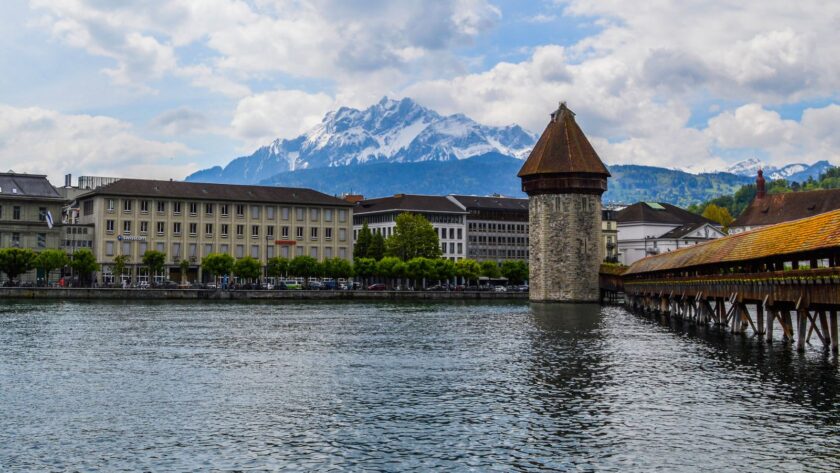
Switzerland’s most famous wooden bridge mostly burned down on the night of 18 August 1993. The Chapel Bridge that everyone photographs in Lucerne today is about two-thirds new, and it’s still the symbol of the whole country. Around it are a turquoise river and a lake biting deep into the mountains, and above it all rises Mount Pilatus, reached by the steepest cogwheel railway in the world. The best things to do in Lucerne fit into two easy days, and the city is small enough to walk end to end. What surprises most people is that you can eat brilliantly here without meat or cheese.
For a small city, Lucerne is very vegan. There’s a fully vegan restaurant on the banks of the River Reuss, a vegan bistro serving ramen and bao, and a plant-based tasting menu. The train station even sells vegan pitas, so you can eat well while changing trains.
So what are the things to do in Lucerne if you have one or two days? Should you go up Pilatus or Rigi, and how do you get there? Does Lucerne still work in winter and in the rain? What will it all cost, and where can you eat vegan in Lucerne so that your meat-eating travel companion leaves happy too? We’ve answered all of it below.
We haven’t made it to Lucerne together yet, so this isn’t a travel diary. In November 2026 we read every restaurant’s own menu, checked opening hours and prices on official websites, and confirmed train, boat and cable car times with the operators. Any place we couldn’t verify from its own website didn’t make it into this article.
Where is Lucerne, and is it worth visiting?
Lucerne sits in central Switzerland, where the River Reuss flows out of Lake Lucerne (Vierwaldstättersee in German). A direct train from Zurich takes 41 to 50 minutes, and from Bern it’s an hour. People here speak Swiss German, but you’ll get by in English everywhere in the centre.
Lucerne is worth visiting if you want a medieval town, a lake and real mountains in one place. You can walk the old town in a morning and be on a boat or a cogwheel train to an Alpine summit by the afternoon. You’ll see the city spelled Luzern on every sign and ticket, and Lucerne in English and French.
If you’re planning a longer trip, our Switzerland holiday planner puts Lucerne together with Zurich, Bern, Interlaken and Zermatt, with trains and a budget for a whole week.
How many days do you need in Lucerne?
Two days is ideal for Lucerne. On day one you walk the old town, both wooden bridges, the Musegg Wall and the Lion Monument, and eat by the river in the evening. Day two belongs to a mountain, either Pilatus or Rigi, because the trip there and back takes most of the day.
Lucerne in one day is possible, but you’ll have to choose between the city and a mountain. Our one-day plan is further down. Three days make sense if you want both mountains, or a rainy-day visit to the Swiss Museum of Transport.
Lucerne on our vegan map
7 places, 5 fully vegan. Tap a pin to see the details.
Loading the map…
- 100% vegan
- Vegetarian
- Vegan options
See every place from this article on our vegan map.
Things to do in Lucerne: the old town and bridges
The top things to do in Lucerne are in the compact old town on both banks of the River Reuss. These are the Chapel Bridge (Kapellbrücke) with its Water Tower and the second wooden bridge, the Spreuerbrücke. Add the painted houses around Weinmarkt square, the Musegg Wall with its nine towers, and the Lion Monument. You can link them into one walk of three to four hours.
Chapel Bridge: the bridge that burned in 1993
The Chapel Bridge (Kapellbrücke) is a covered wooden footbridge from the 14th century and Lucerne’s most famous landmark. According to the city’s website on Lucerne’s bridges, nobody knows exactly when it was built. Tree-ring dating shows it can’t be older than 1356, and it’s first mentioned in writing in 1367. The “built in 1333” date that many guides repeat doesn’t hold up.
On the night of 18 August 1993, most of the bridge burned down. Only the two ends and the Water Tower survived, and the rest was rebuilt in eight months, reopening on 14 April 1994. Of the 111 original paintings in the roof gables, 86 were damaged or destroyed. The paintings date from around 1614 to 1624 and tell the story of Lucerne and the Old Swiss Confederacy.
The octagonal Water Tower (Wasserturm) was standing in the river before the bridge was built. Around 13,800 people cross the bridge every day, so come early in the morning if you want a photo without crowds.
For a crowd-free photo: The classic view of the Chapel Bridge and the Water Tower is from Rathausquai, or from the Jesuit Church on the opposite bank. Early morning, between 7 and 8, is when it’s quietest.
Spreuerbrücke: the bridge with the Dance of Death
The Spreuerbrücke (Chaff Bridge) is Lucerne’s second surviving wooden bridge, a little way downstream and much quieter than the Chapel Bridge. It’s recorded as a complete crossing from 1408. Under its roof hangs a cycle of paintings called the Dance of Death (Totentanz) by the painter Kaspar Meglinger. In it, Death appears alongside people from every rank of society at the time.
There’s a small chapel on the bridge itself. The history of the Spreuerbrücke is tied to the city mills, which in the 13th century stood on what is now Mühlenplatz and on small islands in the river.
The old town, Weinmarkt and the painted houses
Lucerne’s old town lies mostly on the right bank of the Reuss, and its heart is the squares of Weinmarkt, Hirschenplatz and Kornmarkt with the town hall. Many façades are painted with coats of arms, figures and inscriptions, so walk with your head up. You can cover the streets in an hour, but with coffee and a few shops it easily fills a morning.
On the left bank, between the two wooden bridges, stands the baroque Jesuit Church with its onion-domed towers. Its steps give you one of the best views of the Chapel Bridge across the river.
The Musegg Wall and its towers
The Musegg Wall (Museggmauer) is a 13th-century city wall running along the hill above the old town. According to the association that looks after it, it’s 870 metres long, about 9 metres high, and the longest city wall in Switzerland preserved in one piece. Nine of its original 30 towers still stand.
You can walk on the wall and climb several towers for free from spring to autumn. From November to the end of March it’s closed for safety, so in winter you’ll only see it from below. The best-known tower is the Zytturm with its big clock face, looking out over the old town roofs and the lake.
The Lion Monument
The Lion Monument (Löwendenkmal) is a dying lion carved into a rock face, 10 metres long and 6 metres high. It honours the Swiss Guards who were killed on 10 August 1792 defending King Louis XVI at the Tuileries Palace in Paris. The Danish sculptor Bertel Thorvaldsen designed it, and it was unveiled in 1821.
According to Lucerne Tourism’s page on the Lion Monument, around 1.4 million people visit every year, and entry is free. Mark Twain called it “the most mournful and moving piece of stone in the world”. It’s a short walk from the old town, so pair it with the Musegg Wall.
Lake Lucerne: boats, the promenade and the KKL
Lake Lucerne is what turns Lucerne from a pretty old town into one of Switzerland’s great destinations. A boat ride is the cheapest way to see the mountains up close, and the lakeside promenade is free.
A boat trip on Lake Lucerne
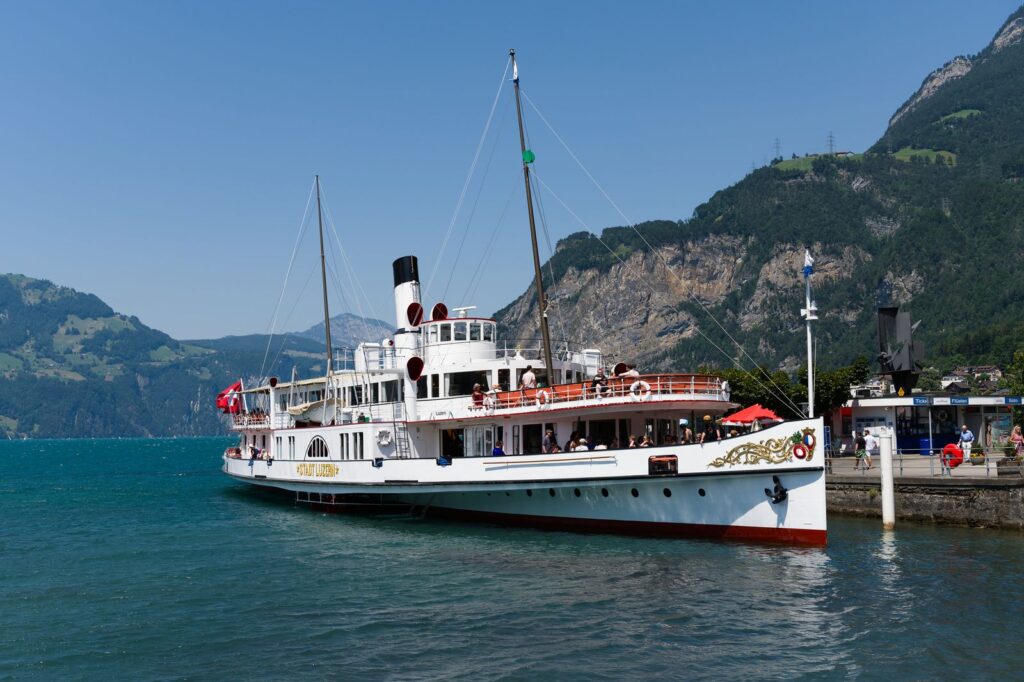
Boats on Lake Lucerne leave from the piers directly opposite the train station. They’re run by SGV (Lake Lucerne Navigation), and in summer historic steamboats join the fleet. The trip to Vitznau, where the cogwheel railway up Rigi starts, takes about an hour.
If you don’t have time for a full day out, a short round trip on the lake is enough. Onboard restaurants mostly serve Swiss classics, so bring your own snacks.
The promenade, the KKL and Inseli Park
Lucerne’s lakeside promenade runs from the station past the KKL culture centre and on along the water to the grand hotels on Schweizerhofquai. The KKL (Kultur- und Kongresszentrum Luzern) is a striking modern concert hall by French architect Jean Nouvel, with a vast flat roof jutting out over the lake.
Right next to the KKL is Inseli Park, a strip of grass by the water where locals sit on warm evenings. In summer (roughly April to September), two seasonal bars, Buvette and Volière, open here for a sunset drink. In summer you can swim at several spots along the lake, while in November and winter a walk is enough.
Pilatus or Rigi? A mountain day trip from Lucerne
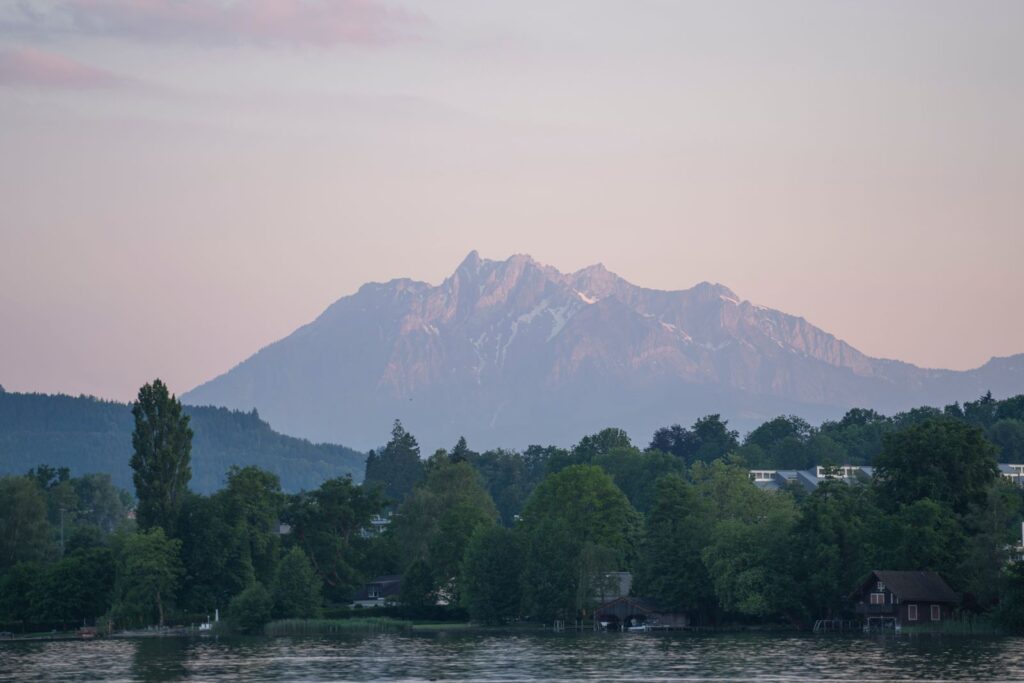
Pilatus is the steeper, more dramatic mountain with jagged rocks, while Rigi is greener and gentler, with lovely easy walks. Pilatus has the steepest cogwheel railway in the world, and Rigi has the first mountain railway in Europe. Both are close to Lucerne and both work as a day trip. Here’s our comparison.
| Pilatus | Rigi | |
|---|---|---|
| Summit | Pilatus Kulm, 2,132 m | Rigi Kulm, 1,797 m |
| From Lucerne | summer: boat to Alpnachstad + cogwheel; all year: bus 1 to Kriens + cable cars | boat to Vitznau + cogwheel; all year: train to Arth-Goldau + cogwheel |
| Claim to fame | world’s steepest cogwheel railway, up to 48% | Europe’s first mountain railway, 1871 |
| Adult return | CHF 84 summer, CHF 60 winter | CHF 84 |
| With a Swiss Travel Pass | half price | free |
| In winter | cable cars from Kriens only | runs, cogwheel from Arth-Goldau and Vitznau |
| Best for | views, thrills, one big ride | families, easy walks, the Rigi Kaltbad spa |
If you have a Swiss Travel Pass, Rigi is free, which makes it the obvious pick. If you’re visiting in summer and want one unforgettable ride, choose Pilatus and its Golden Round Trip. Prices are from the Pilatus and Rigi price lists, checked in November 2026.
How to get to Mount Pilatus from Lucerne
There are two ways to get to Mount Pilatus from Lucerne. From May to October you can take the boat to Alpnachstad and the cogwheel railway up. All year round you can take bus 1 to Kriens and ride the panorama gondolas and the Dragon Ride aerial cableway to the top. The best plan combines both into a loop.
Bus 1 runs from Lucerne station to the Kriens, Zentrum/Pilatus stop in 11 minutes, and from there it’s a 5 to 10 minute walk to the valley station. The cogwheel railway from Alpnachstad takes 27 minutes to the summit and climbs a 48% gradient on its steepest stretch. According to the Pilatus page on the cogwheel railway, it has been running since 1889.
The Golden Round Trip
The Golden Round Trip is a boat, cogwheel railway, cable car and bus loop that covers all of Pilatus in one day. Going clockwise, you sail from pier 2 opposite Lucerne station to Alpnachstad and ride the cogwheel to Pilatus Kulm. Then you come down on the Dragon Ride and the gondolas to Kriens, and take bus 1 back to Lucerne.
The loop only runs from May to October, when both the boats and the cogwheel railway operate. In 2026 the Alpnachstad boat ran until 18 October. An adult ticket costs CHF 119.80 with second class on the boat, or CHF 59.90 with a Half Fare Card. With a Swiss Travel Pass the boat and bus are free and the mountain section is half price. On fine days, reserve a seat on the cogwheel railway in advance.
Mount Pilatus in winter and November
In winter you can only reach Pilatus from Kriens, by panorama gondola and the Dragon Ride cableway. According to the price list, a winter return from December to April costs CHF 60. The cogwheel railway from Alpnachstad doesn’t run in winter.
Watch out in November. According to the Pilatus timetable, the Kriens gondolas and cableway are closed for maintenance from 19 October to 27 November 2026. Until then, the only way up is the cogwheel from Alpnachstad, which runs until 29 November 2026. The cable cars reopen on 28 November. Always check the timetable before you go, because maintenance dates change every year.
Mount Rigi: the queen of the mountains
Mount Rigi rises between Lake Lucerne and Lake Zug and is nicknamed the “queen of the mountains”. Its summit, Rigi Kulm, is 1,797 metres high. The cogwheel railway from Vitznau has run since 21 May 1871 and was the first mountain railway in Europe.
The nicest way to arrive is by boat. The boat from Lucerne to Vitznau takes about an hour, and the railway station is 50 metres from the pier. You can come down the other side on the second cogwheel railway to Arth-Goldau and take the train back to Lucerne, which makes a loop. In winter, a train from Lucerne to Arth-Goldau plus the cogwheel to the summit takes about an hour and a quarter.
Rigi has plenty of easy walking trails, so you can walk part of the way down and catch the train a stop lower. In Rigi Kaltbad there’s also a mountain spa, the Mineralbad Rigi, designed by architect Mario Botta. In November some Rigi lifts close for maintenance, so check the Rigi website for what’s running.
What to eat on the mountain
Mountain restaurants on both Pilatus and Rigi mostly serve Swiss classics, which means fondue, raclette and meat. Pilatus even offers fondue in a gondola and all-you-can-eat raclette. As a vegan you’re unlikely to find more than chips or a side salad up there.
So bring your lunch from town. Pick up a vegan pita at Veganitas in Lucerne station, which opens at 10am, or pack a picnic from a Coop or Migros supermarket. With a full backpack, the summit is a lot more fun.
Swiss mountains aren’t hard for vegans. Swiss mountain restaurants are. Bring your food up from the city and the view tastes the same for everyone.
Things to do in Lucerne in winter or when it rains
Lucerne still works in winter and on rainy days. The Swiss Museum of Transport is open 365 days a year, and the Rosengart Collection has Picasso and Klee. From late November the city turns into an Advent town with an ice rink by the lake. Only the Musegg Wall and the Golden Round Trip take a winter break.
The Swiss Museum of Transport (Verkehrshaus)
The Swiss Museum of Transport (Verkehrshaus der Schweiz) is a huge museum of trains, cars, planes, boats and cable cars, with a planetarium and a cinema. It’s at Haldenstrasse 44 by the lake, a little outside the centre.
According to the museum’s ticket page, a museum-only adult ticket costs CHF 37. A day pass with the planetarium, cinema and the Swiss Chocolate Adventure costs CHF 62. In winter it’s open daily from 10am to 5pm. For kids and for a long wet day, it’s the best place in town.
The Rosengart Collection
The Rosengart Collection is a private art museum near the station with works by Pablo Picasso, Paul Klee and around 25 other artists from Impressionism to Classical Modernism. It’s at Pilatusstrasse 10 and fully wheelchair accessible. It’s perfect for two hours out of the rain, and there’s often a public guided tour in English on Sundays.
Advent in Lucerne and the Ice Magic rink
Advent in Lucerne begins on Saturday 21 November 2026 at 5pm, when the Christmas tree lights are switched on at Europaplatz by the KKL. From 20 November 2026 to 1 January 2027, the Lucerne Ice Magic (Eiszauber) rink stands there with views of the lake and mountains, and skating is free. The main Christmas market is on Franziskanerplatz, with smaller markets on Weinmarkt and at the Hotel Schweizerhof.
If you love Advent markets, read our guide to Swiss Christmas markets. It covers Zurich, Basel and Montreux, with what to eat at each without meat or dairy.
Lucerne in one day: a plan with food
You can see Lucerne in one day if you give the morning to the city and the afternoon to the lake, or the other way round. Here’s our plan for a weekday, when the vegan restaurants are open.
Morning: Start at 8am on the Chapel Bridge while it’s empty, cross to the Jesuit Church and come back over the Spreuerbrücke. In the warmer months, walk up to the Musegg Wall. In winter, head straight to the Lion Monument.
Lunch: Have lunch at Karls Kraut on the riverbank, where the lunch menu with soup or salad costs CHF 22.50 to 24.50. On a Wednesday or Thursday you could also go to Plant. for ramen.
Afternoon: Take a boat on the lake, or in summer the boat to Alpnachstad and the Golden Round Trip up Pilatus. If it’s raining, go to the Museum of Transport.
Evening: Book the tasting menu at BAYTS, or grab a quick vegan pita at the station if you’re moving on.
Where to eat vegan in Lucerne
Lucerne has at least five fully vegan places plus a vegetarian buffet with plenty of vegan dishes. Three of them, Karls Kraut, Plant. and BAYTS, are closed on Sundays and Mondays, so plan your vegan dinners for Tuesday to Saturday. On Sundays and Mondays, the station saves the day.
For every place below we read its own menu and opening hours. Prices are in Swiss francs.

Karls Kraut: a fully vegan restaurant by the river
Karls Kraut is Lucerne’s first fully vegan restaurant, at St. Karliquai 7 right on the River Reuss, a short walk downstream from the Spreuerbrücke. It cooks with organic, regional and seasonal ingredients wherever possible, and they’re happy to box up whatever you can’t finish.
According to the current Karls Kraut menu, evening mains cost around CHF 31 to 32, for example Karls Burger with oven-baked wedges, or a polenta slice with red-wine lentils. At lunch, a main with soup or salad costs CHF 22.50 to 24.50 and the dishes change every week, such as pasta with a lentil and mushroom bolognese or a kebab-style seitan wrap. You’ll spot words like “Väse” and “Vutter” on the menu, because Swiss food law doesn’t allow plant-based products to be called cheese (Käse) or butter.
It’s open for lunch and dinner from Tuesday to Saturday and closed on Mondays. Once a month there’s a Sunday brunch for CHF 45, and the last one in 2026 is on 22 November.
Plant.: vegan ramen and bao
Plant. is a small, fully vegan bistro at Bundesstrasse 21 in the Neustadt district, close to the station. According to the Plant. website, lunch means bao buns, colourful rice bowls and ramen. Dinner is a seasonal menu, with dishes like roasted pumpkin with cashew cream or miso aubergine with black rice.
Lunch runs Tuesday to Friday from 11:30 to 13:30, and dinner Thursday to Saturday from 18:30. It’s closed on Sundays and Mondays. The room is small, so book for dinner.
BAYTS: a plant-based tasting menu
BAYTS is a fully plant-based restaurant at Bireggstrasse 24, and it’s the place for a special night out. According to the BAYTS menu page, the main event is a six-course “BAYTS Erlebnis” menu for CHF 98, which changes every eight weeks. Drinks pairing, with or without alcohol, costs CHF 59 extra.
If you don’t want the full menu, you can build your evening from small plates and a glass of wine. BAYTS opens only in the evening, Tuesday to Saturday from 6pm. Older descriptions on tourism sites still mention daytime opening, which no longer applies.
Veganitas and tibits: eating at the station
Lucerne station is the most reliable place for vegans in the whole city, because it’s open on Sundays too. In the basement food corner you’ll find Veganitas, a take-away selling 100% plant-based pitas in freshly baked bread. It’s open daily from 10am to 9pm, and until 9:30pm Thursday to Saturday.
On the first floor of the station is tibits, the Swiss vegetarian buffet with more than 40 vegetarian and vegan dishes. You pay by the weight of your plate, and there’s a Sunday brunch. Tibits is vegetarian rather than fully vegan, but for a group where everyone eats differently, it’s ideal. It also has lake views.
Vegitat: vegan döner
Vegitat is a fully vegan bistro with Turkish specialities at Bleicherstrasse 29, not far from the station. According to the Vegitat menu, it serves seitan döner, çiğ köfte (spicy bulgur balls) in a wrap from CHF 14, bowls and vegan baklava. According to its own website it’s open every day from 11:30 to 21:00, so it works on a Monday. Lucerne Tourism lists it as closed on Sundays, though, so double-check before a Sunday visit.
A kebab is food that meat-eaters love too, so bring along friends who aren’t vegan.
Chocolate: Max Chocolatier
Max Chocolatier is a family-run Lucerne chocolatier in the old town with a selection of vegan chocolates and pralines. Ask the staff which pieces are vegan. As a gift from Lucerne, it beats a souvenir from the shops by the bridge.
| Place | Type | Sunday | Monday | Best for |
|---|---|---|---|---|
| Karls Kraut | fully vegan | brunch once a month only | closed | lunch and dinner Tue–Sat |
| Plant. | fully vegan | closed | closed | lunch Tue–Fri, dinner Thu–Sat |
| BAYTS | fully plant-based | closed | closed | dinner Tue–Sat |
| Vegitat | fully vegan | open per its website, check | open | lunch and dinner |
| Veganitas (station) | fully vegan | open | open | daily from 10am |
| tibits (station) | vegetarian | open, brunch | open | breakfast to dinner |
Our Lucerne Sunday rule: On Sundays and Mondays, three of these six places are closed. If you’re coming for a weekend, save your restaurant dinner for Saturday, and on Sunday head to the station or take a pita in your backpack to Vitznau.
Where to next in Switzerland
Lucerne pairs perfectly with Zurich, just 45 minutes away by train. Our guide to the best things to do in Zurich includes the world’s oldest vegetarian restaurant and a fully vegan buffet at fair prices.
How to get to Lucerne
The easiest way to get to Lucerne is via Zurich. From Zurich Airport a direct train takes about 1 hour 10 minutes, and from Zurich main station a direct train takes 41 to 50 minutes. You don’t need to go into central Zurich if you’re flying in.
By plane via Zurich Airport
Zurich is Switzerland’s biggest airport, with direct flights from many European cities, including London and Prague. Direct trains to Lucerne leave from the airport’s own railway station. If you’d like a vegan meal on board, read our guide to ordering a vegan airline meal, although not every airline offers one on short flights.
By night train
From Central Europe, you can arrive without flying. The Czech Railways night train from Prague runs via Dresden, Leipzig and Basel to Zurich. According to Czech Railways’ Switzerland page, fares start at CZK 2,430 (€98) with a berth in a three-bed compartment. Change in Zurich for the direct train to Lucerne. Pack your own dinner, because you can’t count on vegan food on board.
From Lucerne to Interlaken and Bern
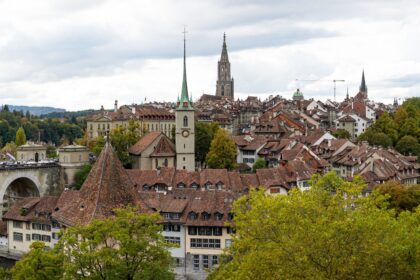
From Lucerne, the scenic Luzern–Interlaken Express takes 1 hour 48 minutes to Interlaken, crossing the Brünig Pass and passing five lakes. Bern is an hour away by direct train. We’ve covered its arcades and bear park in our guide to things to do in Bern.
How much does Lucerne cost?
Lucerne is as expensive as the rest of Switzerland. Most of your money goes on the mountains, because a single return trip up Pilatus or Rigi costs CHF 84. The city itself is almost free, since the bridges, the old town, the Lion Monument and the Musegg Wall cost nothing.
| Item | Price in CHF |
|---|---|
| Lunch at Karls Kraut with soup | 22.50–24.50 |
| Dinner main at Karls Kraut | 31–32 |
| Tasting menu at BAYTS | 98 |
| Wrap at Vegitat | from 14 |
| Pilatus return in summer | 84 |
| Pilatus Golden Round Trip | 119.80 |
| Rigi return from Vitznau | 84 |
| Museum of Transport, museum only | 37 |
| Chapel Bridge, Lion Monument, Musegg Wall | free |
Prices were checked in November 2026.
The Visitor Card Lucerne
The Visitor Card Lucerne is a free card for anyone staying overnight in the city of Lucerne or in Kriens. According to Lucerne Tourism, it gives you free buses and trains in zone 10 of the city network and discounts on cable cars, mountain railways, museums and excursions. Your accommodation emails it to you before you arrive. Boats aren’t included.
With the card, bus 1 to Kriens and the Pilatus valley station is free. Guests staying in Kriens get the same free zone 10 travel. If you stay further out, ask your accommodation what the card includes before you book.
Save money on the mountains: If you’re travelling around Switzerland by train for several days, price up a Swiss Travel Pass. It makes Rigi free and Pilatus half price. For a single trip to Lucerne, though, it usually doesn’t pay off.
Where to stay in Lucerne
The best places to stay in Lucerne are around the station or in the old town. The station is where the boats, trains and the Pilatus bus leave from, and the old town is five minutes on foot. Stay in the city itself or in Kriens and you also get the Visitor Card with free local transport.
Another option is Kriens at the foot of Pilatus, 11 minutes from the station on bus 1, where you still get the Visitor Card. If you want to watch the sunrise over the Alps, you can sleep on the mountain itself, as both Pilatus and Rigi have hotels. A vegan breakfast in the mountains isn’t a given, so ask ahead. If you’d rather stay somewhere that’s plant-based throughout, take a look at our list of fully vegan hotels.
Useful German phrases for vegans in Lucerne
People in Lucerne speak Swiss German, but everyone understands standard German, and English works in restaurants. These phrases help in the mountains and in ordinary restaurants where you want to ask about ingredients.
| English | German | Say it like / When it helps |
|---|---|---|
| Hello | Grüezi | GROO-eh-tsee, the Swiss greeting |
| I’m vegan | Ich bin Veganer / Veganerin | ish bin veh-GAH-ner / veh-GAH-ner-in |
| Is this vegan? | Ist das vegan? | ist dass veh-GAHN |
| No meat, fish, milk or eggs | Ohne Fleisch, Fisch, Milch und Eier | OH-neh flysh, fish, milsh oont EYE-er |
| Is there butter or cream in it? | Hat es Butter oder Rahm drin? | Rahm is the Swiss word for cream |
| Do you have oat milk? | Haben Sie Hafermilch? | for your coffee in a café |
| Thank you very much | Merci vielmal | MER-see FEEL-mal, very Swiss |
Final thoughts: Lucerne is the best first city in Switzerland
Lucerne is Switzerland in miniature. In a morning you walk medieval bridges and a city wall, and by the afternoon you’re on a boat or a mountain. In the evening you’re eating at a fully vegan restaurant by the river. Unlike the Alps, you don’t have to compromise on food here, as long as you save your restaurant dinners for Tuesday to Saturday.
If you only have one day, don’t spend it on a mountain wrapped in cloud. Check the summit webcam, and if it’s grey up there, choose the city and the lake and go up the next morning instead. So which would you pick, Pilatus or Rigi? Tell us in the comments.
Frequently asked questions
What are the best things to do in Lucerne?
The best things to do in Lucerne are walking across the Chapel Bridge and the Spreuerbrücke, exploring the old town around Weinmarkt, walking the Musegg Wall and seeing the Lion Monument. Add a boat trip on Lake Lucerne and a day trip up Mount Pilatus or Mount Rigi.
How do you get to Mount Pilatus from Lucerne?
You can get to Mount Pilatus from Lucerne all year by taking bus 1 to Kriens and the cable cars to the summit. From May to October you can also take the boat to Alpnachstad and ride the world’s steepest cogwheel railway up. The Golden Round Trip combines both for CHF 119.80.
Is Pilatus or Rigi better?
Pilatus is higher and more dramatic, with the world’s steepest cogwheel railway, and is best for one big day out. Rigi is greener and gentler, with easy walks and a mountain spa, and it’s free with a Swiss Travel Pass. In winter Rigi is easier, because its cogwheel railways keep running.
How many days do you need in Lucerne?
Two days is ideal for Lucerne. Spend the first day on the old town, the bridges, the city wall and the Lion Monument, and the second on Pilatus or Rigi. One day works too, but you’ll need to choose between the city and a mountain.
Is Lucerne vegan friendly?
Yes, Lucerne is very vegan friendly for its size. Karls Kraut, Plant., BAYTS and Vegitat are fully vegan, and Veganitas sells vegan pitas in the station, where you’ll also find the vegetarian buffet tibits. Karls Kraut, Plant. and BAYTS are closed on Sundays and Mondays.
Newsletter
Get our free e-books
Join the newsletter and download Our Vegan Christmas Kitchen straight away, 10 recipes for Czech cookies, gingerbread and vánočka. Then once a month, new places from the vegan map and new articles. Unsubscribe with one click.