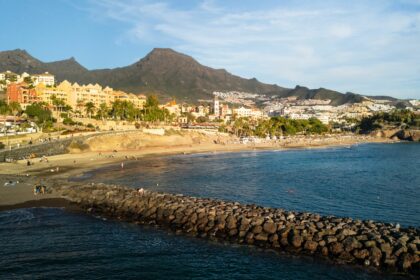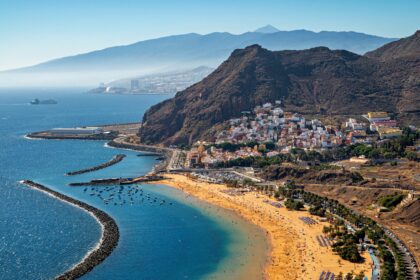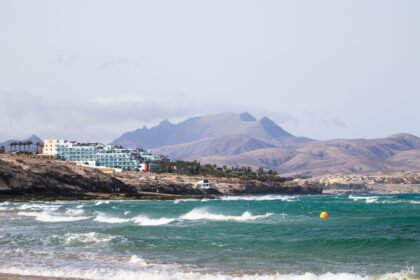
Gran Canaria gets called a miniature continent, and for once that is not marketing copy. You can drive around the whole island in a single day. In that day you pass sand dunes that look like the Sahara, pine forest at two thousand metres, banana plantations, fishing villages and a capital city with a three kilometre beach running through the middle of it. The gap between the north and the south is so wide that someone in the capital reaches for a jumper while people fifty kilometres away lie on a beach in thirty degrees. For how Gran Canaria compares with the rest of the archipelago, see Which Is the Best Canary Island? All Eight Compared.
We have not been to Gran Canaria yet and we are not going to pretend otherwise. What we did instead was go through the climate data, the island’s official sources, restaurant menus and recent reviews, and put together the guide we wanted to find. The food section took the longest, because plant-based eating here is spread far more unevenly across the island than most articles admit. We also ran into three things that a surprising number of guides get flatly wrong.
So what is there actually to do beyond the beach? Why is the weather different in the north and the south, and which side should you book? How long is the flight, where should you stay, and can you eat well as a vegan once you leave the capital? Everything below is arranged so you can plan straight from it.
Where is Gran Canaria and why is it called a miniature continent
Gran Canaria sits in the middle of the Canary archipelago, between Tenerife to the west and Fuerteventura to the east, roughly two hundred kilometres off the coast of Africa. It is the third largest island in the group at around 1,560 square kilometres, and it is almost perfectly round. Picture an upturned plate whose centre rises to about two thousand metres, with deep ravines running down from it in every direction.
That shape explains everything else. The mountains in the middle split the island into climate zones that differ so sharply that driving from one side to the other is an event in itself. The north is green, humid and often cloudy. The south is dry, bare and almost permanently sunny. The centre grows pine forest and occasionally gets snow in winter.
Around 43 percent of the island has been a UNESCO Biosphere Reserve since 2005. Unlike neighbouring Lanzarote, where the whole island is protected, here it covers the central and south-western section plus a wide marine strip. You notice it the moment you leave the coastal resorts, because the development thins out fast and gives way to hairpin bends, tiny villages and ravines.
If you are still deciding where in Spain to go, we compare the regions in Is Spain vegan friendly?. And if you are torn between the Canary Islands, we cover the biggest of them in Vegan Tenerife, because even these two neighbouring islands offer very different holidays.
Gran Canaria on our vegan map
3 places, 1 fully vegan. Tap a pin to see the details.
Loading the map…
- 100% vegan
- Vegetarian
- Vegan options
See every place from this article on our vegan map.
Gran Canaria weather and the north to south divide
This is the single most useful thing to understand before you book, and most brochures skip it entirely. The north-easterly trade winds carry damp Atlantic air across the Canaries. When that air hits the mountains in the middle of Gran Canaria it is forced upwards. The result is a solid layer of low cloud sitting over the northern half of the island, roughly between five hundred and fifteen hundred metres.
Locals call it the panza de burro, the donkey’s belly, after the colour of that cloud layer seen from underneath. In summer it can sit over Las Palmas for weeks at a time. The capital will be around 25–26°C and grey while the south of the island is clear and close to 30°C. This is not a freak weather event, it is the normal summer pattern and everyone there plans around it.
That is why every large resort is in the south. It is not a developer’s whim, it is simply the only part of the island where the sun reliably lasts all day, even in August.
So if you book a hotel in Las Palmas imagining long days of sunbathing, you may be caught out. Equally, if you hate summer heat, the capital has a far more comfortable climate than anywhere else on the island.
| Season | Daytime highs (south) | Sea | Best for |
|---|---|---|---|
| December–February | around 21°C, January coolest | 19–20°C, brisk for swimming | winter sun, peak northern European season |
| March–May | 22–24°C | 19–20°C | hiking inland, lower prices |
| June–August | 26–29°C south, around 25–26°C in Las Palmas | 21–22°C | swimming, but cloudiest in the north |
| September–October | 26–28°C | warmest of the year, around 23°C | the best all-round months on the data |
| November | around 24°C | 22°C and falling | quiet, just before the winter rush |
The sea is cooler than the air temperature suggests. The Atlantic sits between roughly 19°C in late winter and 23°C in September and October, so even in summer the first step in is bracing. Anyone used to Croatia or Greece in August will notice. December is the wettest month, though that still means only a handful of days and usually short showers.
The best things to do in Gran Canaria
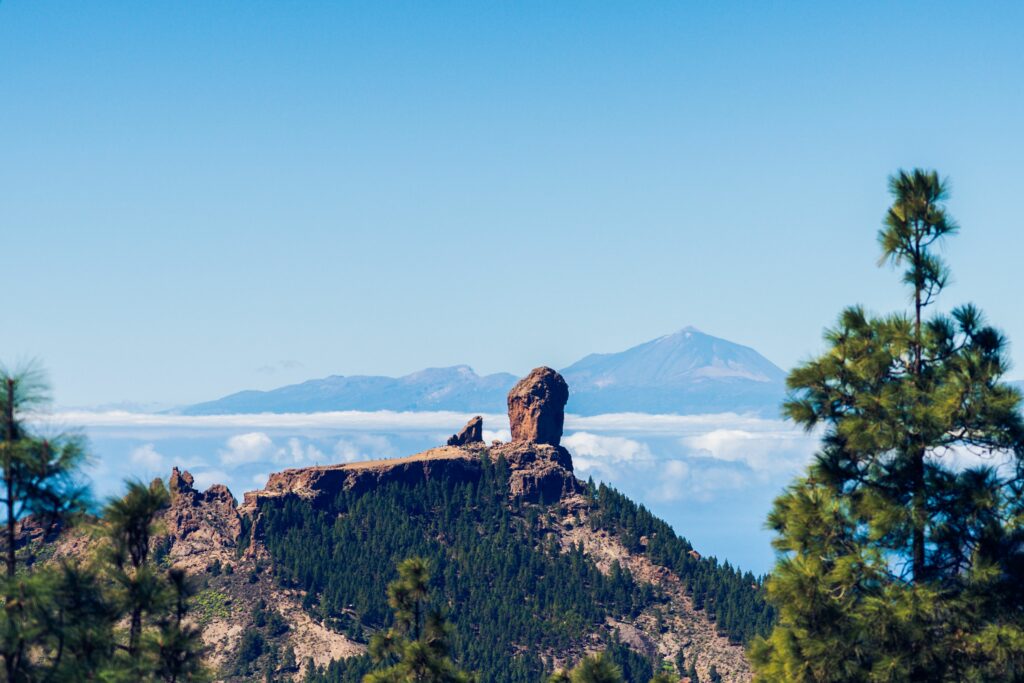
Roque Nublo is the island’s symbol and its most photographed spot. It is a rock monolith around eighty metres tall standing on a plateau at roughly 1,813 metres. It is a remnant of volcanic rock from eruptions millions of years ago, left standing as the softer rock around it eroded away. The walk itself is short, roughly half an hour each way, and not difficult, though you will feel the thinner air.
Here is the first thing most guides online have not caught up with. Since 3 February 2025 access to Roque Nublo has been regulated. The trail from Degollada de la Goleta now requires booking in advance, daily between 9am and 5pm, with capacity capped at around sixty people per hour. The reason is crowds of up to 2,000 visitors a day at peak times and the damage that was doing to the site.
At the same time the car park at the trailhead was removed and turned into a shuttle bus stop. You now park at Cruz de Los Llanos or in Tejeda itself and take a shuttle to the trail. Book through the official island trail reservation site. If you arrive on foot via other routes you do not need a reservation. Plenty of articles and itineraries still send people to a car park that no longer exists, so check before you drive up.
Pico de las Nieves is usually given as the island’s highest point at 1,949 metres, though a nearby summit is technically a few metres higher. The distinction makes no practical difference, because a road runs all the way up Pico de las Nieves and on a clear day you can see across the sea to Mount Teide on Tenerife. Clear days are not guaranteed, so go early.
Tejeda is the mountain village below Roque Nublo and one of the loveliest places on the island, white houses scattered across a slope above an enormous crater valley. Artenara is higher still, the highest village on the island, known for homes cut into the rock. And Teror in the interior has the finest Canarian wooden balconies you will see anywhere, plus a Sunday market.
Risco Caído, and one thing guides keep getting wrong
In July 2019 UNESCO inscribed Risco Caído and the Sacred Mountains of Gran Canaria on the World Heritage list. It covers a large landscape around Artenara containing cave dwellings, granaries and cisterns built by the island’s original inhabitants. They arrived from North Africa around the beginning of the common era and lived here in isolation until the Spanish came in the fifteenth century. It includes two sacred sites, Risco Caído and Roque Bentayga, thought to be linked to watching the sky and the seasons.
The second thing: you cannot actually visit the Risco Caído cave itself. It is closed to the public for conservation and ongoing research, and plenty of articles and itineraries fail to mention this, so people plan a trip to somewhere they cannot enter. What you can visit is the interpretation centre in Artenara, which houses a full scale one to one facsimile of the most important cave. Entry has been free, and visits may need booking, so check opening hours with the centre (+34 610 547 305) before you go. The inscription details are on the UNESCO World Heritage listing.
| What to see | Where | Time needed | Why go |
|---|---|---|---|
| Roque Nublo | island centre | 3–4 hrs incl. shuttle | the island’s symbol, booking required since 2025 |
| Maspalomas dunes | south | 2–3 hrs | protected reserve of dunes and lagoon |
| Vegueta, Las Palmas | north | half a day | old town dating from the late 1400s |
| Playa de las Canteras | Las Palmas | half a day | three kilometre city beach sheltered by a reef |
| Tejeda and Artenara | interior | full day | mountain villages and cave dwellings |
| Puerto de Mogán | south-west | half a day | canals, bridges and a calmer pace |
| Barranco de Guayadeque | east | half a day | ravine with homes built into the rock |
| Pico de las Nieves | island centre | 1–2 hrs | views across to Teide on a clear day |
The Maspalomas dunes and how to walk them properly
The dunes are what draws most people to the south of the island. They cover around 404 hectares of shifting sand stretching between Playa del Inglés and the Maspalomas lighthouse. Some dunes are well over ten metres high and the sand really does move, so the landscape looks slightly different every time.
It is not a desert though, whatever it looks like. It is a special nature reserve made up of three linked ecosystems. Alongside the dunes there is La Charca, a coastal lagoon that matters enormously to birds migrating between Europe and Africa, and a grove of endemic Canarian palms. Plant and insect species live here that exist nowhere else on earth.
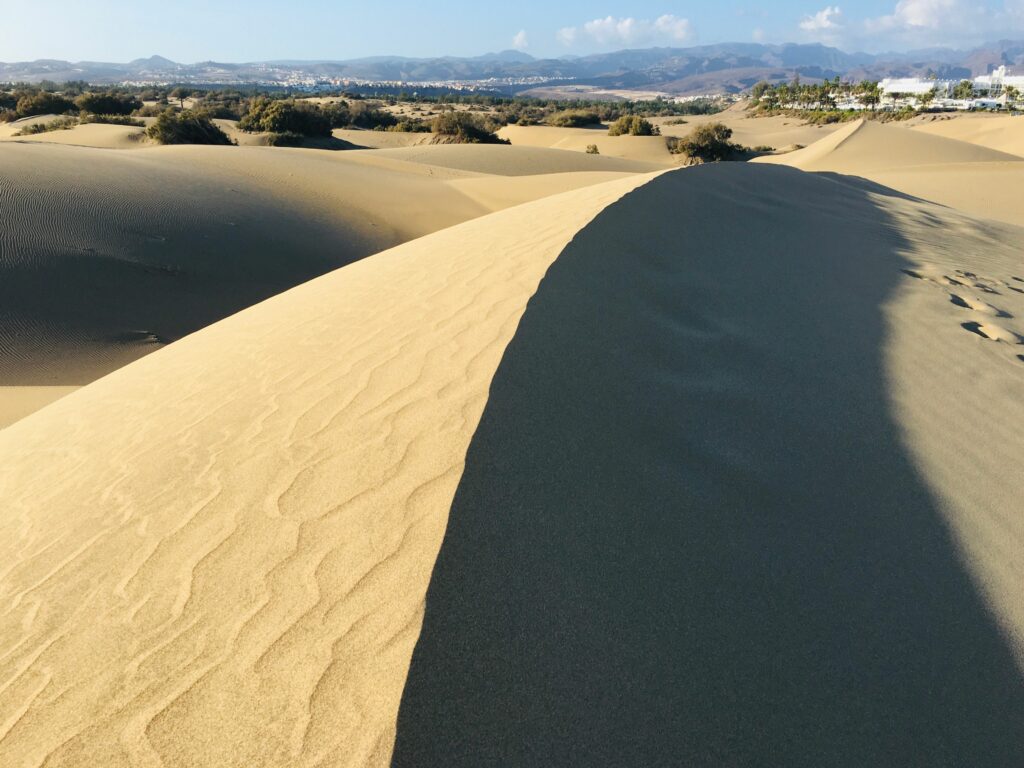
An important rule: There are around eight kilometres of marked paths through the dunes and you are only permitted to walk on those. Going off the marked routes is prohibited and finable, because trampling destroys the vegetation holding the dunes together. Do not stack stone cairns, do not camp, and leave the birds at the lagoon alone. Those dramatic photos of someone standing on a dune ridge away from the path are photos of someone who should not have been there.
Where to stay in Gran Canaria
Choosing between north and south matters far more than choosing a particular hotel. Las Palmas is a real city of more than 380,000 people, the largest in the Canary Islands, with a university, an old quarter and a three kilometre beach running through the middle of it. It has the best plant-based food on the island, the lowest prices for eating out, and an atmosphere that has nothing to do with a resort. You pay for that with more cloud and a 40-minute drive to the southern beaches.
Playa del Inglés and Maspalomas form the main tourist zone in the south. It is large, heavily built up and very international, with an enormous range of accommodation at every price and the dunes on the doorstep. Playa del Inglés is louder and younger, Maspalomas a little calmer and more family oriented. San Agustín next door is the quietest of the three.
Puerto de Mogán in the south-west is the opposite of Playa del Inglés. A small harbour with canals and bridges, white houses covered in bougainvillea, no high rises. It is the prettiest resort on the island and also the priciest and hardest to reach without a car. The interior, meaning Tejeda or Artenara, is worth a couple of nights if you want mountains and quiet, but you will need a car.
Puerto Rico and Amadores beach
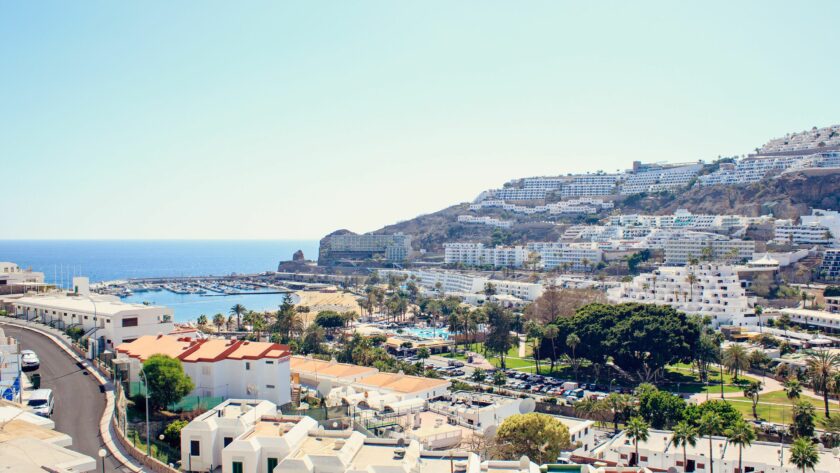
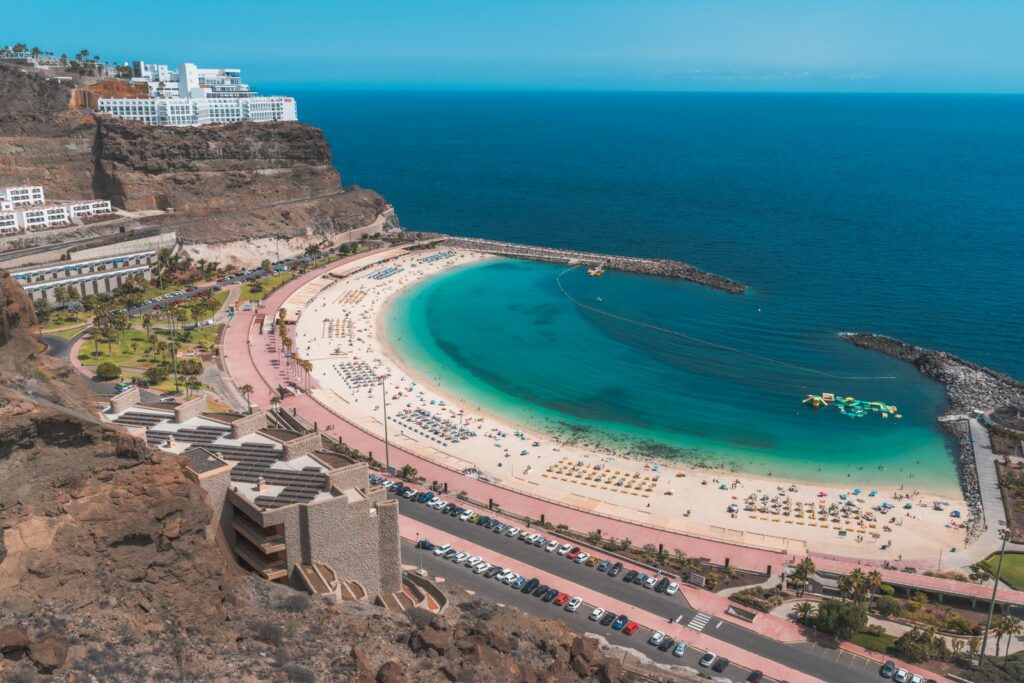
Puerto Rico appears in every brochure and it is worth knowing what you are booking. It sits in a narrow bay on the south-west coast, in the sunniest and most sheltered corner of the island, where the trade winds barely reach. That is its real selling point. When it is windy elsewhere, it is usually calm here.
Let us also be straight about it. Puerto Rico is a purpose-built resort that climbs the steep sides of its bay in dense terraces of apartment blocks. If you are looking for a Canarian village, this is not it. If you want guaranteed sun, calm water and everything within walking distance, you are in exactly the right place. It is a classic choice for families with small children and for winter stays.
The neighbouring beach at Amadores is linked to Puerto Rico by a promenade of about a kilometre along the coast. It is a man-made beach of imported pale sand, sheltered behind two breakwaters, so the water is almost always flat and wave-free. It first won Blue Flag status in 2004. For families with young children it is one of the safest spots on the island, though anyone who likes a wild beach will find it tame.
Las Palmas and an old town that is not a UNESCO site
Vegueta is the oldest quarter of the capital and the starting point of Spanish settlement across the whole archipelago. The city was founded in 1478, and Vegueta still holds buildings from the late fifteenth and early sixteenth centuries, probably the oldest surviving structures in the Canary Islands. You walk cobbled lanes between houses with wooden balconies, past the cathedral and a museum in the house where Christopher Columbus is said to have stopped.
Here is the third thing guides keep getting wrong. Vegueta is frequently described as a UNESCO World Heritage Site. It is not on the list. It is protected as a Spanish national cultural monument, specifically as a historic ensemble designated by decree in 1973. The city has been campaigning for World Heritage status for years without securing it. The only World Heritage listing on Gran Canaria is Risco Caído.
Playa de las Canteras is the reason people actually live in Las Palmas rather than just visiting. Three kilometres of sand run straight through the city, sheltered by a natural volcanic reef called La Barra that lies parallel to the shore and acts as a breakwater. The water behind it is calm and clear, so families swim there, while the exposed end at La Cícer is where people surf.
Eating vegan in Gran Canaria
Time to be specific, because this is the part most island guides gloss over. Plant-based options on Gran Canaria are distributed very unevenly. Las Palmas has a genuine vegan scene. The southern resorts effectively do not.
That does not mean you will go hungry in the south. You will eat perfectly well.
It means that in Playa del Inglés or Puerto Rico you will not find a fully vegan restaurant to go out to for dinner. What you will find is ordinary restaurants with a vegan section on the menu, or kitchens happy to adapt something. That is a real difference, and better to know before you go than to discover on day two.
On this island the question is not whether the destination is vegan friendly. It is which side of the mountains you are sleeping on.
Las Palmas, where it works
A Raíces on Calle Juan Manuel Durán González is a small vegan place that recent reviews speak about more warmly than anywhere else on the island. The menu is short and changes often, and it runs to vegan takes on traditional Canarian tapas alongside things like Caribbean rice with coconut. It really is small and usually opens only Thursday to Saturday, and hours can change, so message or call ahead (+34 633 43 43 77).
La Hierba Luisa on Calle Mendizábal in Vegueta used to be a favourite with vegan visitors, but we found no sign of it trading in 2025 or 2026, so we would not plan a trip around it.
Berro Bistrot, a street back from the La Cícer end of Las Canteras beach, is the most interesting of the three from a cooking point of view. It does creative plant-focused food using Canarian produce and is run by a pair who between them bring a head chef and a sommelier. One important note, they describe themselves as a vegetarian restaurant rather than a fully vegan one, so check individual dishes for cheese and eggs.
If you head up into the mountains, Biocrepería RiscoCaído in Artenara, a small organic creperie with plenty of vegan dishes, usually opens at weekends only. Worth confirming before you drive up, because opening hours in the mountain villages are seasonal and change often.
The south, where it takes a little planning
In the southern resort zone a different strategy works. Instead of hunting for a vegan restaurant, look for cuisines that are naturally accommodating. Italian places are the most reliable, since pizza without cheese or pasta with tomato is almost always possible. Indian restaurants with dal and vegetable curries work well, and Thai kitchens will usually leave out the fish sauce if you ask. Falafel and hummus are easy to find too.
Of the specific places that come up repeatedly near Playa del Inglés, reviewers mention vegan options at Allende 22 on Avenida de Tirajana. It is a tapas bar serving meat and fish too, so ask what can be made vegan. Bear in mind that most vegan guides to the south of this island are now several years old, so it is worth checking the current situation shortly before you travel.
The other thing that works very well in the south is cooking for yourself. Most accommodation in the southern resorts comes with a kitchenette, which is a significant advantage for a vegan. We cover a lot of transferable tactics in our guide to managing vegan food at an all inclusive resort.
We checked the places listed above in October 2026 against their own websites and the most recent reviews available. Please treat that date seriously, because the food scene across the Canary Islands turns over fast. A good number of the vegan guides you will find online are between two and six years old, and still send people to restaurants that have closed. Confirm current opening hours before you set off.
Shopping tip: Do one big shop at Mercadona or HiperDino on your first day and top up after that. Beachfront minimarkets will charge you roughly double for the same items. Plant milk, hummus, tofu, pulses and plant yoghurts are all easy to find, though ready-made meat substitutes are thinner on the ground than you may be used to. Fruit and vegetables are cheap and excellent, especially at the inland markets.
Canarian food and what is actually vegan
Canarian cooking is simpler and more rustic than mainland Spanish food, and several of its staples happen to be plant-based already. Papas arrugadas, small potatoes boiled in heavily salted water until the skins wrinkle, are just potatoes, water and salt. They come with mojo sauces, green from coriander and parsley, red from paprika and garlic, and in their traditional form both are dairy-free.
Gofio is a toasted grain flour eaten by the island’s original inhabitants and still eaten today. The flour itself is plant-based, but watch how it is served. Gofio escaldado, the most common restaurant version, is traditionally made with fish stock. It looks like an innocent flour porridge and it is one of the most common traps here.
The second trap is dessert. Bienmesabe is a Canarian almond speciality that sounds perfectly plant-based, almonds after all. Traditionally it is made with egg yolks, so it is not vegan at all. Watch out too for almogrote and queso asado, which are cheese specialities, and for sancocho and ropa vieja, which are fish and meat respectively.
| Dish | Vegan? | What to watch for |
|---|---|---|
| Papas arrugadas | yes | potatoes, water and salt, nothing else |
| Mojo verde and mojo rojo | yes | dairy-free traditionally, check labels on jarred versions |
| Gofio (the flour itself) | yes | toasted grain flour, plant-based |
| Gofio escaldado | usually not | traditionally made with fish stock, always ask |
| Gazpacho, pan con tomate | usually yes | simple and dependable choices |
| Bienmesabe | no | sounds like almonds, but contains egg yolk |
| Almogrote, queso asado | no | cheese specialities |
| Sancocho, ropa vieja | no | fish and meat classics |
Spanish phrases for vegans
You will manage in English across the resorts without any trouble, but inland and in smaller places in Las Palmas a few phrases go a long way. Canarian Spanish is softer and quicker than the mainland version, but these sentences will be understood anywhere.
| English | Spanish | Roughly pronounced |
|---|---|---|
| I’m vegan | Soy vegano / vegana | soy veh-GAH-no / veh-GAH-na |
| No meat and no fish, please | Sin carne y sin pescado, por favor | seen KAR-neh ee seen pes-KAH-do |
| No cheese and no egg | Sin queso y sin huevo | seen KEH-so ee seen WEH-vo |
| Does it contain fish stock? | ¿Lleva caldo de pescado? | YEH-va KAL-do deh pes-KAH-do |
| Do you have anything vegan? | ¿Tienen algo vegano? | TYEH-nen AL-go veh-GAH-no |
| Is this suitable for vegans? | ¿Es apto para veganos? | es AP-to PA-ra veh-GAH-nos |
Getting there and getting around
Gran Canaria has one airport, coded LPA, on the east coast roughly halfway between Las Palmas and the southern resorts. It is about half an hour by road from either, which is more convenient than on several other islands.
Flights from the UK take around four and a half hours, and from central Europe closer to five and a half. Winter is the high season here rather than summer, so schedules are usually better between November and March, and charter flights bundled into package holidays often fill gaps that scheduled routes leave. Current island information is on the official Gran Canaria tourist website.
We would hire a car if you want to see the interior. Public transport between the main resorts and Las Palmas is good and cheap, but getting into the mountains that way is slow and awkward. Inland roads are narrow and full of hairpins, so allow more time for journeys than the map suggests.
Four things you probably didn’t know about Gran Canaria
The island shares its status as regional capital. Las Palmas de Gran Canaria and Santa Cruz de Tenerife are jointly the capital of the Canary Islands, with the seat of regional government alternating between them every four years. It is a compromise born of a long rivalry between the two islands that you can still feel today.
The Maspalomas dunes are not blown in from the Sahara. It is a persistent story you will hear even from guides, but the sand comes from the seabed and is largely made up of ground-down shell and marine organisms, washed ashore and then shaped by the wind.
There is pine forest at two thousand metres. The Canary pine is remarkable for surviving forest fires and resprouting directly from its trunk. It also combs water out of fog and low cloud, which then runs down the trunk into the soil, and on an island with little rainfall that matters enormously.
The Canaries run on a different clock to mainland Spain. They are an hour behind, which puts them on the same time as the UK and Portugal. Worth remembering when you are booking flights and restaurant tables.
Gran Canaria rewards anyone willing to look further than the beach in front of the hotel. An hour’s drive from a resort puts you in a mountain village where the cooking is different, the accent is different and it is ten degrees cooler, and that contrast is the whole point of the island. For a vegan it means a bit more planning in the south and a pleasant surprise in Las Palmas.
Planning a trip to Gran Canaria, or been already? Tell us in the comments where you ate, especially if you find something good in the south. We would love to add it.
Frequently asked questions
What is there to do in Gran Canaria besides the beach?
Quite a lot. The mountainous interior has walking routes around Roque Nublo, which needs booking in advance, and Pico de las Nieves, plus cave villages at Artenara and Tejeda and the UNESCO listed Risco Caído landscape. Las Palmas has a fifteenth century old town and a three kilometre city beach, and the Maspalomas dunes are a protected nature reserve you can walk through on marked trails.
When is the best time to visit Gran Canaria?
For winter sun, November to February works well, with southern daytime highs around 21°C and plenty of clear days. For warm sea and comfortable hiking, September and October are better, since the Atlantic is at its warmest then. Summer is hot in the south and often cloudy in the north.
How long is the flight to Gran Canaria?
Around four and a half hours from the UK and closer to five and a half from central Europe. The island has a single airport, LPA, on the east coast, roughly thirty minutes from both the capital and the southern resorts. Winter is high season, so schedules are generally better from November to March.
Is Gran Canaria vegan friendly?
It depends heavily on where you stay. Las Palmas has several vegan and plant-based restaurants and the choice there is strong. The southern resorts have almost no fully vegan restaurants, though ordinary restaurants there often carry a vegan section and most accommodation includes a kitchenette, which makes self-catering easy.
Where should I stay in Gran Canaria?
For guaranteed sun and beaches, stay south in Maspalomas, Playa del Inglés or Puerto Rico. For city life, food and atmosphere, stay in Las Palmas. Puerto de Mogán is the prettiest resort but costs more and is harder to reach without a car.
Is Gran Canaria windy?
The north-easterly trade winds blow across the island year round, and they are most noticeable on exposed northern and eastern coasts. The south-west, particularly around Puerto Rico and Amadores, is the most sheltered corner and is usually calm when it is breezy elsewhere.
Featured photo: Summer Stock, Pexels.
Newsletter
Get our free e-books
Join the newsletter and download Our Vegan Christmas Kitchen straight away, 10 recipes for Czech cookies, gingerbread and vánočka. Then once a month, new places from the vegan map and new articles. Unsubscribe with one click.