Mallorca has a reputation problem. Say the name and most people picture package holidays, sunburn and a strip of bars in Magaluf. That strip is real, and it is roughly ten kilometres of a coastline that runs for around five hundred and fifty. The rest is a mountain range on the UNESCO list, a cave system with one of the world’s largest underground lakes, wooden trains that have been running since 1912, and a capital city with a better café scene than most places three times its size.
So what is actually worth doing in Mallorca, and how many days do you need? When should you go to avoid both the heat and the crowds? Where should you stay if you would rather not end up behind a resort fence? And can you eat well here on a plant-based diet? That last one has a better answer than you might expect, and it involves a pastry that has been made with pork lard for three hundred years.
We will take it in order. First where the island sits and what to see, then the places where you can eat properly without compromise, then the traditional Mallorcan food that is quietly plant-based (and the food that is quietly not). After that comes the practical side of a Mallorca holiday, meaning weather, flights, where to stay, the tourist tax and a few phrases worth knowing.
Where is Mallorca, and is it the same as Majorca?
Yes, Mallorca and Majorca are the same island. The name comes from the Latin insula maior, the larger island, as opposed to its smaller neighbour Menorca. Majorca is the older anglicised spelling, still common in British holiday brochures. Mallorca is the Catalan form, it is what appears on every road sign on the island, and it has become the standard international spelling. Both are pronounced the same way, with the double L sounding like a Y.
The island is the largest of Spain’s Balearics, sitting in the Mediterranean about two hundred kilometres off the coast near Valencia and Barcelona. At 3 640 square kilometres it is almost exactly the size of Cornwall, but the variety packed into it is remarkable. The Serra de Tramuntana runs down the north-west coast, the south and east are lined with rocky coves, and the middle is a flat agricultural plain called Es Pla, full of almond groves and vineyards.
One thing to know as a vegan traveller. Mallorca is not Barcelona or Berlin, where a plant-based place turns up on every other street. Nearly the whole vegan scene is concentrated in Palma, with a handful of outposts in the north and south-west. Plan around that and you will eat brilliantly. Assume you will stumble across something in an inland village and you will be having bread and tomato for dinner. For how the rest of the country compares, see our honest look at whether Spain is vegan friendly.
Mallorca on our vegan map
10 places, 6 fully vegan. Tap a pin to see the details.
Loading the map…
- 100% vegan
- Vegetarian
- Vegan options
- Stays
- Sanctuaries & charities
See every place from this article on our vegan map.
What to do in Mallorca
A week is enough to see a great deal, because nothing is far from anything else. From Palma you can reach any corner of the island in about ninety minutes. Here is what we would not skip.
Palma de Mallorca
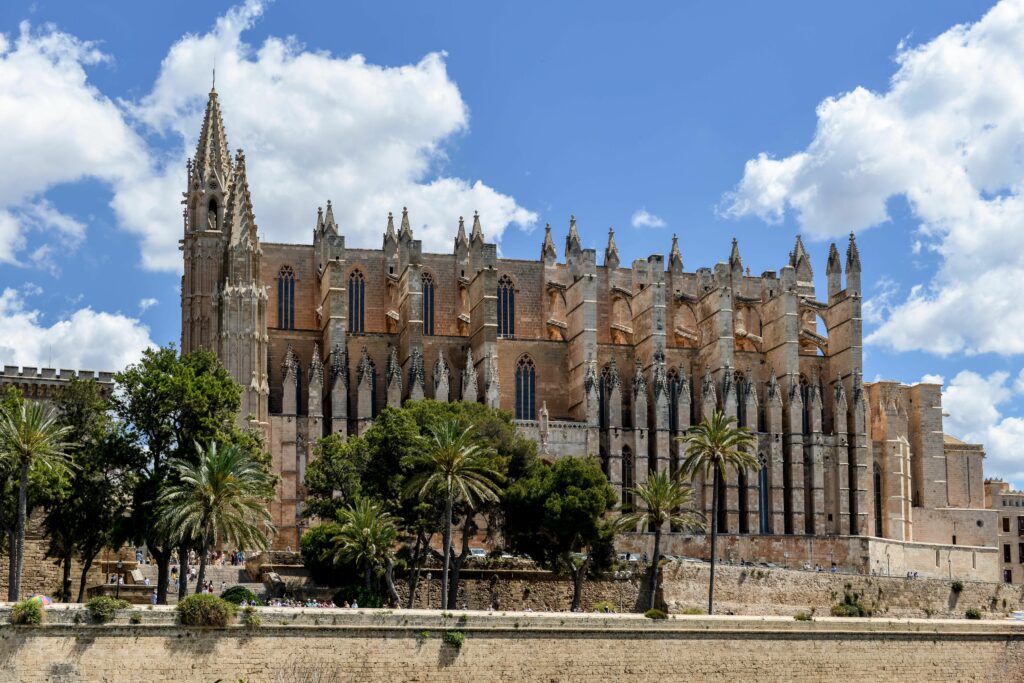
Palma is one of the most underrated cities in the Mediterranean. Plenty of people land at the airport, get bussed straight to a resort and never come back, which is a genuine loss. La Seu cathedral rises directly above the sea, and its main rose window is 13.8 metres across, making it one of the largest Gothic rose windows anywhere. It is built from more than twelve hundred pieces of glass, and twice a year, on 2 February and 11 November, its projected light lines up exactly beneath the second rose window to form a figure of eight on the wall. People queue from early morning to see it.
Above the city stands Bellver Castle, begun around 1300 under King Jaume II. It is completely circular, the only castle of its kind in Spain, and the walkway around the top gives you the whole bay. Fill the rest of the day with the old town’s narrow lanes and Arab baths, the Mercat de l’Olivar food market, and Santa Catalina, a former fishing quarter that is now the best address in the city for eating and drinking coffee.
The Serra de Tramuntana and the Sóller train
The Serra de Tramuntana, the mountain range along the north-west coast, was added to the UNESCO World Heritage list on 27 June 2011 as a cultural landscape. That category matters, because the listing is not just for the scenery. It recognises a thousand years of terraces, dry stone walls and water channels built first by Arab settlers and then maintained by generations of farmers. It is the most beautiful part of the island and the part most visitors never reach.
The best way in without a car is the historic train from Palma to Sóller, running on a narrow gauge line since 1912 with its original wooden carriages still in service. The journey takes about an hour, passes through thirteen tunnels and ends in Sóller’s main square, where an equally old tram carries on down to the port. Also worth your time are Valldemossa, where Chopin spent a famously miserable winter with George Sand, Deià clinging to the hillside above the sea, and Fornalutx, a regular winner of Spain’s prettiest village polls. Drivers should not miss the road down to Sa Calobra and its hairpin known as the Nus de sa Corbata, the tie knot.
Cap de Formentor and the north
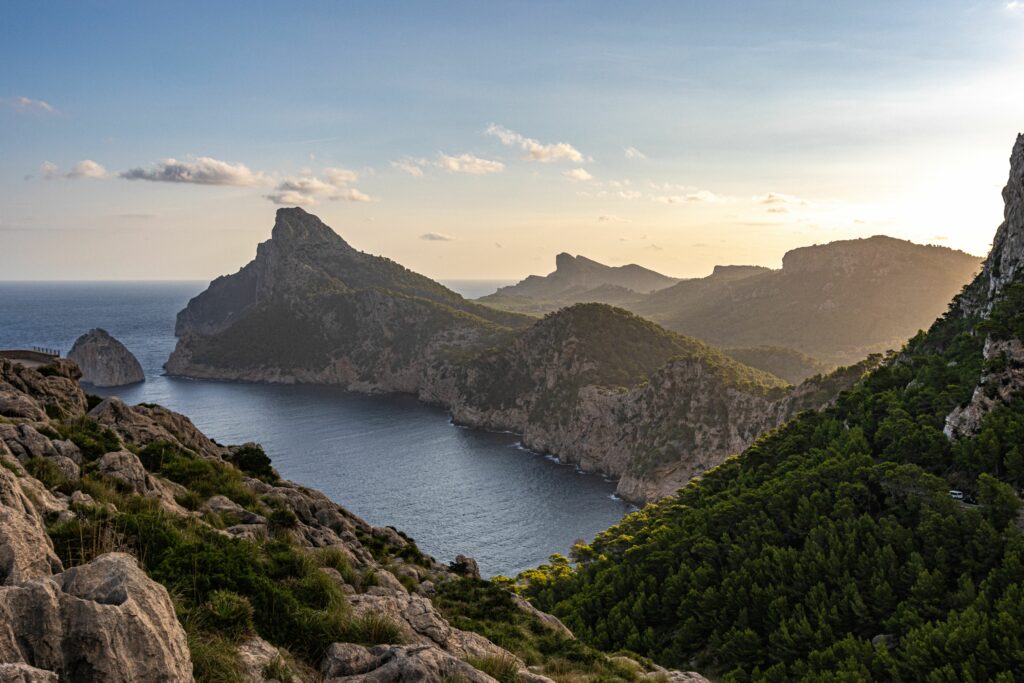
Cap de Formentor is the island’s northern tip, where cliffs drop into the sea and a twisting road ends at a white lighthouse. It is one of the most photographed spots in Mallorca and one of the most congested, which is why access is now controlled.
Tip: For the 2026 season the final stretch, from Formentor beach out to the lighthouse, is closed to private cars from 15 May to 18 October, daily between 10am and 10pm. You can still drive as far as the Mirador des Colomer and the beach car park, if a space is free. Shuttle bus 334 runs all the way to the lighthouse from Alcúdia and Port de Pollença and takes about an hour. Driving past the control point anyway carries a fine of 100 to 200 euros. The dates shift each year, so check with the island transport operator TIB before you go. If you want to drive it, set off early morning or late evening.
The north around Alcúdia and Pollença is calmer than the south. Alcúdia has a walled old town and a beach several kilometres long where the water stays shallow enough to walk fifty metres out and still stand up, which is why families with toddlers gravitate here. In Pollença, the Calvari steps climb three hundred and sixty-five stairs to a chapel above town.
The Caves of Drach and the east coast
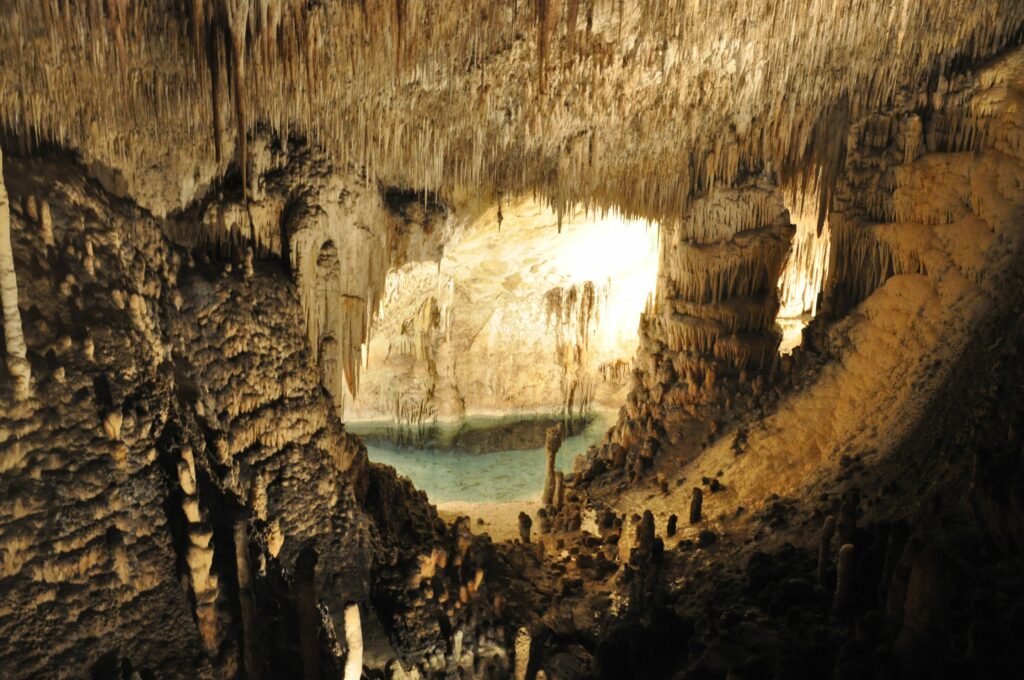
The Caves of Drach near Porto Cristo, Coves del Drac in Catalan, are among the island’s most visited sights. Four connected caves run for roughly 1.2 kilometres, and at the bottom lies Lake Martel, one of the largest underground lakes in the world at a hundred and seventeen metres long. The water is slightly salty because it connects to the sea. It was explored in 1896 by the French speleologist Édouard-Alfred Martel, whose name it carries. Every tour includes a short classical concert performed by musicians in rowing boats on the lake itself. Book on the official site, because summer slots sell out days ahead.
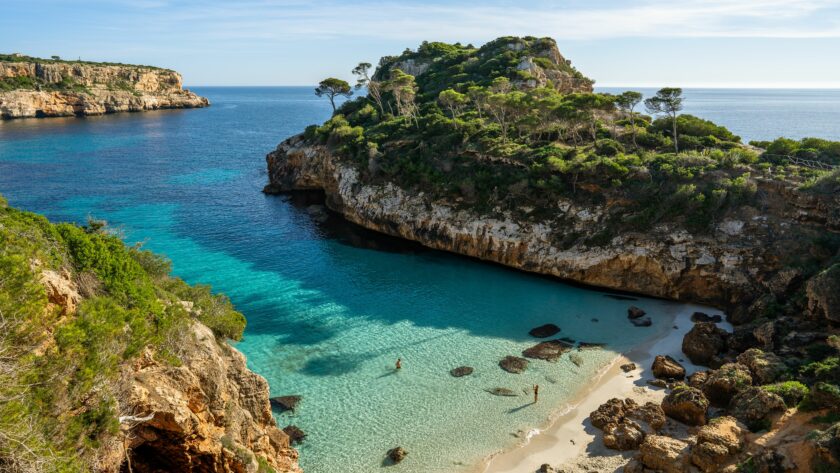
The rest of the east coast is a run of calas, small coves cut into the rock. The most photographed are Caló des Moro and Cala s’Almunia near Santanyí, which is exactly why parking there in August is close to impossible. We would rather point you at Es Trenc on the south coast, a long wild beach inside a protected area with no hotels behind it.
Where to eat vegan in Mallorca
Now the good part. Mallorca’s vegan scene is smaller than Barcelona’s but better than most visitors expect, and it goes back further than you would guess. Places tend to be small and busy, so book the good ones. Everything below was verified against current sources in August 2026, though opening hours change constantly, so check before you travel.
Palma, the centre of it all
Start with the history, because it explains why the food here is better than the island’s reputation suggests. The island’s first vegetarian restaurant was called Bon Lloc and it opened in Palma in 1978, when Spain was one year past its first free elections since Franco. It ran for more than four decades and closed in 2021. One of its founders, Juanjo Ramírez, immediately opened La Mujer de Verde on the square beside the Es Baluard museum, so the thread was never really broken. The cooking is seasonal, the menu changes every month, and the three-course set lunch is one of the better value meals in central Palma.
In the La Lonja quarter of the old town, Ca n’Ela is where chef Elena Martínez turns out raw beetroot ravioli, cashew cheeses and seasonal risottos. It is the most dinner-shaped of the lot and closes on Sundays. A few streets away on Carrer del Temple, Temple Natura Café Garden calls itself a vegan restaurant and has a courtyard garden in the middle of the city, which means shade even in high summer. One English menu online still lists dairy cheese, so ask if you’re unsure. Order the carbonara or the carrot cake, and note that it is closed on Tuesdays and Wednesdays.
For something less formal, Alubia Plant Power on Passeig de Mallorca does burgers, bowls, pinsas and arepas, with takeaway available. Sabores de Sandra cooks plant-based comfort food, meaning lasagne, empanadas, vegetable paella and a proper spread of raw desserts. And for brunch, Ahimsa in Cala Major is worth the short bus ride out of the centre. It is a vegetarian café with plenty of vegan food rather than a fully vegan one, so check the dish.
Tip: Spain eats late, and kitchens often do not open until half past seven or eight in the evening. Small vegan places usually run two separate services, lunch and dinner, and shut completely in between. Turning up at half four expecting lunch will not work. Note both windows before you go, and book in high season, because most of these rooms seat twenty to thirty people.
Beyond Palma
Outside the capital the map thins out, but it is not empty. In Nova Santa Ponsa on the south-west coast, Donna Vegana is fully vegan and fully gluten-free, open all year, running from smoothie bowls through to Lebanese and Asian dishes. Up north in Port de Pollença, Bellaverde is a garden restaurant that has gone 100% vegan, with chef Christopher Wilson now running the kitchen. It works seasonally and usually shuts over winter.
In Sóller, Miga de Nube has a garden right in the centre of town and serves cakes, bowls and smoothies with vegan options on a mostly vegetarian menu. It is not fully plant-based, so ask, but as a stop after the train it does the job nicely.
| Place | Where | Style | Best for |
|---|---|---|---|
| La Mujer de Verde | Palma, near Es Baluard | Plant-based, seasonal | Set lunch, book ahead |
| Ca n’Ela | Palma, La Lonja | 100% vegan, creative | Dinner, closed Sundays |
| Temple Natura Café Garden | Palma, old town | Vegan by its own description, ask about cheese | Garden lunch in the shade, closed Tue and Wed |
| Alubia Plant Power | Palma, Passeig de Mallorca | 100% vegan, casual | Burgers, bowls, takeaway |
| Sabores de Sandra | Palma | 100% vegan, home cooking | Lasagne, raw desserts |
| Tiraflecha | Palma, Santa Catalina | Bakery | Vegan sinsaimada, order a day ahead |
| Ahimsa | Cala Major | Vegetarian, lots of vegan | Brunch and coffee |
| Donna Vegana | Nova Santa Ponsa | 100% vegan and gluten-free | Breakfast and lunch, year round |
| Bellaverde | Port de Pollença | 100% vegan | Dinner in season |
| Miga de Nube | Sóller | Café with vegan options | Cake after the train ride |
Traditional Mallorcan food and the truth about ensaimada
You do not have to spend the whole trip hunting down vegan restaurants. Mallorcan cooking is built on vegetables, olive oil and almonds, and several classics are plant-based without anyone having to try. You just need to know where the traps are, because a few dishes look innocent and are not.
- Tumbet. Layers of fried aubergine, potato, pepper and tomato with olive oil and garlic, essentially the Mallorcan answer to ratatouille. Vegan as standard, though it is sometimes topped with fish or egg, so say so when ordering.
- Trampó. A salad of finely chopped tomato, green pepper and onion dressed with oil and salt. The best hot-weather food on the island and entirely plant-based.
- Coca de trampó. The same salad on a thin flatbread base, somewhere between pizza and focaccia. Most bakeries now use an olive oil dough, but the traditional recipe calls for lard, so it is worth asking in smaller village bakeries.
- Pa amb oli. Bread rubbed with tomato and olive oil. Ask for it explicitly without cheese and without ham, because it arrives with both by default.
- Olives, almonds and dried figs. Mallorca is almond country, and every market has salted roasted almonds by the bag. Ideal for long drives in the mountains.
And now the traps. Ensaimada, the spiral pastry you will see in every window and that visitors carry home in round boxes, contains pork lard. It is literally named after it, since saïm is Catalan for lard. Sopes mallorquines, the thick bread and vegetable soup, is almost always made with meat stock or sausage. Arròs brut is a rice dish with meat, and gató d’ametlla, the almond cake, is built on eggs.
There is a way around the ensaimada problem, and it is our favourite story on the island. A Bolivian baker called Jorge Saucedo developed a vegan version while working at La Mujer de Verde and named it the sinsaimada, a pun on sin saïm, without lard. He bakes it at his bakery Tiraflecha on Carrer de la Fàbrica in Santa Catalina. Quantities are limited, so order a day ahead.
Do it on your first day rather than your last. It fits the same round box as the original and travels home fine.
An island whose most famous pastry is built on pork lard now has a vegan version of it. That tells you more about Mallorca than any restaurant list.
Things you probably did not know about Mallorca
- The train was built for oranges. The 1912 line to Sóller exists because the valley’s citrus growers needed a way to get fruit to Palma. Before it opened, oranges crossed the mountains on mules.
- February looks like snow. From late January the almond groves across the Es Pla plain come into blossom and the whole plain turns white. It is the prettiest time of year on the island, even though nobody is swimming.
- Chopin hated it. The composer wintered in Valldemossa in 1838 hoping the climate would help his health. It rained, he got worse, and the locals shunned the couple for living together unmarried. The monastery he stayed in is now one of the island’s most visited museums.
- Locals march against tourism. On 26 July 2026 another anti-overtourism demonstration crossed Palma, with police estimating twenty-five thousand people and the organisers claiming closer to seventy thousand. It is not hostility towards visitors, it is about housing costs and overloaded services. Travelling considerately, spending with local businesses and avoiding August is a reasonable response.
Mallorca weather and the best time to go
Mallorca has a Mediterranean climate, so hot dry summers and mild damp winters. The annual average sits around seventeen degrees and total rainfall is roughly four hundred millimetres a year, which is about half what most of northern Europe gets.
| Month | Average high | Average low | Sea | Rainfall |
|---|---|---|---|---|
| January | 15 °C | 4 °C | 14 °C | 35 mm |
| February | 16 °C | 4 °C | 14 °C | 30 mm |
| March | 18 °C | 6 °C | 14 °C | 30 mm |
| April | 20 °C | 8 °C | 15 °C | 35 mm |
| May | 24 °C | 12 °C | 17 °C | 25 mm |
| June | 28 °C | 16 °C | 21 °C | 15 mm |
| July | 31 °C | 19 °C | 24 °C | 7 mm |
| August | 32 °C | 20 °C | 26 °C | 16 mm |
| September | 28 °C | 17 °C | 24 °C | 50 mm |
| October | 24 °C | 13 °C | 22 °C | 70 mm |
| November | 19 °C | 9 °C | 18 °C | 50 mm |
| December | 17 °C | 6 °C | 16 °C | 45 mm |
The table points to a fairly clear answer. September is the sweet spot, with the sea still at twenty-four degrees, air temperatures around a manageable twenty-eight, the crowds gone after the first week and prices dropping. June is the runner-up, though the water is noticeably cooler. August is survivable but it is the hottest, priciest and busiest month of the year, and thirty-five degrees is not unusual.
If swimming is not the point and you are here for the walking, the villages and the food, April and May are excellent, as is late October into November. Just note that autumn brings more rain in a month than the whole summer produces, and seasonal businesses in the coastal resorts tend to close from late October until March. Palma itself stays open all year, but the rest of the coast empties out.
Where to stay in Mallorca
Choosing your base shapes the holiday more than choosing the hotel does. The island is small, but not so small that you want to drive end to end every day.
- Palma is the obvious pick for vegans, city people and anyone who would rather not hire a car. The best areas are the old town, Santa Catalina and Portixol by the water. Almost every place on our list above is walkable or a couple of bus stops away.
- Port de Sóller and the Tramuntana for quiet, mountains and hiking. The prettiest part of the island, with higher prices and thinner food options.
- Alcúdia and Port de Pollença for families, thanks to that long shallow beach, and for easy access to Formentor. Bellaverde is right there.
- The east around Cala d’Or and Porto Cristo for coves and the Caves of Drach. The most seasonal corner of the island, largely shut outside summer.
- The south-west around Santa Ponsa and Magaluf is classic big-resort territory. Cheap and convenient, short on local character.
Tip for vegans in resorts: Mallorca is a big all-inclusive destination and the buffets have improved a lot in recent years, but left to themselves most will offer you salad and chips. Email the hotel a week before you arrive to say you eat plant-based, then repeat it to the head chef on the first evening. We have a full walkthrough in our guide to eating vegan at an all-inclusive resort. If you’d rather skip the buffet negotiations entirely, Villa Vegana near Selva is one of Europe’s longest-running vegan hotels.
Practical information for a Mallorca holiday
Flights and getting around
Palma de Mallorca airport (PMI) is one of the busiest in Spain and flights land from across Europe. From London the flight is around two hours twenty, from Prague or Berlin roughly two and a half hours, and from Dublin or Manchester a little over two and a half. In peak season the choice is enormous and fares are low. Out of season direct routes thin out considerably, and connecting through Barcelona or Madrid sometimes works out cheaper.
From the airport, the A1 bus runs into central Palma for around five euros, which is by far the cheapest option. Taxis wait outside arrivals and run on the meter. Uber has operated in Mallorca since 2023 but mainly within Palma and with fewer drivers than on the mainland, so install Cabify or Free Now as a backup. The island has a decent TIB public bus network plus a couple of train lines, though for the Tramuntana and the remoter coves a hire car is far easier. In summer, expect to find nowhere to park at popular beaches after about nine in the morning.
Tourist tax, water and money
The Balearics charge a sustainable tourism tax, usually called the ecotasa. In high season from May to October it runs from roughly one euro to 4.40 euros per person per night depending on your accommodation category, and it drops sharply outside those months. From the ninth consecutive night in the same place it halves, and under-sixteens are exempt. It is normally collected at the property rather than included in a package price, so budget for it.
Tap water in Mallorca meets EU standards and is safe to drink in most municipalities. The limestone geology and heavy chlorination give it a taste that means most locals do not drink it, and several mainly inland municipalities have had periods where the supply was declared unfit for consumption. The practical answer is a filter bottle, or the large eight-litre containers sold in every supermarket. Palma has installed filtered drinking fountains across its parks and squares, so refilling is free in the city.
How to ask for vegan food
Spanish works everywhere, Catalan earns you a smile. These four phrases cover almost everything.
- Soy vegano / vegana. I’m vegan. Use the first form if you are male, the second if you are female.
- Sin carne, sin pescado, sin queso, sin huevo. No meat, no fish, no cheese, no egg. List them all, because “no meat” on its own often results in fish arriving.
- ¿Lleva manteca? Does it contain lard? The single most useful question in any bakery on this island.
- ¿Tienen algo vegano? Do you have anything vegan? Works even in the most ordinary village bar.
Mallorca is not an island where you have to choose between the beach and eating well. Palma manages both, and the rest of the island throws in mountains, caves and villages where very little has changed in a century. Whether you come for a week by the sea or for spring walking, you will not go hungry on a plant-based diet. And if you get hold of a sinsaimada still warm from the oven, you will understand why people keep coming back. Have you been to Mallorca, or is it still on your list? Tell us in the comments which spot you would not skip.
Frequently asked questions
Is Mallorca the same as Majorca?
Yes, they are the same island and the same pronunciation, just two spellings. Majorca is the older anglicised version derived from the Latin insula maior, meaning larger island. Mallorca is the Catalan spelling, it is what you will see on every road sign there, and it is now the standard international form.
What to do in Mallorca in a week?
A week covers the highlights comfortably. Give one day to Palma for La Seu cathedral and Bellver Castle, one to the historic Sóller train and the Tramuntana villages, one to Cap de Formentor in the north and one to the Caves of Drach near Porto Cristo. Leave the rest for beaches. Nothing is more than about ninety minutes from Palma.
Is Mallorca good for vegans?
Yes, with a little planning. Almost the entire vegan scene sits in Palma, which has several fully plant-based restaurants plus a bakery making a vegan ensaimada. Outside the capital the options concentrate in Nova Santa Ponsa, Port de Pollença and Sóller. In inland villages expect to rely on naturally vegan dishes like tumbet and trampó salad.
Is ensaimada vegan?
The traditional one is not, because it is made with pork lard. The pastry is named after it, since saïm is Catalan for lard. A vegan version called the sinsaimada is baked at Tiraflecha in Palma’s Santa Catalina quarter. It is made in small quantities, so order a day in advance.
Can you drink tap water in Mallorca?
In most of the island yes, the supply meets EU standards. Heavy limescale and chlorination make it taste unpleasant enough that many locals avoid it, and several mostly inland municipalities have had spells where the water was declared unfit to drink. A filter bottle or the large supermarket containers solve it. Palma has free filtered drinking fountains around the city.
Is there Uber in Mallorca?
Yes, Uber has operated on the island since 2023, but mostly within Palma and with a smaller driver pool than mainland Spanish cities, so expect longer waits than you would get in Barcelona. Cabify and Free Now are widely used alternatives worth installing as backup. Metered taxis are available across the island, and the A1 airport bus into Palma costs around five euros.
Read next
Comparing Spanish islands? Have a look at vegan Tenerife, where you can swim in January and the plant-based scene is even broader. And if you are still deciding on a beach trip, we round up the best summer holidays for vegans.
Newsletter
Get our free e-books
Join the newsletter and download Our Vegan Christmas Kitchen straight away, 10 recipes for Czech cookies, gingerbread and vánočka. Then once a month, new places from the vegan map and new articles. Unsubscribe with one click.