
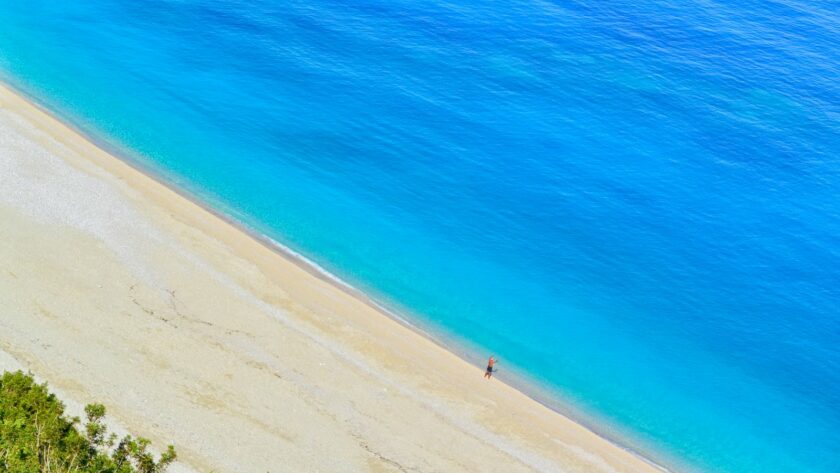
Kefalonia is the largest of the Ionian Islands and a bit of an unexpected treasure. People come for the turquoise water, the dramatic cliffs above Myrtos beach and a slower pace you struggle to find on the more famous Greek islands. The question we get asked most often, though, is a different one. Can you actually eat vegan in Kefalonia without living on chips and a feta-free Greek salad all week? The short answer is yes. And it works better than you would expect from a “cheese and fish” Greek island.
Let’s be honest from the start. We haven’t been to Kefalonia ourselves yet, so instead of inventing stories we went through dozens of reviews, listings on vegan restaurant finder apps and the experiences of travellers who ate vegan there. This article is an honest planning guide, not a memoir. Where is Kefalonia and when is the best time to go? What is there to do, and which beaches are the prettiest? Where should you stay, is Kefalonia expensive, and how do you even get there? And most importantly, where can you eat vegan, and what do you order in an ordinary taverna that has no vegan menu at all?
We treat veganism here as a bonus, not an obstacle. Greek cooking is one of the most plant-friendly in Europe and a lot of traditional dishes happen to be vegan all on their own. So even if you travel with non-vegans, with kids, or you are only vegan-curious, read on. Kefalonia will feed everyone, and a few things will probably surprise you. For how Kefalonia compares with the other Greek islands, see Greece Holidays: Where to Go, What to Eat, What It Costs.
Is Kefalonia vegan-friendly?
Yes, and more than you might think. It works for two reasons. First, in Argostoli (the capital) and in resort areas like Lassi you’ll find places with clearly marked vegan dishes. Second, and this matters more, Greek cuisine is full of food that is plant-based by default. You don’t need to track down a dedicated vegan restaurant to eat well. You just need to know what to ask for.
The key is the Greek Orthodox fasting tradition. Observant Greeks keep roughly one hundred and eighty fasting days a year, when they eat no meat, fish, milk, cheese or eggs. This food is called nistisima and it is essentially vegan. That’s why almost any taverna can put together a plate with no animal products without blinking. Just say the magic word “nistisimo” and the staff usually know exactly what you mean.
Traditional Greek dishes that are naturally plant-based include gigantes (large butter beans baked in tomato sauce), briam (roasted vegetables, a bit like Greek ratatouille), fava (a smooth yellow split-pea purée), gemista (tomatoes and peppers stuffed with rice), dolmadakia (stuffed vine leaves, ask for the egg-free version), melitzanosalata (roasted aubergine dip) and horta (boiled leafy greens with olive oil and lemon). Most of these fall under ladera, vegetable dishes slow-cooked in olive oil and tomato, and they are the backbone of eating vegan on the island. And you can always order a Greek salad without the feta.
How to order vegan: Learn “nistisimo” (fasting food, so no animal products) and “choris feta, parakalo” (no feta, please). When ordering, say you don’t eat “kreas, psari, tyri, gala, avga”, meaning meat, fish, cheese, milk and eggs. In tourist areas most staff speak good English, so you’ll get by easily.
Kefalonia on our vegan map
2 places. Tap a pin to see the details.
Loading the map…
- Vegan options
See every place from this article on our vegan map.
When to visit Kefalonia and what the weather is like
The season in Kefalonia runs roughly from May to October. The peak is July and August, when it’s hottest, priciest and busiest. In September the temperatures stay high and the sea is beautifully warm after the summer. If you don’t have to travel during school holidays, our pick is late May to June and the whole of September. It’s warm, the swimming is lovely and the island isn’t bursting at the seams.
For swimming, the sweet spot is roughly late June to the end of September, when the sea is warm and the days are long. If you’re mainly here for sightseeing and walking, May and early October are kinder because the heat won’t flatten you. In May the sea is still fresh (around 19°C), so a long swim is more for the hardy.
| Period | Weather | Best for |
|---|---|---|
| May and early June | Sunny, pleasantly warm, green, fresher sea | Sightseeing, lower prices, quiet |
| Mid-June to August | Hot, often above 30°C, warm sea | Classic beach holiday, but pricey and busy |
| September | Warm, sea still heated, thinning crowds | Our favourite time after spring |
| Early October | Milder temperatures, sea still warm | Quiet holiday, walks and food |
What to do in Kefalonia and the prettiest places
Kefalonia is unusually varied for a Greek island. You get dramatic cliffs, turquoise coves, an underground lake, a mountain national park and postcard-perfect villages. Search “what to do in Kefalonia” and the same handful of places keep coming up, and by all accounts rightly so. Here are the ones we’d put at the top.
Myrtos beach
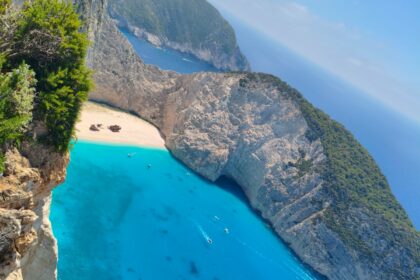
Myrtos is the most photographed beach on the island and one of the best-known views in all of Greece. White pebbles, steep cliffs and deep turquoise water make a combination you won’t forget in a hurry. The most striking angle is from the viewpoint on the road down to the beach. Keep in mind it’s pebbly rather than sandy and the entry into the water can be steep, so it’s more about the scenery and a swim than a beach with sunbeds at every step.
Assos
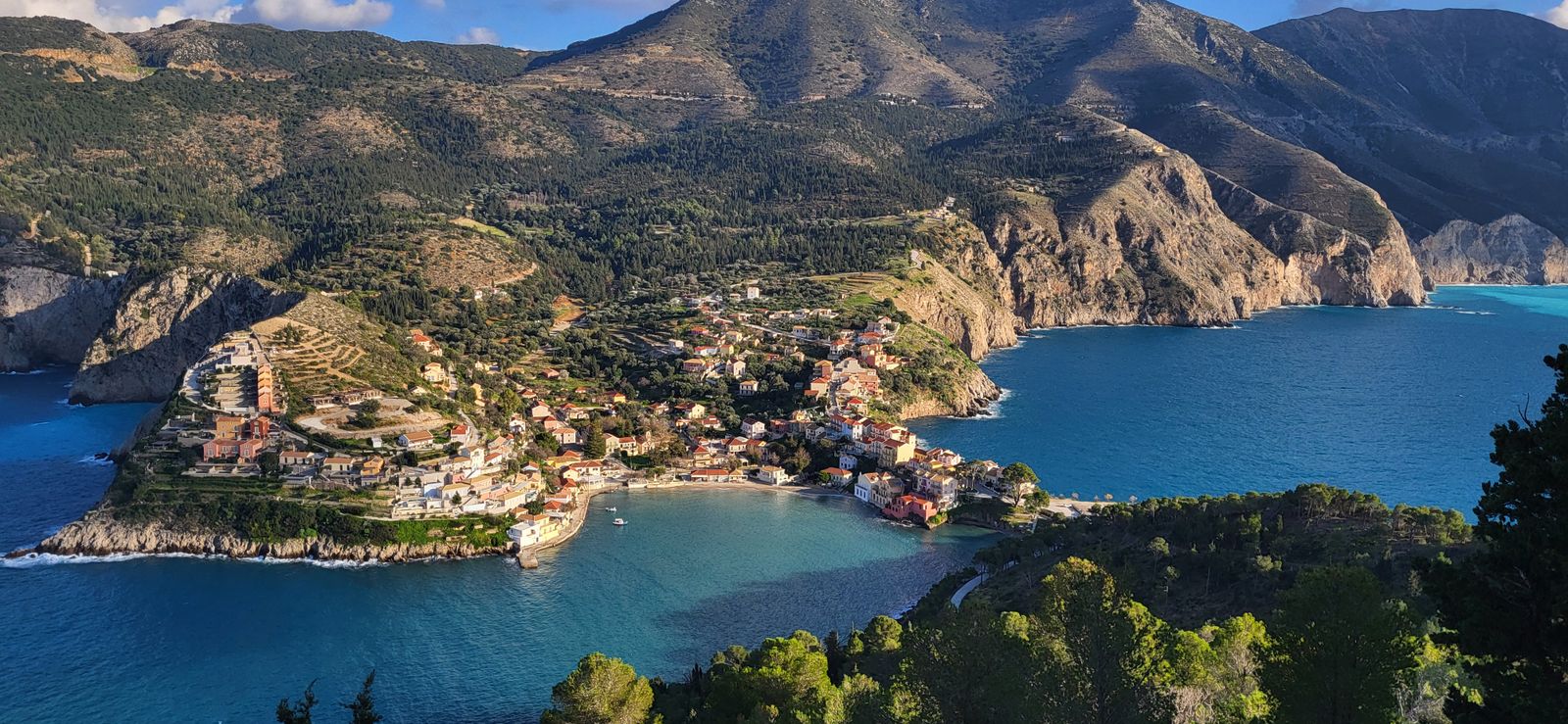
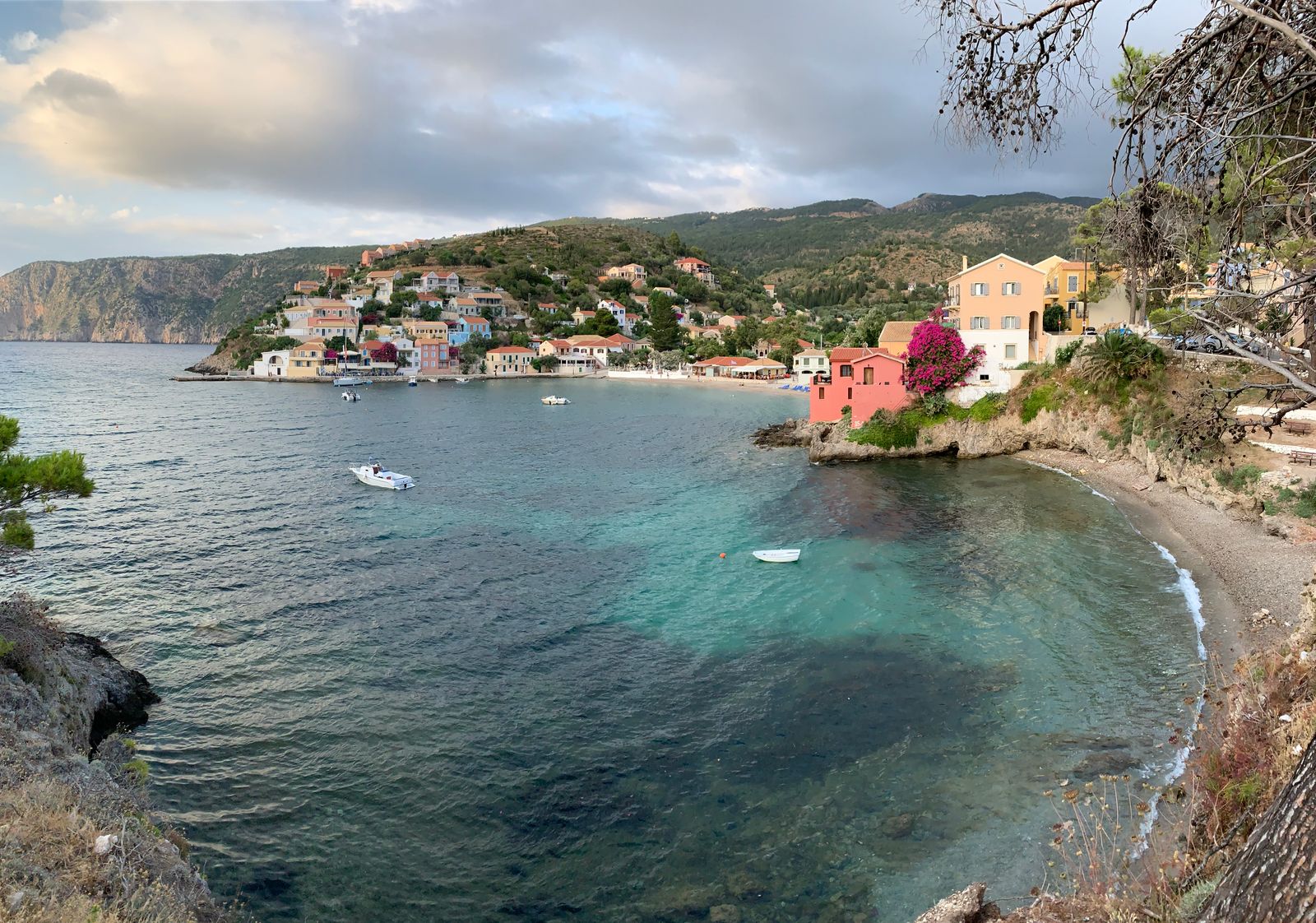
Assos is the most charming village on the island, a little peninsula of colourful houses with a small beach and the ruins of a Venetian fortress on the hill above. It’s a quiet, unfussy place where it’s easy to sit by the water with a plate of Greek vegetable dishes. The fortress is worth the climb for the views, especially towards evening when the light softens.
Fiskardo
Fiskardo is a harbour village on the northern tip of the island and the one place that largely survived the devastating 1953 earthquake. As a result it kept its original Venetian houses in soft pastel colours, lining a pretty little port. There’s a string of cafes and tavernas by the water, and it’s the more elegant, pricier corner of Kefalonia. Perfect for an evening stroll and a slow dinner.
Melissani and Drogarati caves
Melissani is an underground lake whose roof collapsed long ago, letting sunlight pour in. Arrive around midday and the sun hits the surface, turning the water an unbelievable blue. You float across on a small boat and it’s one of the loveliest experiences on the island. Just nearby is the Drogarati stalactite cave, spacious and cool, so the two pair nicely into one morning.
Argostoli and Mount Ainos
Argostoli is the capital and the liveliest hub on the island, good for shops, cafes and a walk around the lagoon, where loggerhead sea turtles sometimes appear. Rising above it all is Mount Ainos, the highest peak in the Ionian Islands and the only national park on a Greek island. The rare Kefalonian fir grows here and you get views across half the Ionian Sea. You drive up to the ridges, and it’s a welcome escape from the beach heat.
A boat trip to Atokos, the island of swimming pigs
One of the most unusual trips nearby goes to the tiny uninhabited island of Atokos, which sits in the Ionian Sea between Kefalonia, Ithaca and Lefkada. A small herd of feral pigs lives here, and they sometimes wander down to the water and paddle near swimmers. The only way over is by boat, for example on a day cruise from Kefalonia, and a pig encounter isn’t guaranteed, since these are wild animals. That’s exactly why it’s nicest to watch them from a respectful distance, not feed them and let them be.
The best beaches in Kefalonia
Kefalonia’s beaches are remarkably varied, from long sandy stretches to tiny pebble coves tucked under cliffs. Beyond the famous Myrtos, a few others are worth a mention depending on the kind of swimming you’re after.
| Beach | Type | Best for |
|---|---|---|
| Myrtos | White pebbles, steep cliffs | Views and photos, stunning scenery |
| Antisamos | Pebbles, green hills around the bay | Calm, clear water, snorkelling |
| Xi | Reddish clay sand, shallow water | Families with kids, easy entry |
| Skala | Long sandy beach with sunbeds | Facilities, classic beach holiday |
| Petani | Pebbles, dramatic west-coast bay | Sunsets, fewer crowds |
Where to eat vegan in Kefalonia
There’s no fully vegan restaurant on the island, but that really doesn’t matter. You’ll eat best in ordinary tavernas where you build a plate from plant-based Greek dishes, and a handful of places mark vegan choices right on the menu. The spots below come from reviews and travellers’ experiences. Opening hours and menus shift season to season on the islands, so always check the current situation in advance, ideally on Google Maps or the venue’s own social media.
In Argostoli the standout is Ladokolla, a grill house with several vegan items such as a veggie burger, chickpea fritters and vegan “souvlaki”. One thing to note, a reviewer mentioned the vegan food is grilled on the same grill as the meat, so for stricter vegans it may not be ideal and it’s worth asking. The Italian-leaning Da Veronica in nearby Lassi tends to have clearly marked vegan options, including a vegan moussaka and garlic mash.
Also in Argostoli, on the waterfront, Captain’s Table serves vegan dishes, and reviewers say they are marked on the menu. They mention a vegan moussaka, stuffed peppers and tomatoes, vegan breakfasts and a mushroom tagliatelle with cashew cream. The regular menu has meat too, so it suits a mixed group.
Near the beaches you can often eat well in plain tavernas like Paradise Beach Taverna in Agia Efimia, which serve fava, fried courgettes, aubergine with onion, or garlic and lemon potatoes. These dishes are vegan by nature and you’ll find them just about everywhere on the island.
| Place | Where | What to order |
|---|---|---|
| Ladokolla | Argostoli | Veggie burger, chickpea fritters, vegan souvlaki |
| Da Veronica | Lassi | Vegan moussaka, garlic mash |
| Captain’s Table | Argostoli | Vegan moussaka, stuffed peppers and tomatoes |
| Paradise Beach Taverna | Agia Efimia | Fava, fried courgettes, aubergine, garlic potatoes |
On a Greek island you don’t only eat vegan in a vegan restaurant, you eat vegan in an ordinary taverna. You just need to know a few dish names and the magic word “nistisimo”.
Where to stay in Kefalonia
Kefalonia is a big island and crossing from one end to the other can easily take an hour or more, so where you base yourself shapes the whole trip. Here’s a quick rundown of the main areas by what you want from your stay.
- Argostoli is best if you don’t want to drive. It has the most restaurants and shops plus the island’s bus links, so you can do a fair bit without a car.
- Lassi sits just outside Argostoli and is a classic resort area with beaches and hotels close by, ideal for a first visit and for families.
- Skala and Katelios in the south have long sandy beaches and a calmer feel, good for an easy beach holiday.
- Sami on the east coast is close to the Melissani and Drogarati caves and has its own port.
- Assos and Fiskardo in the north are the most scenic and quiet, but also the priciest and farthest from the airport. Worth it if you have a car.
Getting around: Public transport in Kefalonia is limited and buses only run between the larger towns. If you want to see more than your hotel’s neighbourhood, it’s worth renting a car for at least a few days. Without one, base yourself in Argostoli or Lassi, where you can cover the most on foot and by bus.
Interesting facts about Kefalonia
Kefalonia is more than beaches and turquoise water. A few things you probably don’t know make it a far more interesting place than the brochure suggests.
- Fiskardo survived the destruction. In August 1953 a series of powerful earthquakes flattened most of the island’s buildings. Fiskardo in the north came through almost untouched, which is why it’s the only village where the original Venetian houses still stand.
- Its own national park. Mount Ainos is the highest peak in the Ionian Islands (1,628 metres) and the only national park on a Greek island. The endemic Kefalonian fir grows here and nowhere else in the world.
- Film fame. Kefalonia is the setting for the novel Captain Corelli’s Mandolin, and the 2001 film with Nicolas Cage and Penélope Cruz was shot here too.
- Its own wine. On the stony slopes below Mount Ainos they grow the Robola grape, which makes a crisp, citrusy white wine. It’s one thing you shouldn’t miss on the island, and happily it’s vegan.
If you’re thinking of Kefalonia as part of a bigger Greek trip, take a look at our guide to the neighbouring island. We’ve written up what to see and where to eat vegan on Zakynthos, and we did the same honest job on Corfu. Together with Kefalonia they make a lovely Ionian itinerary. Outside the Ionian we gave vegan Rhodes the same treatment.
Practical tips and is Kefalonia expensive
Kefalonia has its own airport near Argostoli, and in season both charter and scheduled flights come in. From the airport it’s only a few kilometres to the capital and to Lassi, so transfers are quick. If you want to explore the island, plan on renting a car, because public transport doesn’t cover much.
On price, Kefalonia sits in the middle of the Greek-island range. It’s noticeably cheaper than Santorini or Mykonos, but a bit more than the mainland. As vegans you’re at an advantage, too. Ladera vegetable dishes are among the cheapest things on any menu, so a proper dinner with wine works out reasonably. You’ll save most by heading into an ordinary taverna off the main tourist strip and ordering what the locals eat.
A quick language note
A few words of Greek open doors and the staff appreciate it. “Ime vegan” means “I’m vegan”. “Nistisimo, parakalo” is “fasting food (no animal products), please”. And “choris feta, choris tzatziki” means “no feta, no tzatziki”. Tzatziki is made from yoghurt, so don’t expect a plant-based version as standard.
Kefalonia is proof that a Greek island can be beautiful, calm and vegan-friendly all at once. You just need to know what to order and settle into a taverna that cooks the way locals have always cooked. If you’re planning a longer Greek adventure, have a look at our pick of the best summer holidays for vegans. Then tell us, where are you headed, and what will you order first in Kefalonia?
Frequently asked questions
Is Kefalonia worth visiting?
Yes. Kefalonia pairs some of Greece’s most striking scenery, like Myrtos beach and the Melissani cave, with a calmer feel than the busier islands. Add naturally vegan-friendly food and pretty villages like Assos and Fiskardo, and it’s an easy recommendation for a relaxed trip.
Is Kefalonia expensive?
It’s mid-range for a Greek island, cheaper than Santorini or Mykonos but a little more than the mainland. Vegans tend to spend less because ladera vegetable dishes are among the cheapest things on any taverna menu. Eat away from the main tourist strip to save the most.
Where should I stay in Kefalonia?
Argostoli and nearby Lassi are best if you want restaurants, beaches and bus links without a car. Skala and Katelios suit a quiet sandy beach holiday, while Assos and Fiskardo in the north are the most scenic but pricier and far from the airport, so a car helps.
Is Kefalonia vegan-friendly?
Yes. There’s no fully vegan restaurant, but Greek cuisine is full of plant-based dishes thanks to Orthodox fasting, including fava, gigantes, briam, gemista and horta. Argostoli has places with marked vegan options, and any taverna can feed you if you ask for “nistisimo” food.
What is the best time to visit Kefalonia?
For swimming, late June to the end of September is ideal, when the sea is warm and the weather settled. For sightseeing with fewer crowds and less heat, choose late May to June or September. September is our overall favourite balance of warm sea and calmer resorts.
Newsletter
Get our free e-books
Join the newsletter and download Our Vegan Christmas Kitchen straight away, 10 recipes for Czech cookies, gingerbread and vánočka. Then once a month, new places from the vegan map and new articles. Unsubscribe with one click.