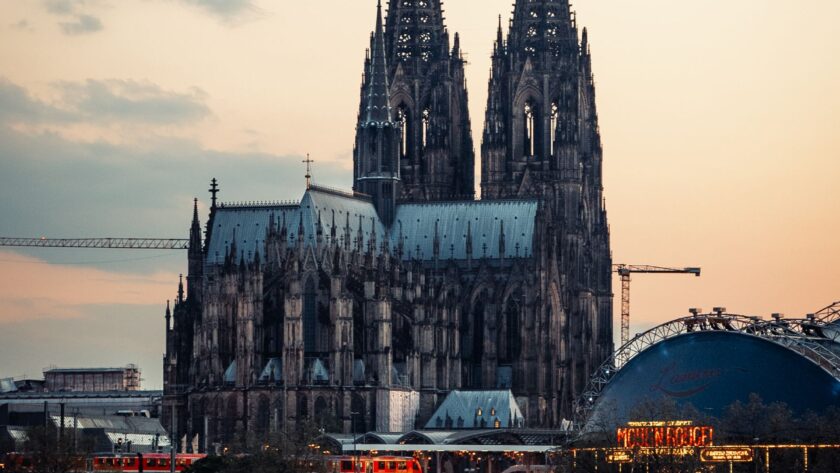
There are more things to do in Cologne than the one photo of the cathedral everyone takes from the station steps.
Cologne (Köln in German) is Germany’s fourth-largest city, sitting on the Rhine close to the Belgian and Dutch borders. It has a Gothic cathedral that took more than 600 years to finish and twelve Romanesque churches. There’s a chocolate museum on the river, and beer halls where the waiter keeps bringing small glasses until you tell him to stop. And it has so many fully vegan restaurants that local magazines sort them by neighbourhood.
Is Cologne worth a weekend, or is one day enough? How much does the cathedral cost since this July, and is there still a way in for free? What can you do when it rains, after dark, or in December when the Christmas markets light up? And where do you eat vegan in Cologne without spending the whole day hunting for something you can order? All prices are in euros.
We haven’t made it to Cologne together yet, so this isn’t a trip diary. It’s a carefully sourced guide. In November 2026 we looked up every place on its own website and read its actual menu. Where a place had no working site, we found at least two independent, recent sources.
Cathedral prices and hours come from the cathedral’s official website, and Christmas market dates from each organiser. We dropped places that have closed or that we couldn’t confirm are still trading, even where other guides still recommend them.
Is Cologne worth visiting, and how many days do you need?
Yes, Cologne is worth visiting, and two full days is the right length for a first trip. Bombing raids in the Second World War destroyed most of the old centre, so don’t expect the medieval lanes of Bamberg or Regensburg. What you get instead is a relaxed, student-heavy city with an enormous cathedral and excellent museums. Half the city sits out on the riverfront in the evening, and the vegan scene is one of the best in Germany.
How many days in Cologne?
Two days is enough for Cologne. Spend day one on the cathedral, the old town hall, Alter Markt square and a walk along the river to the Chocolate Museum. On day two, pick one museum that suits you (modern art, the Romans or perfume). Spend the afternoon in Ehrenfeld or the Belgian Quarter, where most of the vegan food is. A third day makes sense if you want the zoo, a day trip to Bonn, or more markets in December.
Cologne or Düsseldorf?
Choose Cologne over neighbouring Düsseldorf if you want the cathedral, history and beer-hall culture. Düsseldorf is sleeker and more about shopping and modern architecture. The two cities are close, with frequent trains between them, so with extra time you can add Düsseldorf as a half-day trip. If you’re travelling further around the country, we’ve also covered Berlin and its vegan food in every district.
Cologne on our vegan map
22 places, 16 fully vegan. Tap a pin to see the details.
Loading the map…
- 100% vegan
- Vegetarian
- Vegan options
See every place from this article on our vegan map.
Things to do in Cologne’s old town: the cathedral and around
Most of Cologne’s main sights are within fifteen minutes’ walk of the main station (Köln Hbf), which sits directly below the cathedral. You step off the train and the cathedral is right in front of you. Here are the top things to do in Cologne’s centre, in an order that works for a single day.
Cologne Cathedral (Kölner Dom)
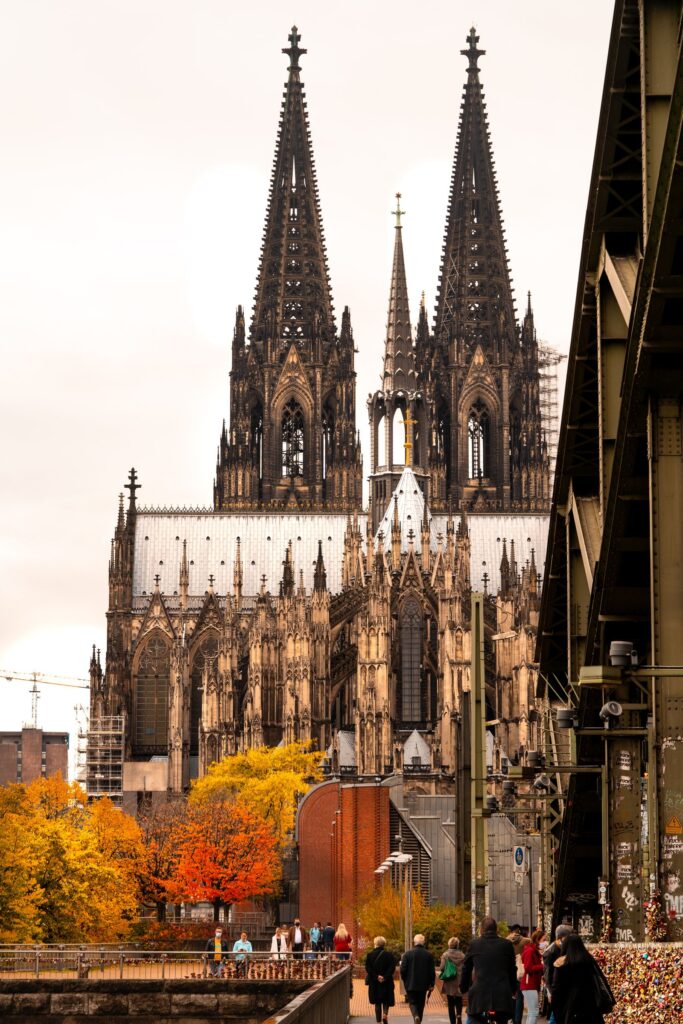
Cologne Cathedral is the Gothic Cathedral of St Peter, begun in 1248 and only completed in 1880. It has been a UNESCO World Heritage Site since 1996 and is Germany’s most visited landmark, with around six million visitors a year. Its greatest treasure is the golden Shrine of the Three Kings, which drew pilgrims here in the Middle Ages.
Since 1 July 2026, visiting Cologne Cathedral costs money. An interior ticket is €12, or €6 reduced for students, trainees and pupils aged 14 and over, and children up to 13 go free. Sightseeing is usually daily from 10:00 to 17:45, but only 13:30 to 16:30 on Sundays and church holidays. You can book up to three months ahead on the cathedral’s official ticket page.
You can still go into the cathedral for free if you’re attending a service or want a quiet moment to pray or light a candle. The north transept stays open for this without a ticket, through the entrance on the main station side, usually from 6:00 to 20:00 on weekdays and 6:00 to 18:15 at weekends. You won’t see the whole cathedral, but you’ll get the atmosphere and the light through the stained glass.
Climbing the south tower
The south tower has 533 steps up to a viewing platform at about 100 metres. The climb costs €8 (€4 reduced), and a combined ticket with the treasury is €12. There’s no lift, so allow 30 to 45 minutes.
From November to February the tower opens 9:00 to 16:00, and from March to October until 18:00. On the way up you pass the belfry, where eight of the cathedral’s twelve bells hang.
Hohenzollern Bridge and the riverfront
The Hohenzollern Bridge (Hohenzollernbrücke) is the railway bridge right behind the cathedral, and its railings are covered with thousands of love locks. Walk across to Deutz on the other bank, where the Rheinboulevard has wide steps down to the water. This is the best view of the cathedral and the old town, especially at sunset. In the evening, locals sit here with a beer, and the view is free.
Alter Markt, the town hall and Great St Martin
The old town between the cathedral and the Rhine is small, and you can walk it in an hour. On Alter Markt square stands the historic town hall, with a Gothic tower full of statues.
A little further on, the tower of Great St Martin (Groß St. Martin) rises over the riverfront. It’s one of the twelve large Romanesque churches Cologne rebuilt after the war. The colourful houses of the Fischmarkt below it are the most photographed corner of the old town.
| Sight | Where | Admission 2026 | Good to know |
|---|---|---|---|
| Cologne Cathedral, interior | Domkloster | €12, children up to 13 free | Sundays only 13:30 to 16:30 |
| Cathedral south tower | entrance by Roncalliplatz | €8, €4 reduced | 533 steps, no lift |
| Treasury and tower, combined | Domkloster | €12, €6 reduced | the KölnCard only discounts the treasury |
| Hohenzollern Bridge and Rheinboulevard | between Hbf and Deutz | free | best view at sunset |
| Chocolate Museum | Rheinauhafen | see the museum’s website | book online in winter |
| Romano-Germanic Museum | Belgisches Haus, Cäcilienstraße 46 | see the museum’s website | main building by the cathedral closed for renovation |
Prices are from the cathedral’s and museums’ official websites, checked in November 2026.
Beyond the cathedral: the river, museums and Ehrenfeld
Outside the old town, four things are worth your time. They are the Chocolate Museum on the river, the museums around the cathedral, the Ehrenfeld district and the cable car over the Rhine. All of them are a riverside walk or a few tram stops from the centre.
The Chocolate Museum and the Rheinauhafen
The Chocolate Museum (Schokoladenmuseum) was opened by chocolate maker Hans Imhoff in 1993 on a peninsula in the former Rheinauhafen harbour. It covers the whole history of cocoa, and a chocolate fountain stands in the middle. The fountain is filled with Lindt chocolate, and we found nothing saying it’s vegan, so assume it isn’t and enjoy the exhibition instead.
Right next door are the three Kranhäuser (“crane houses”), modern office blocks shaped like upside-down harbour cranes. The walk from the cathedral along the river takes about 20 minutes.
What to do when it rains
Cologne is a great rainy-day city because its museums sit close together. Museum Ludwig, right next to the cathedral, has the world’s third-largest Picasso collection and plenty of pop art. The Wallraf-Richartz-Museum covers older painting from the Middle Ages onwards. The fragrance museum in the Farina-Haus tells how Eau de Cologne was created here in the 18th century, which is why “cologne” still means a light perfume in English.
And the Romano-Germanic Museum, now in the Belgisches Haus at Cäcilienstraße 46 while its main building is renovated, holds the world’s largest collection of Roman glass.
Ehrenfeld, street art and Melaten cemetery
Ehrenfeld is a former industrial district in the west of Cologne, now home to clubs in old factory halls, the city’s best street art and a lot of vegan food. Walk along Venloer Straße and the side streets, where whole walls are painted.
Close to Ehrenfeld is Melaten cemetery, a huge park of old graves and statues that stays quiet even on a Saturday afternoon. Entry is free.
Free things to do in Cologne
A lot of the best of Cologne costs nothing. Crossing the Hohenzollern Bridge and sitting on the Rheinboulevard steps is free, and so is the riverside walk to the crane houses, the street art in Ehrenfeld and Melaten cemetery. You can still go into the cathedral for free for a service or a quiet prayer in the north transept. And the Rheinpark across the river is where locals go to lie in the grass in summer.
The cable car across the Rhine and the zoo
The Cologne cable car (Kölner Seilbahn) crosses the Rhine for 930 metres between the zoo and the Rheinpark, and the ride takes about six minutes. This year’s main season ends on 8 November 2026. After that it only runs on the four Advent weekends (Saturdays and Sundays, from 28 and 29 November). Cologne Zoo is right by the lower station, so you can combine both in one morning with kids.
Things to do in Cologne in December: Christmas markets 2026
December is one of the best times to visit Cologne, because it has several big Christmas markets close together and one that’s fully vegan. Our detailed roundup with other cities is in the best Christmas markets in Europe for vegans. Every market’s 2026 dates, a map and what vegans can eat at each one are in our full guide to the Cologne Christmas market. Here’s what matters most.
The Cathedral Christmas market and the old town markets
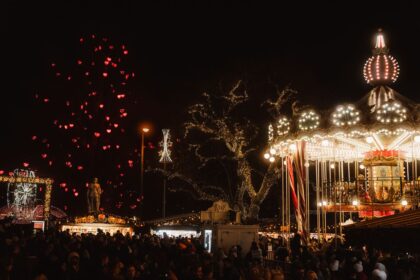
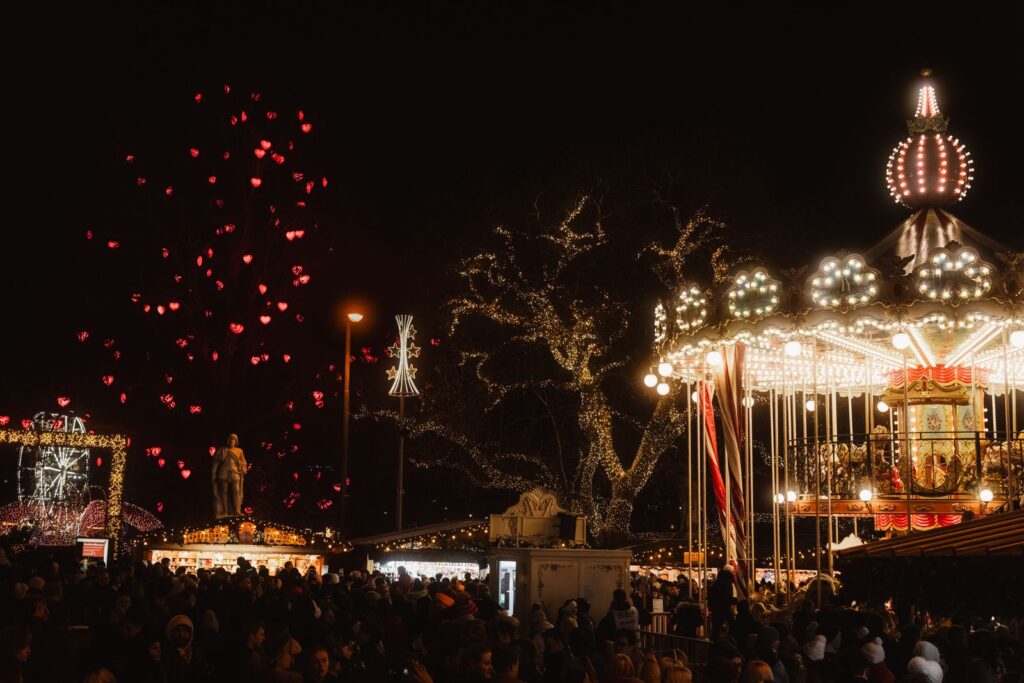
The Cologne Cathedral Christmas market (“Markt der Herzen” on Roncalliplatz) runs from 16 November to 23 December 2026. It’s closed on Sunday 22 November, which is Totensonntag, Germany’s Sunday of remembrance for the dead. It opens Sunday to Wednesday 11:00 to 21:00, Thursday and Friday 11:00 to 22:00, and Saturday 10:00 to 22:00.
Two more markets open in the old town on 23 November, on Alter Markt until 23 December and on Heumarkt, with its ice rink, into January. You can walk between all three in one evening.
What vegans can eat at the Cologne Christmas market
The Cathedral market’s organiser says on its website that several stalls sell vegan food, such as chili sin carne and köttbullar (Swedish-style meatballs). The line-up changes every year, though, so ask at the stall: “Ist das vegan?” Watch out for mulled wine and potato fritters (Reibekuchen), which depend on each stall’s recipe. Glühwein is sometimes sweetened with honey, and the fritters often contain egg.
Go to the Cathedral market on a weekday afternoon rather than a Saturday evening, when you can barely move between the stalls. And remember it’s closed on Sunday 22 November 2026 for Totensonntag, so plan a museum or Ehrenfeld for that day.
Cologne’s vegan Christmas market at Voodmarkt
Cologne also has a fully vegan Christmas market. It’s called the Veihnachtsmarkt (a pun on “vegan” and “Weihnachtsmarkt”) and is run by Voodmarkt in the Protestant church in Kalk, Steinmetzstraße 57. This year it runs over three December weekends, 4 to 6, 11 to 13 and 18 to 20 December 2026. Dates and the programme are on the Voodmarkt website.
Cologne is one of the few big cities where vegans don’t just watch at the Christmas markets. They find chili sin carne or vegan meatballs at the classic market and everything else at their own.
Carnival and 11 November
In Cologne, carnival season opens every year on 11 November at 11:11, when the old town fills with people in costume. The main carnival comes in February. In 2027, Weiberfastnacht (women’s carnival day) falls on 4 February and the big Rosenmontag parade on 8 February. Hotels cost more on those days and some museums close, so if you want a quiet visit, plan around them.
Where to eat vegan in Cologne
Cologne is one of the best cities in Germany for vegans, and most places are in the Belgian Quarter, around Neumarkt square and in Ehrenfeld. The local cooking, by contrast, is very meat-heavy, so look for vegan food in modern restaurants rather than in the beer halls. We checked every place below in November 2026 on its own website or in two independent sources.
Vegan restaurants in the city centre
Zen Chay at Apostelnstraße 2, near Neumarkt, is a fully vegan Asian restaurant. According to its website, everything is vegan, including the sushi and the cocktails. Small sharing plates cost €6.50. Try the bao bun with a soy patty, crispy tofu coated in rice flakes, or “Green Leaf”, tofu and king oyster mushrooms wrapped in betel leaves.
Sattgrün at Ludwigstraße 11, a few minutes from the cathedral, is a vegan buffet where you help yourself to hot dishes, salads, soups and cakes. You pay by plate size, €12.90 for small, €15.90 for medium and €17.50 for large. It’s open daily from 12:00 to 22:00 and closed on public holidays. For families and groups where everyone wants something different, it’s the easiest choice in the centre.
Udum at Am Rinkenpfuhl 55 is a vegan restaurant with sushi, tapas and bowls. Cologne’s food magazines especially praise the sushi with plant-based “salmon” and the vegan “fish” tartare. It’s open Tuesday to Sunday, 12:00 to 23:00, and closed on Mondays.
Vegan food in the Belgian Quarter
The Belgian Quarter (Belgisches Viertel), near Rudolfplatz, is a district of bars, small shops and the densest vegan choice in Cologne. Well Being at Brabanter Straße 48 is a small, fully vegan Vietnamese restaurant cooking with organic ingredients, serving bowls, curries, rice-noodle soups and summer rolls. It only opens in the evening, usually Tuesday to Saturday, so check before you go.
Chum Chay, in a courtyard at Friesenwall 29, is a Vietnamese restaurant with vegetarian and vegan cooking, so ask whether each dish is vegan. It’s closed on Sundays.
Vegan food in Ehrenfeld and Kalk
Virtuous Pie at Venloer Straße 241–245 in Ehrenfeld is a fully vegan pizzeria with its own ice cream. Pizzas cost €14.90 to €17.90, and the menu also has mac and cheese made with cashew cream. It’s closed on Tuesdays, and on Monday, Wednesday and Thursday it only opens at 17:00. The current Virtuous Pie menu is on its website.
Trash Chic at Wiersbergstraße 31 in Kalk is a vegan pub with table football and a punk feel. The favourite is soy gyros with fries, tzatziki and salad. It opens Tuesday to Sunday from 17:00 and is closed on Mondays. Zarathustra at Dasselstraße 4 in Neustadt-Süd is a Persian restaurant where most dishes are vegan, such as kebabs made from plant-based mince or stuffed vine leaves.
| Place | Area | Type | What to order | Closed |
|---|---|---|---|---|
| Zen Chay | Neumarkt | fully vegan | sharing plates at €6.50, sushi | open daily |
| Sattgrün | near the cathedral | fully vegan buffet | plate €12.90 to €17.50 | public holidays |
| Udum | Neumarkt | fully vegan | sushi, “fish” tartare | Monday |
| Well Being | Belgian Quarter | fully vegan | bowls, curry, pho | Monday, Sunday |
| Chum Chay | Belgian Quarter | vegetarian, many vegan dishes | curry with rice noodles (ask for vegan) | Sunday |
| Virtuous Pie | Ehrenfeld | fully vegan | pizza, ice cream | Tuesday |
| Trash Chic | Kalk | fully vegan | soy gyros | Monday |
| Zarathustra | Neustadt-Süd | most dishes vegan | vegan kebab | check |
Opening days are from each venue’s website and local magazines, checked in November 2026.

Travelling on around Germany?
What to order at a bakery or a sausage stand, and how to spot vegan products in German shops, is in our guide to what vegans can eat in Germany.
Beer halls and Kölsch: Cologne in the evening
In the evening, Cologne goes to the beer hall (Brauhaus) for a Kölsch, and this is where vegans need a little planning. The beer halls are an experience, but their kitchens are built around meat, so vegans tend to come for the beer and the atmosphere and eat dinner elsewhere.
Kölsch, the Stange and the Köbes
Kölsch is a pale, top-fermented beer that may only be brewed in and around Cologne. It’s served in tall, narrow 0.2-litre glasses called a Stange.
The waiter, known here as a Köbes, carries the glasses on a round tray. He puts a fresh Kölsch in front of you as soon as you finish the last one. When you’ve had enough, the custom is to put a beer mat on top of your glass. If you don’t drink alcohol, most beer halls also have an alcohol-free version.
What to eat in a beer hall if you don’t eat meat
Traditional Cologne dishes are meat-heavy. “Himmel un Ääd” (heaven and earth) is mashed potato with apple, but it usually comes with black pudding. A “halver Hahn” isn’t half a chicken but a rye roll with cheese.
Most beer hall menus are built around meat. One exception we found is Gaffel am Dom, by the cathedral, whose current menu lists a vegan burger with fries and coleslaw. Otherwise, don’t count on dinner there. Have one or two Kölsch in an old beer hall by the cathedral, then move on to dinner in the Belgian Quarter, a few minutes away by tram.
Cologne after dark
Cologne’s nightlife is mainly in the Belgian Quarter, around Zülpicher Platz near the university, and in Ehrenfeld. The best free evening plan, though, is to cross the Hohenzollern Bridge and sit on the Rheinboulevard steps, with the lit-up cathedral right across the water.
For non-vegans: If you’re travelling with someone who eats plant-based and you’re not sure what you’ll like, start at Sattgrün. It’s a buffet, so you can take a small plate first and see what you enjoy. And if you love pizza, you won’t miss the dairy cheese at Virtuous Pie.
Practical info: getting there, getting around and budget
Cologne is one of Germany’s best-connected cities, and the main station is right in the centre. Once you’re there, getting around is simple.
Getting to Cologne
Cologne Hauptbahnhof is a hub for high-speed trains, so most travellers arrive by rail. From Amsterdam it’s under three hours by train, and from Prague about nine and a half hours at best, usually with one or two changes.
If you fly, Cologne Bonn Airport (CGN) is linked to the main station by the S19 suburban train, which runs every 20 minutes and takes about 14 minutes. You’ll find connections and fares on the Deutsche Bahn website.
Getting around, the Deutschlandticket and the KölnCard
Cologne’s trams and buses are run by KVB and the S-Bahn by Deutsche Bahn, and one ticket covers both. You can walk the centre, though, and you mainly need the tram for Ehrenfeld and Kalk.
If you’re travelling around Germany for longer, look at the Deutschlandticket. It costs €63 a month, rising to €66.80 from 1 January 2027, and covers all regional trains and local transport in Germany. The KölnCard tourist pass includes transport and museum discounts. At the cathedral, though, it only gives you a discount on the treasury, not the interior or the tower.
If your trip includes a Sunday, do the cathedral interior on Saturday. On Sundays the interior is only open for sightseeing from 13:30 to 16:30, which gives you three hours at the busiest time of the week.
Best time to visit Cologne
The best time to visit Cologne is May to September, when you can sit outside by the Rhine and the cable car is running. December is the next best choice for the Christmas markets, though weekends get crowded. Outside carnival week and the big trade fairs, January to March tends to be quieter, with lower hotel prices. Avoid carnival week in February unless carnival is the reason you’re going.
How much does a weekend in Cologne cost?
Cologne is one of the pricier German cities, especially during big trade fairs. For food, budget €12.90 to €17.50 for a plate at Sattgrün, €6.50 per sharing plate at Zen Chay and around €17 for a pizza at Virtuous Pie. The cathedral costs €12 and the tower €8.
You’ll save by making a buffet plate your main meal of the day. Many of the best things to do in Cologne (the riverfront, the bridge, Ehrenfeld, Melaten) are also free.
Where to stay in Cologne
For a first visit, stay within walking distance of the main station and the cathedral. You’ll save time and transport fares, because the old town, the museums and Sattgrün are all a few minutes away on foot. We didn’t find a fully vegan hotel in Cologne. If you’d like a vegan stay somewhere else on your trip, have a look at our 25 fully vegan hotels around the world.
Around the cathedral and the main station
The area around the main station and the cathedral is the most practical base, especially if you arrive by train and leave early. It’s busy in the evening, but everything is close. Prices go up in December and during big trade fairs, so check your dates before you pay.
The Belgian Quarter and Ehrenfeld
If you’d rather stay where the food is, choose the Belgian Quarter or Ehrenfeld. Both are a few tram stops from the centre, and you’ll have vegan restaurants around the corner in the evening. Deutz, across the river, is close to the trade fair grounds and has views of the cathedral, but fewer vegan places.
Useful German phrases for vegans
You’ll get by in English in Cologne, but a few German words help at market stalls and in beer halls. These are the phrases you’ll use most when ordering.
| English | German | Say it like / When it helps |
|---|---|---|
| Is this vegan? | Ist das vegan? | ist dass veh-GAHN, at a market stall |
| I eat vegan. | Ich esse vegan. | ikh ESS-uh veh-GAHN, when ordering |
| Without meat, milk, cheese and egg, please. | Ohne Fleisch, Milch, Käse und Ei, bitte. | OH-nuh flysh, milkh, KAY-zuh oont eye, BIT-uh |
| Is there a vegan option? | Gibt es eine vegane Option? | gipt ess EYE-nuh veh-GAH-nuh op-tsee-OHN, in a beer hall |
| Is there honey in it? | Ist da Honig drin? | ist dah HOH-nikh drin, for mulled wine |
| One Kölsch, please. | Ein Kölsch, bitte. | ine kurlsh, BIT-uh |
| No more, thank you. | Ich möchte keins mehr, danke. | ikh MURKH-tuh kines mair, DAN-kuh, plus a beer mat on the glass |
| Long live Cologne! (carnival cheer) | Kölle Alaaf! | KUR-luh ah-LAHF, on 11 November and in February |
Cologne is worth eating as much as seeing
People come to Cologne for the cathedral, but vegans have a reason to stay longer. Two days covers the cathedral, the riverfront, one museum and one neighbourhood, and you can eat at a fully vegan restaurant for every meal without planning your route around food. This is the first year you pay for the cathedral, so decide whether you want the interior, the tower or just a free, quiet moment in the north transept. And if you can come in December, the combination of the Cathedral market and the vegan Voodmarkt is hard to beat in Germany.
If you’re heading further west, Cologne is under three hours by train from Amsterdam, and via Brussels you can continue to Ghent. And if you’d like another Christmas city, there’s Leipzig, with its Christmas market and vegan food.
Have you been to Cologne? Which vegan restaurant would you add, and which would you tell us to skip?
Frequently asked questions
What are the best things to do in Cologne?
The best things to do in Cologne are the cathedral and its south tower, the Hohenzollern Bridge and the old town around Alter Markt. The Chocolate Museum and Museum Ludwig are the top museums. Add an afternoon in Ehrenfeld for street art and vegan food.
Is Cologne Cathedral free?
No, since 1 July 2026 Cologne Cathedral charges €12 for the interior (€6 reduced), and children up to 13 go free. The tower climb is €8. Attending a service or praying in the north transept is still free.
When is the Cologne Christmas market 2026?
The Cologne Cathedral Christmas market runs from 16 November to 23 December 2026, closed on Sunday 22 November. The fully vegan Voodmarkt in Kalk opens on the weekends of 4 to 6, 11 to 13 and 18 to 20 December 2026.
Is Cologne vegan friendly?
Yes, Cologne is one of the most vegan-friendly cities in Germany. Fully vegan restaurants cluster around Neumarkt (Zen Chay, Udum), in the Belgian Quarter (Well Being) and in Ehrenfeld (Virtuous Pie). Traditional beer halls, by contrast, cook mostly meat.
How many days do you need in Cologne?
Two days is enough for Cologne. Use day one for the cathedral, the old town and the riverfront, and day two for a museum and an afternoon in Ehrenfeld or the Belgian Quarter. Add a third day for the zoo, Bonn or extra Christmas markets.
Newsletter
Get our free e-books
Join the newsletter and download Our Vegan Christmas Kitchen straight away, 10 recipes for Czech cookies, gingerbread and vánočka. Then once a month, new places from the vegan map and new articles. Unsubscribe with one click.