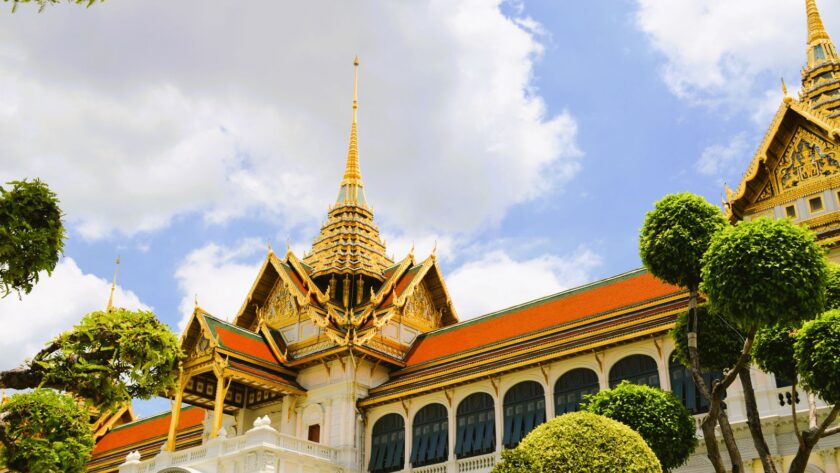
The best things to do in Bangkok are closer together than you’d think. The Grand Palace, Wat Pho and Wat Arun fit into one morning, with a river crossing that costs less than a bus ticket at home. The hard part is everything around them: a huge city, midday heat that sends you running for shade, and menus where fish sauce hides in almost every dish.
So we paired every area of the city with places nearby where you can eat well without meat.
Which temples are worth the entry fee, and what do they actually cost? How do you get around without losing an afternoon to traffic? What do you do in Bangkok when it rains, where do you go at night, and what works with kids?
And where do you get a proper lunch without meat, whether you’re vegan or simply travelling with someone who is? This article answers all of it, with a checked vegan restaurant a short walk or one stop from each part of the city.
We haven’t made it to Bangkok together yet, so this is a carefully researched guide rather than a travel diary. In October 2026 we checked entry prices and opening hours on the official websites of the palace, temples and museums, and we checked every restaurant against its own website or menu, or at least two independent sources where it has none. Places we couldn’t confirm are not in this article, even if other sites still recommend them.
See every vegan restaurant from this article on our vegan map.
Things to do in Bangkok: the best of a first visit
On a first visit, the things to do in Bangkok that matter most start with the temples of Wat Pho and Wat Arun and the Grand Palace. Add a boat ride on the Chao Phraya River, Chinatown after dark and, at the weekend, Chatuchak market. With more time, add Lumphini Park and its monitor lizards, Jim Thompson House, and a day trip to the old capital, Ayutthaya.
Bangkok is easiest to plan by neighbourhood. The old town with the palace sits by the river in the west, the modern centre around Siam and Sukhumvit lies to the east, and Chinatown is in between. Getting from one to another takes longer than the map suggests, so give each day one area.
Thais rarely call their city Bangkok, by the way. To them it is Krung Thep, the City of Angels.
| Sight | Entry (foreigners) | Open | Vegan food nearby |
|---|---|---|---|
| Grand Palace and Wat Phra Kaew | 500 baht | daily 8:30 to 16:30, tickets until 15:30 | Vegan Mahanakhon (across the river) |
| Wat Pho | 300 baht | daily 8:00 to 19:30 | Vegan Mahanakhon, So Vegan |
| Wat Arun | about 200 baht | daily, from around 8:00 | Vegan Mahanakhon |
| Jim Thompson House | 250 baht (ages 10 to 21: 150) | daily 10:00 to 17:00 | Veganerie, Vistro (Sukhumvit) |
| Museum Siam | about 200 baht | Tue to Sun 10:00 to 18:00 | So Vegan (Chinatown) |
| Bangkok Art and Culture Centre | free | Tue to Sun, closed Mondays | Broccoli Revolution (Sukhumvit) |
These prices come from official websites in October 2026. Wat Arun and Museum Siam don’t publish an official price list, so their figures come from several recent travel sources. As a rough guide, 100 baht is about €2.60 or £2.20, so the 500-baht palace ticket costs around €13 (£11).
Bangkok on our vegan map
14 places, 13 fully vegan. Tap a pin to see the details.
Loading the map…
- 100% vegan
- Vegetarian
Things to do in Bangkok’s old town: Grand Palace, Wat Pho and Wat Arun
Bangkok’s old town, Rattanakosin Island, holds the most famous sights in Thailand, and you can see them in a single day. Arrive early, before the heat builds, and start with the palace because it closes first.
The Grand Palace and the Emerald Buddha
The Grand Palace is the former home of the Thai kings, and inside its walls stands Wat Phra Kaew, the temple of the Emerald Buddha, the most sacred statue in the country. According to the palace’s official website, it opens daily from 8:30 to 16:30, but tickets are only sold until 15:30 and cost 500 baht.
The dress code is stricter here than anywhere else. You need covered shoulders and knees, so no vests, short shorts or ripped jeans.
A scarf over your shoulders often isn’t enough, so wear light long trousers or a long skirt from the start. Near the palace, people may stop you to say it is “closed today” and offer a tuk-tuk tour instead. It’s a well-known scam, and the palace is open almost every day.
Wat Pho, the Reclining Buddha and the famous massage
Wat Pho sits right behind the palace wall and is famous for its giant golden Reclining Buddha, around 46 metres long. According to the temple’s own visitor page, it opens daily from 8:00 to 19:30 and foreigners pay 300 baht. Women may not enter in shorts above the knee.
Wat Pho is also the home of traditional Thai massage. Thai massage (nuad thai) has been on the UNESCO list of intangible cultural heritage since 2019, and the school inside the temple grounds offers it every day. Thirty minutes cost 340 baht and an hour costs 520 baht (around €9 and €14). After a morning on your feet, it’s the best money you’ll spend all day.
Wat Arun and the ferry across the river
Wat Arun, the Temple of Dawn, stands on the opposite bank, and you reach it on a small cross-river ferry from the pier by Wat Pho for a few baht. Entry costs about 200 baht according to travel sources. Its tower is covered in pieces of coloured porcelain, and it looks best late in the afternoon and at sunset, ideally from the opposite bank.
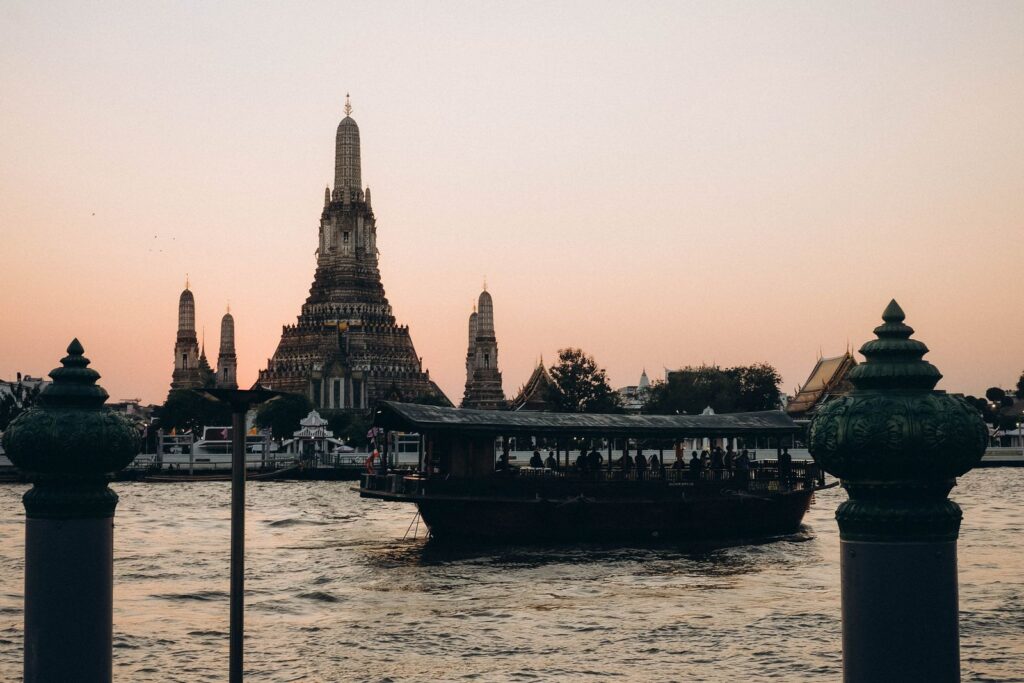
The same dress code applies at Wat Arun as at the palace. The steps up the tower are steep, so proper shoes beat flip-flops.
The Golden Mount (Wat Saket)
The Golden Mount is a temple on an artificial hill topped with a golden stupa, reached by more than 300 steps, with a view over the whole old town from the top. The climb is gradual, so older travellers and children manage it fine. Entry is small, about 100 baht for foreign visitors according to recent travel sources. Late afternoon is best, when it’s cooler and the city starts to light up.
Where to eat vegan in the old town
The best vegan lunch in the old town is Vegan Mahanakhon, fully plant-based Thai cooking in a wooden house more than a century old on Arun Amarin Road in Bangkok Noi, across the river from the palace. According to its own website, it opens daily from 10:30 to 21:00, and booking is a good idea. This is where you try traditional Thai dishes you won’t get vegan in an ordinary restaurant.
Around Khao San Road, 15 to 20 minutes’ walk from the Golden Mount, May Kaidee on Soi Samsen 5 started in 1988 as a street cart and is now a vegan Thai restaurant with cooking classes. On Tanao Road near Khao San, Vegan Pranakhon serves modern vegan Thai food, such as vegan “pork belly” with garlic confit rice. Ethos, in an alley off Khao San, is vegetarian rather than fully vegan, but its vegan dishes are marked on the menu.
Temples and lunch in one day: Start at the palace, move on to Wat Pho, take the ferry to Wat Arun and continue by taxi to Vegan Mahanakhon for lunch. If you still have energy, head back to the Golden Mount for sunset and have dinner around Khao San.
The river and canals: Bangkok from the water
The Chao Phraya River is the cheapest and most beautiful way to get around Bangkok, and an experience in itself. Boats link the palace, Chinatown and the modern district around Taksin Bridge, and they skip every traffic jam.
The Chao Phraya Express Boat for under 20 baht
Chao Phraya Express Boat runs several lines, marked by the colour of the flag at the back of the boat. For ordinary trips, the orange-flag boat is all you need, and from 5 October 2026 it costs 19 baht a ride, according to this up-to-date fare overview. That’s about 50 euro cents. Fares changed several times in 2026 because of diesel prices, but it is still small change.
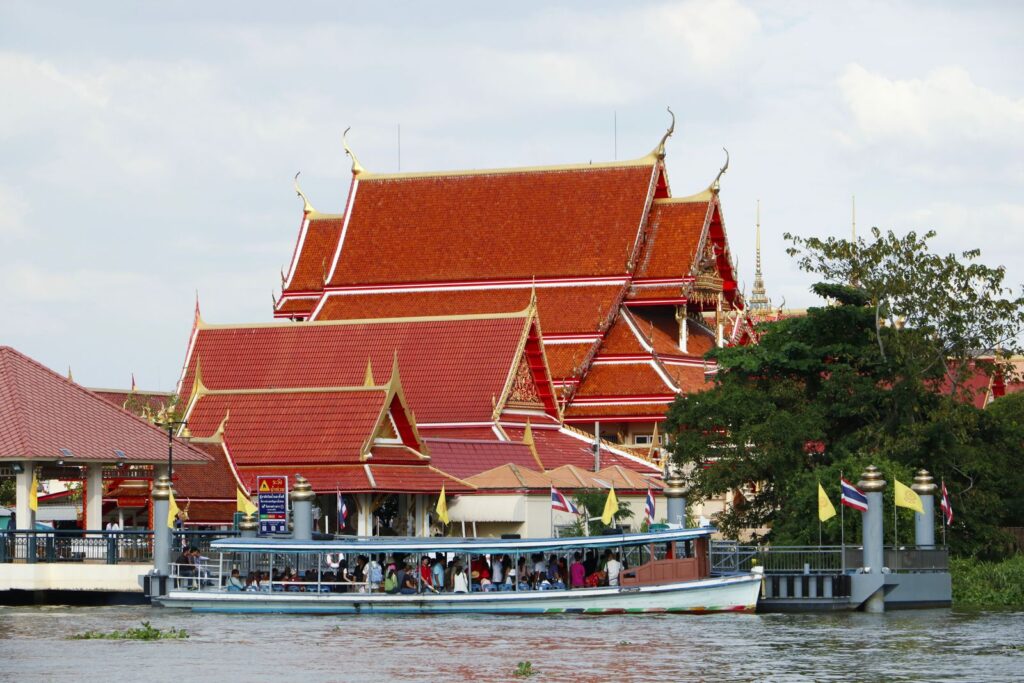
A pricier blue-flag tourist boat also runs, stopping mainly at the sights. Hop on at Sathorn Pier by BTS Saphan Taksin, where the river meets the Skytrain.
Bang Krachao, Bangkok’s green lung
Bang Krachao is a green peninsula in a bend of the river, reached by ferry from Khlong Toei pier, where you get around by bike instead of by car. According to In Your Pocket, it lies just a quarter of an hour from the city centre, yet you ride along narrow raised paths between mangroves and palm trees. You can rent bikes by the pier. It’s the perfect half day for anyone craving green after two days of concrete.
Chinatown (Yaowarat): street food and yellow jay flags
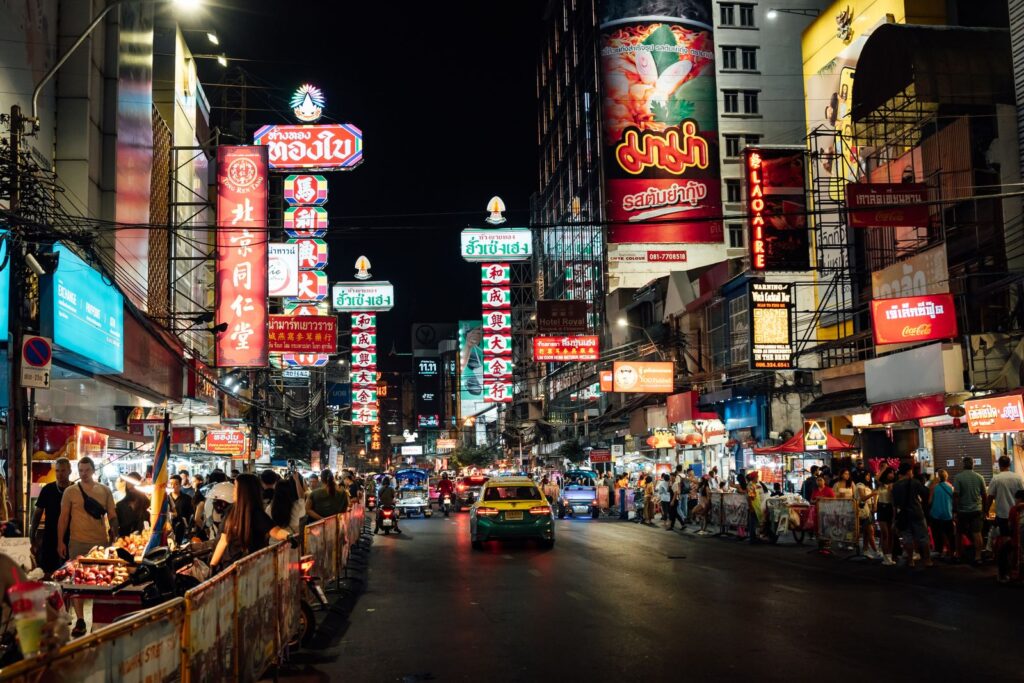
Bangkok’s Chinatown on Yaowarat Road is the best place in the city for street food, and it has a big extra for vegans, jay cooking. Go in the evening, when the street fills with stalls and neon.
What jay is and how to spot it
Jay (เจ in Thai) is a Chinese-Thai tradition of fully plant-based eating with no meat, fish, eggs or dairy, and no garlic or onion either. You can spot jay stalls and restaurants by their yellow flag with red lettering. You can trust these places more than any other restaurant, because jay has religious roots and is kept strictly.
Every autumn, Chinatown hosts the jay vegetarian festival, when whole streets are hung with yellow flags and stalls sell plant-based versions of everything from duck to prawns. The date follows the Chinese lunar calendar and falls in September or October. The 2026 festival has already taken place, and the next one is in autumn 2027.
In Bangkok you don’t need to know restaurant names. Look for a yellow flag with red lettering and you know everything on the plate is plant-based.
Where to eat vegan in Chinatown
The safest vegan choice in Chinatown is So Vegan on the second floor of the I’m Chinatown mall on Charoen Krung Road, with a long, fully vegan Thai menu including dishes without onion and garlic. Further down Charoen Krung towards the river, in Bang Rak, Broccoli Revolution has a second branch, open daily from 11:00 to 21:30.
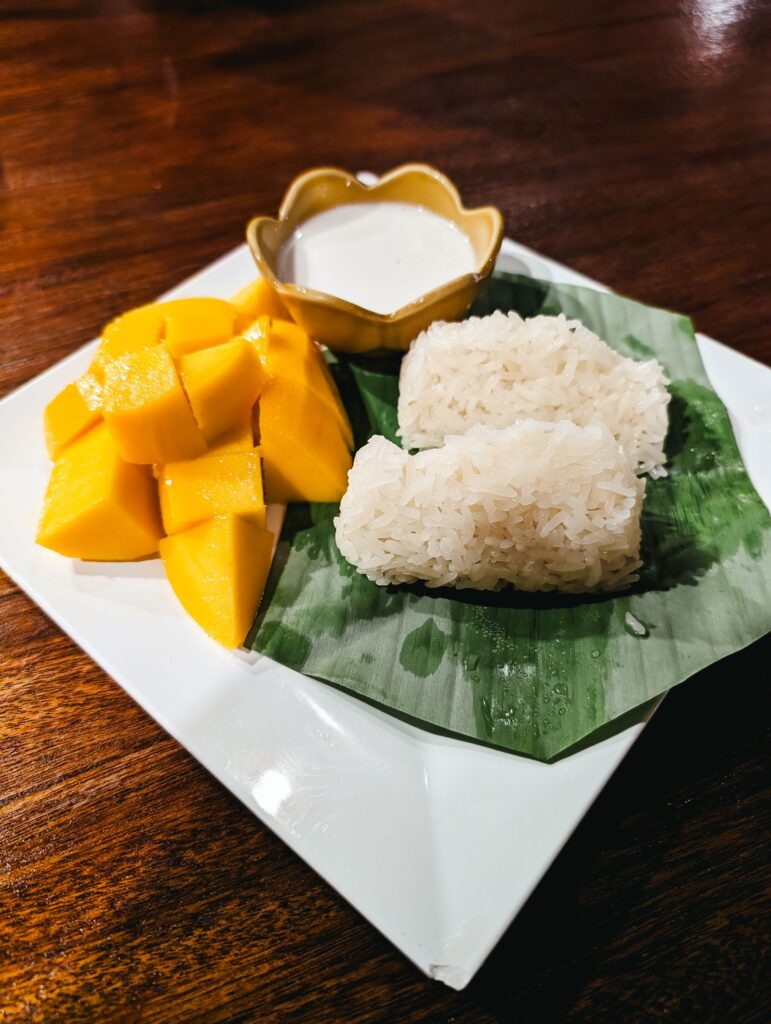
Chinatown is ideal for mixed groups too, since everyone can pick a different stall. Share a plate of mango sticky rice, the Thai dessert of sticky rice with mango and coconut milk. It’s usually free from animal products and everyone loves it.
Pak Khlong Talat flower market
Pak Khlong Talat is a wholesale flower market near Chinatown that, according to In Your Pocket, runs more or less around the clock. It’s at its liveliest between midnight and 5 am, when mountains of marigolds, jasmine, orchids and lotus flowers are traded for temple garlands. If jet lag keeps you awake, there’s no better way to spend your first night in Bangkok.
Modern Bangkok: Sukhumvit, Siam and the parks
Modern Bangkok along the BTS Skytrain is the district of malls, skyscrapers and, above all, the city’s largest number of vegan restaurants. Most foreign visitors stay here, and it’s the most convenient base for a first trip.
Lumphini Park and its monitor lizards
Lumphini Park is a large green park between Silom and Sukhumvit, with a lake, jogging paths and plenty of monitor lizards basking calmly by the water. It’s one of the most unexpected experiences in Bangkok, for children and adults alike, and the lizards barely notice people. Come early in the morning, when locals practise tai chi and the heat is still bearable.
Jim Thompson House
Jim Thompson House is a museum of traditional Thai wooden houses by a canal, the former home of the American businessman who made Thai silk famous after the Second World War. According to the museum’s website, it opens daily from 10:00 to 17:00, adults pay 250 baht and visitors aged 10 to 21 pay 150 baht. You can only enter the main house with a guide, tours run in English, and no booking is needed. Thompson disappeared mysteriously in the Malaysian jungle in 1967, so the guides have stories to tell.
Vegan restaurants on Sukhumvit
Sukhumvit has more fully vegan restaurants than anywhere else in Bangkok, and the best ones are within walking distance of each other. Broccoli Revolution by Soi 49 has been fully plant-based since 2015, from a quinoa burger to Thai curries and homemade ice cream, and opens daily from 8:00 to 21:00. Soi 24, near BTS Phrom Phong, has two vegan places. Veganerie Concept behind Benjasiri Park does pancakes, burgers and a big cake counter, while Vistro serves breakfast from 8:00 and dishes such as chilli bao or vegan “crab” croquettes.
May Veggie Home has served 100% vegan home-style Thai food since 2011, such as vegan pad thai or basil kraphao. Its own website places it in Prasarnmit Plaza on Soi 23, while older listings still say Soi 101, so check the address before you go. Nature’s Charm Cafe on Soi 51 is the coconut milk brand’s café, serving banana blossom “fish” and poke bowls. The small Carrots The Vegan Kitchen near Soi 46 cooks everything from scratch, with dishes from 150 to 340 baht (about €4 to €9).
Not vegan but travelling with vegans? Broccoli Revolution is the safe choice for a mixed group. A big menu, Thai and Western dishes, and plenty of guests who aren’t vegan either.
Markets: Chatuchak and weekends in Bangkok
Chatuchak is the biggest market in Thailand and the best weekend plan in Bangkok. It has more than 15,000 stalls across 27 sections, selling everything from clothes and ceramics to plants.
Chatuchak Weekend Market
The main market opens only on Saturdays and Sundays, roughly from 9:00 to 18:00. Exact times vary by an hour between sources, and on Wednesdays and Thursdays only the plant and flower section is open. Take the MRT to Kamphaeng Phet, which drops you right at the market, or the BTS to Mo Chit. Go in the morning, because after midday the lanes under the tarpaulins get seriously hot.
Part of the market sells live animals. If that makes you uncomfortable, skip the pet sections and stick to clothes, art and food.
The vegetarian food court behind Chatuchak
Right behind the market, on Kamphaeng Phet Soi 1, there’s a vegetarian food court linked to the Asoke community and the Vegetarian Society of Thailand, serving cheap meat-free Thai food. According to Messy Vegan Cook, a blog about Thai vegan food, it closes by around 2 pm, is closed on Mondays and sometimes shuts for a few days at a time. Food runs out fast, so come for breakfast or an early lunch and do the market afterwards.
What to do when it rains
When it rains in Bangkok, head for the museums, galleries and malls, which are everywhere and all air-conditioned. In the rainy season it also rarely pours all day; usually a heavy shower arrives in the afternoon and is over within an hour.
- Bangkok Art and Culture Centre near BTS National Stadium shows contemporary Thai art. Entry is free and it’s closed on Mondays.
- Museum Siam near Wat Pho tells the story of what it means to be Thai through interactive exhibits, and works well for kids. It’s closed on Mondays.
- Jim Thompson House has indoor tours of the house and takes about an hour.
- A Thai massage at the Wat Pho school or any good salon is the perfect plan for an afternoon downpour.
- A cooking class at May Kaidee near Khao San teaches you vegan versions of Thai dishes you can cook at home.
- The malls around Siam, linked by covered walkways to BTS Siam, let you walk half a kilometre without getting wet.
In the rainy season, plan temples for the morning. Showers usually come in the afternoon, so mornings are the best time for outdoor sights. Save the museums for later in the day.
Bangkok at night
Bangkok comes alive after sunset, when it cools down and the streets fill up. The best evening plans are Chinatown, a boat ride past the illuminated Wat Arun, and Khao San Road if you fancy a backpacker atmosphere and cheap beer.
Where to eat and drink vegan at night
For dinner with cocktails, the top pick is Golden State Vegan on the third floor of the RR Space building on Sukhumvit Soi 33. It serves vegan Californian-Japanese sushi and burgers and, according to its own website, opens from noon to midnight, so it works for a late dinner too. Vegan Mahanakhon by the river closes at 21:00 and is ideal for dinner after sunset at Wat Arun. Around Khao San, Vegan Pranakhon and the vegetarian Ethos both stay open in the evening.
Muay Thai at Rajadamnern Stadium
Muay Thai, Thai boxing, is the national sport, and you can watch it live at two main stadiums. Rajadamnern on Ratchadamnoen Nok Road is the older one with the stronger atmosphere, while the new Lumpinee stadium stands further north. Fights run several evenings a week, and you can buy tickets at the box office or online.
Travelling with kids
Bangkok with kids works better than you’d expect, as long as you split the day into short stretches with air-conditioned breaks. Children love the river boats, the monitor lizards in Lumphini Park and the climb up the Golden Mount with its view over the city.
In the rainy season or the midday heat, try Museum Siam, where touching is encouraged, or the library at the Bangkok Art and Culture Centre, which has a children’s corner according to THAIest. At the weekend, Bang Krachao by bike works even with little ones in a child seat.
Bangkok also offers many animal attractions, such as elephant shows, tiger photos or crocodile farms. We recommend skipping them. Behind the fun there is often a long story of animal suffering. The monitor lizards in Lumphini or the birds of Bang Krachao are just as exciting for children, and they live free.
For meals with kids, Veganerie Concept with its pancakes and cakes and Broccoli Revolution with burgers and ice cream are the easiest picks, plus the fresh fruit that every street stall will cut up for you.
Day trips from Bangkok: Ayutthaya and floating markets
The best day trip from Bangkok is Ayutthaya, the former capital of Siam, whose temple ruins have been a UNESCO World Heritage Site since 1991. Trains run from Krung Thep Aphiwat or Hua Lamphong station in about one to two hours (faster trains from Krung Thep Aphiwat take about an hour), and according to Thai Train Guide, a morning rapid train suits a day trip best. Get around the ruins by rented bike or tuk-tuk.
Floating markets are the other popular trip. The best known, Damnoen Saduak, is about two hours’ drive from the city and very touristy. Closer and calmer is the weekend market at Taling Chan on Bangkok’s western edge, a taxi ride away. Floating markets sell lots of fruit, coconut water and fried bananas, so vegans eat well here too.
Best time to visit Bangkok
The best time to visit Bangkok is November to February, when it’s dry and “only” around 30 °C. From March to May it’s very hot, and from mid-May to mid-October it’s the rainy season, with the most rain in September and October.
| Season | Weather | Good to know |
|---|---|---|
| November to February | dry, most comfortable | high season, Loy Krathong in late November, pricier hotels |
| March to May | very hot, hottest in April | Songkran 13 to 15 April, a city-wide water fight |
| Mid-May to mid-October | rainy season, peak in September and October | short heavy showers, fewer tourists, lower prices |
| September or October | wettest months | jay vegetarian festival in Chinatown |
Loy Krathong is the festival of lights, when people float small candlelit boats made of banana leaves on the river. In 2026 it falls on 24 November. Songkran, the Thai New Year, turns mid-April into a giant water fight across the city, wildest on Khao San and Silom. If you’d rather not get soaked with your passport in your pocket, avoid it.
Practical info: getting there, where to stay and budget
Most travellers from Europe fly into Bangkok’s main airport, Suvarnabhumi, on a long-haul flight, often with one change. After that, it’s simple: train from the airport, then Skytrain, metro and boat around the city.
From the airport to the city
From Suvarnabhumi, the Airport Rail Link train runs to the city. It takes just under half an hour to the end of the line at Phaya Thai, where you change to the BTS, and costs 45 baht (about €1.20), according to Wego’s airport transfer guide. A taxi or Grab costs 400 to 575 baht according to the same source, and takes longer in traffic. If you fly a budget airline, you’ll probably land at the second airport, Don Mueang, in the north.
For a long-haul flight, order a vegan meal in advance; we explain how in our guide to the vegan airline meal (VGML).
Where to stay in Bangkok as a vegan
The best base for vegans is Sukhumvit between Soi 23 and Soi 49. From here you can walk to Broccoli Revolution, Veganerie, Vistro and May Veggie Home, and the BTS gets you anywhere in minutes. If you want the temples on your doorstep, pick the old town around Khao San, which is cheaper and close to May Kaidee and Vegan Pranakhon.
Riverside hotels are the most expensive but have the views and their own boats. For fully vegan stays around the world, see our list of vegan hotels.
How much Bangkok costs
Bangkok is cheaper than most European capitals, and your biggest costs are the flight and the hotel. Food, transport and entry fees add up to a few euros or pounds a day.
| Item | Price in baht | Approx. in euros |
|---|---|---|
| Orange-flag river boat | 19 | €0.50 |
| Airport Rail Link to the city | 45 | €1.20 |
| Wat Pho entry | 300 | €8 |
| Grand Palace entry | 500 | €13 |
| One-hour Thai massage at Wat Pho | 520 | €14 |
| A dish at Carrots The Vegan Kitchen | 150 to 340 | €4 to €9 |
Prices come from official websites and menus in October 2026, converted at the Czech National Bank rate of 26 October 2026.
How many days in Bangkok
Give Bangkok three days. Day one, the old town with its temples, and Chinatown in the evening. Day two, the river, Jim Thompson House, and Sukhumvit at night. Day three, Chatuchak if it’s a weekend, or Ayutthaya on a weekday.
Most people then continue north to Chiang Mai or to the islands. For what to eat in the rest of the country, see our answer to is Thailand vegan friendly.
Heading south to the sea? Our things to do in Phuket covers the island’s sights and vegan food.
Read next: vegan Bali
Planning Indonesia after Thailand? Find out the best time to visit Bali and what to eat as a vegan, including vegan warungs in Ubud and what the trip costs.
How to order vegan food in Bangkok: Thai phrases
In Bangkok you can order vegan food with three or four Thai phrases, and you can simply show them on your phone. The most important is “gin jay”, which tells staff you eat fully plant-based. The biggest trap in everyday Thai cooking is fish sauce and oyster sauce, which go into vegetable dishes too.
| What you want to say | Thai (transliteration) | Meaning |
|---|---|---|
| I eat vegan | gin jay | I eat fully plant-based, jay tradition |
| No fish sauce | mai sai nam pla | please don’t add fish sauce |
| No oyster sauce | mai sai nam man hoi | please don’t add oyster sauce |
| No egg | mai sai kai | please don’t add egg |
| Thank you | khob khun kha / khrap | women say “kha”, men say “khrap” |
Away from vegan restaurants, an ordinary 7-Eleven helps too, and Bangkok has one on nearly every corner. You’ll find fruit, soy milk, nuts and often products with a yellow jay sticker. For Thai-style curries to cook at home without fish sauce, try our vegan curry recipes.
Is Bangkok worth visiting?
Bangkok is worth it, for vegans and their non-vegan travel companions more than you’d expect. The temples are stunning, the river is cheap and beautiful, and few big Asian cities have so many fully vegan restaurants so close to their main sights.
Don’t let the heat or the size of the city put you off. Plan each day around one neighbourhood, with temples in the morning, a museum or massage in the afternoon, and food in the evening. Look for the yellow jay flags and learn to say “gin jay”. Do that, and you’ll eat better in Bangkok than in many European cities.
Have you been to Bangkok? Which vegan restaurant or jay stall would you recommend to other readers? Tell us in the comments, and we’ll gladly add it at our next check.
Frequently asked questions
What are the best things to do in Bangkok in 3 days?
In three days in Bangkok you can see the Grand Palace, Wat Pho and Wat Arun, take a boat on the Chao Phraya River, explore Chinatown at night, and visit Jim Thompson House and Lumphini Park. On day three, go to Chatuchak market at the weekend or take a day trip to Ayutthaya on a weekday.
What is the best time to visit Bangkok?
The best time to visit Bangkok is November to February, when it’s dry and at its most comfortable. March to May is very hot, and mid-May to mid-October is the rainy season, with the most rain in September and October.
How much is the Grand Palace entrance fee?
The Grand Palace costs 500 baht (about €13), with tickets sold daily from 8:30 to 15:30. You need covered shoulders and knees. Wat Pho next door costs 300 baht.
What to do in Bangkok when it rains?
When it rains in Bangkok, visit the Bangkok Art and Culture Centre (free), Museum Siam, Jim Thompson House, a Thai massage at Wat Pho or a cooking class. Note that the art centre and Museum Siam are closed on Mondays.
Is Bangkok vegan friendly?
Yes, Bangkok is one of the most vegan-friendly cities in Asia. It has dozens of fully vegan restaurants, mostly on Sukhumvit, plus the jay tradition of fully plant-based food, marked by a yellow flag with red lettering. In ordinary restaurants, say “gin jay” and “mai sai nam pla” (no fish sauce).
Newsletter
Get our free e-books
Join the newsletter and download Our Vegan Christmas Kitchen straight away, 10 recipes for Czech cookies, gingerbread and vánočka. Then once a month, new places from the vegan map and new articles. Unsubscribe with one click.