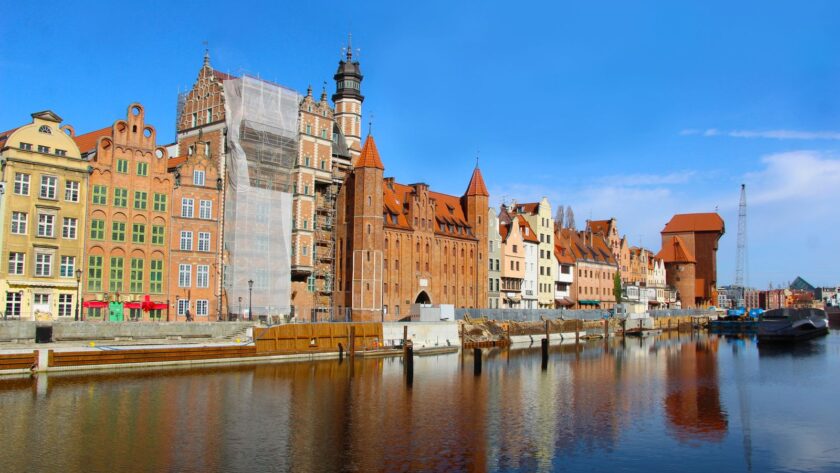
Looking for the best things to do in Gdańsk? Start with Long Market and Neptune’s Fountain, the medieval wooden crane on the Motława river and one of the largest brick churches in the world. Add the shipyard gate where Solidarity was born in 1980 and a sandy Baltic beach you can reach by tram. Then there are two very different neighbours, Sopot and Gdynia, half an hour away by local train.
What most guides skip is that Gdańsk is a very good city for vegan food. There is a fully vegan, table-service restaurant in the historic centre. One street in the Wrzeszcz district has a vegan bistro, café and shop side by side. And a pierogi place lets a vegan and a meat-eater order at the same table.
Is Gdańsk worth visiting, or is it just a cruise-ship stop, and how many days do you need? Where do you eat vegan when your travel partner still eats meat, and what is Gdańsk like in December, when the Christmas market fills Targ Węglowy? We answer all of it below, with prices in złoty.
We haven’t made it to Gdańsk together yet, so this isn’t a trip diary. In October 2026 we read every restaurant’s own menu, checked the sights on their official websites and looked up the trains and airport buses. Places we couldn’t find fresh proof for, that they’re open and actually cook vegan, are left out, even if other sites still recommend them.
Is Gdańsk worth visiting?
Yes, Gdańsk is worth visiting, especially if you want a beautiful historic city and the sea in one trip. The Main Town (Główne Miasto) is compact and easy to walk. Its museums on the 20th century are among the best in Poland. And the beach is only a few tram stops from the centre.
Gdańsk rewards three nights more than a rushed weekend, because the sea and the Tricity add as much as the old town. If you only want an old town and great vegan food, our vegan Kraków weekend is the easier first trip to Poland.
Gdańsk is also the largest of the three cities Poles call the Tricity (Trójmiasto). Gdańsk, Sopot and Gdynia sit one after another along Gdańsk Bay, joined by a single commuter rail line. Stay four days and the spa town of Sopot and modernist Gdynia come almost free.
How many days do you need in Gdańsk?
Plan three days for Gdańsk. Day one covers the Main Town, Long Market, St Mary’s and the Motława waterfront. Day two is for the European Solidarity Centre, the Museum of the Second World War and an afternoon on the beach at Brzeźno.
Day three belongs to Sopot and Gdynia. A fourth day fits Westerplatte, Oliwa or simply a slow breakfast.
Gdańsk on our vegan map
8 places, 5 fully vegan. Tap a pin to see the details.
Loading the map…
- 100% vegan
- Vegetarian
- Vegan options
See every place from this article on our vegan map.
Things to do in Gdańsk: the Main Town and Royal Way
The first thing to do in Gdańsk is walk the Royal Way, from the Upland Gate along Długa street to Long Market and the Green Gate by the river. In less than a kilometre you pass the city’s most famous sights, and it takes about an hour with photo stops.
Gdańsk’s historic centre looks like a Hanseatic port that war never touched. In fact much of it was rebuilt after 1945. Just like Warsaw, which was rebuilt from the ruins, the reconstruction is so careful that most visitors never notice.
Długa, Long Market and Neptune’s Fountain
Długa street and Długi Targ (Long Market) are Gdańsk’s showpiece, lined with narrow merchants’ houses and ornate gables. In the middle stands Neptune’s Fountain, completed in 1633, a fitting symbol for a city that grew rich on sea trade. Next to it is Artus Court, where wealthy merchants once met, and the Main Town Hall with its slender tower.
Long Market is at its best early in the morning, before the cruise groups arrive. In the evening the lamps come on and the façades look like a stage set. The town hall is home to the Museum of Gdańsk, which also runs several other historic buildings in the centre.
St Mary’s Church: over 400 steps to the top
St Mary’s Church (Bazylika Mariacka) dominates Gdańsk and is one of the largest brick churches in the world. Building started in 1343 and the last brick of the vault went in in 1502. According to the basilica’s official website, it is 105 metres long.
Inside it is white and bright, which surprises after the dark brick outside. More than 400 steps lead up the tower, rewarding you with rooftops, shipyard cranes and, on a clear day, the sea. The tower closes in bad weather, so check on the day.
Mariacka street and Baltic amber
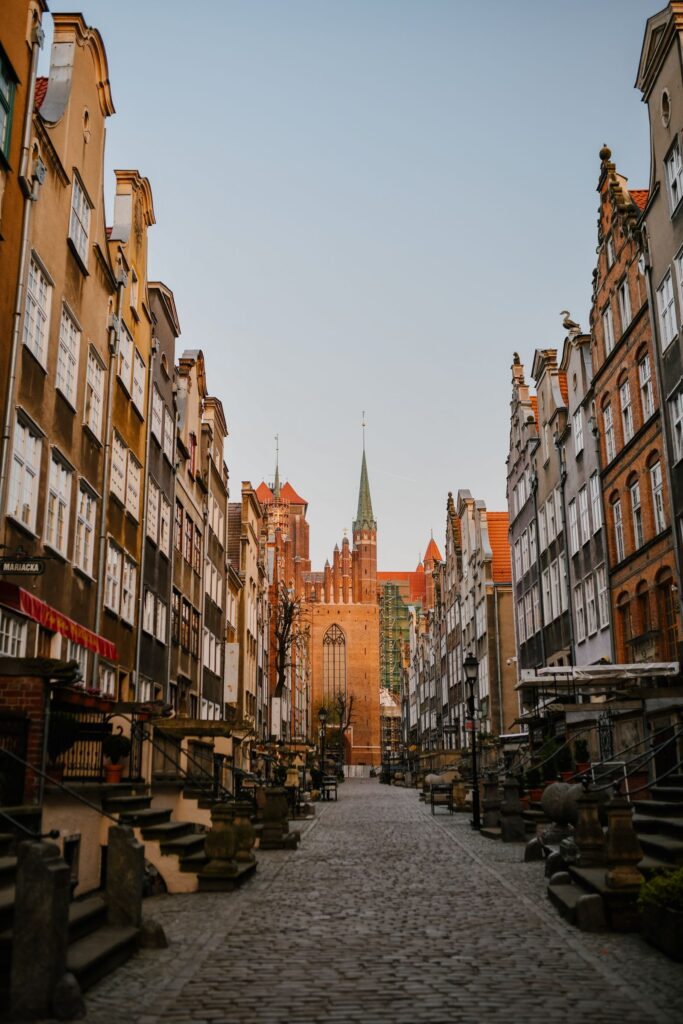
Mariacka street runs from St Mary’s down to the river and is the most photogenic street in Gdańsk. The houses have raised stone terraces with steps, called przedproże, and gargoyles shaped like animal heads. At street level are small shops selling amber, the thing Gdańsk has traded for centuries.
Amber is fossilised tree resin that the Baltic washes up on its beaches. For vegans that’s good news, since it’s plant-based. If you want a souvenir, Mariacka is the nicest street to buy it, though prices in the most touristy shops run higher.
The Motława waterfront and the medieval crane
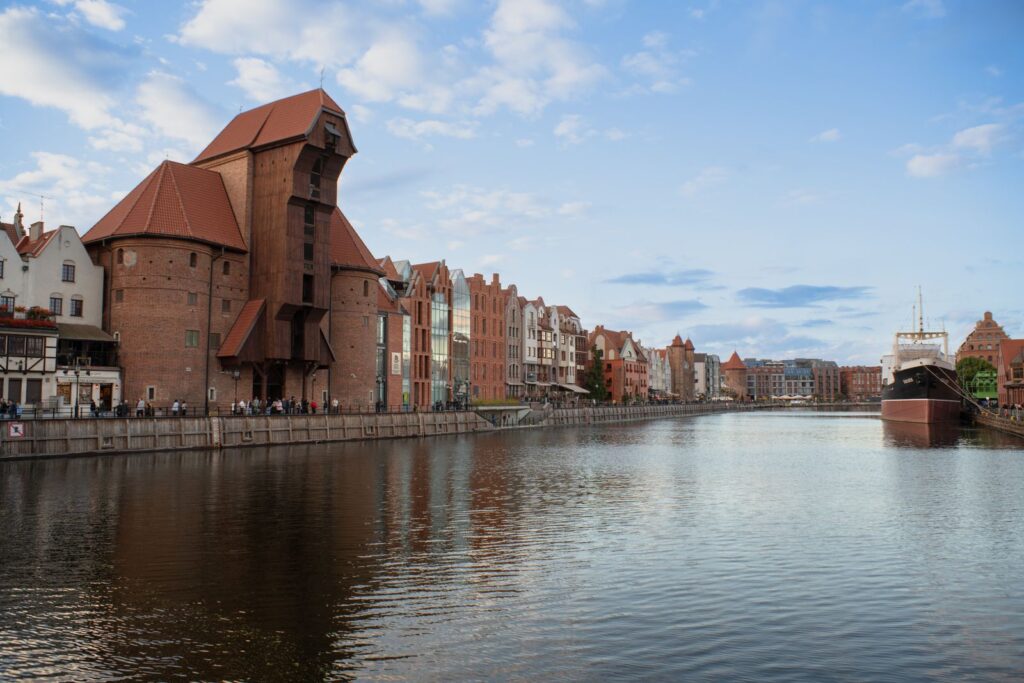
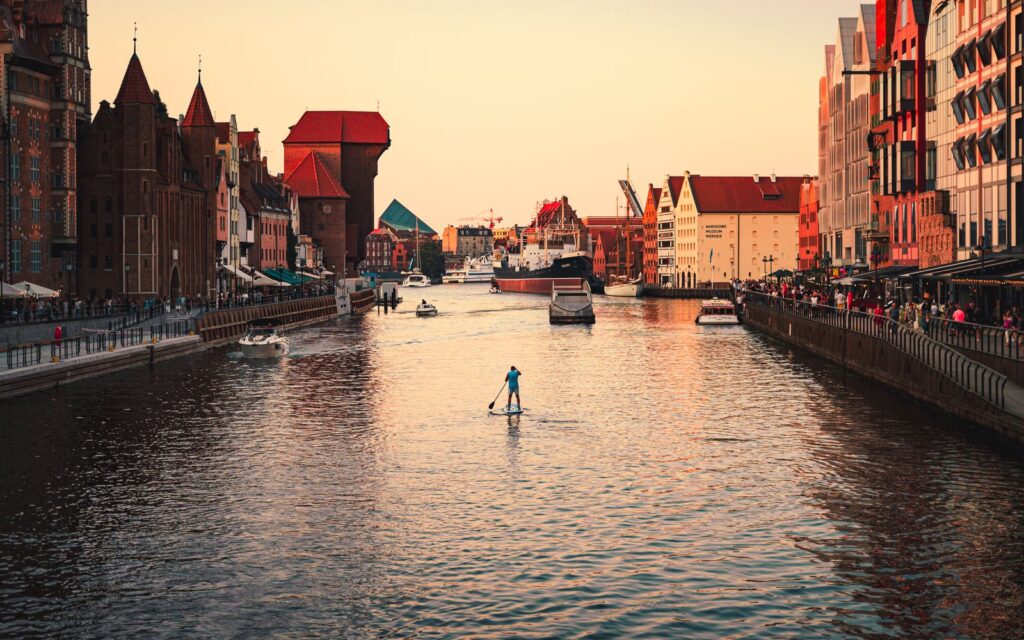
The Motława river is Gdańsk’s promenade, and on it stands the city’s best-known symbol, the medieval crane, Żuraw. This wooden harbour crane from 1442–1444 once lifted cargo and ships’ masts. Today it is part of the National Maritime Museum.
The Długie Pobrzeże waterfront is lined with cafés and sightseeing boats. Cross the bridge to Ołowianka island and Granary Island (Wyspa Spichrzów), where old granaries have turned into new apartments and hotels. Come at dusk, when the houses reflect in the water.
Route tip: Walk the Royal Way in the morning from the Upland Gate to the Green Gate, then come back along the Motława. Lunch at the vegan restaurant Manna 68 on Świętego Ducha street is then only a few minutes’ walk away.
Gdańsk and the 20th century: Solidarity and Westerplatte
Gdańsk is where the Second World War began and where, forty years later, communism in Central Europe began to crack. That’s why it has two of the best museums in Poland. Both are modern, interactive and fully labelled in English.
The European Solidarity Centre
The European Solidarity Centre (Europejskie Centrum Solidarności) stands by the gate of the former shipyard where the strike of August 1980 broke out. According to the Centre’s official website, ten million Poles joined the independent Solidarność union after the August Agreements. The exhibition takes you from the strike through martial law in December 1981 to the fall of communism.
You’ll spot the rust-coloured building from afar. Besides the exhibition it has a rooftop view over the shipyard and a library. Allow two to three hours.
The Museum of the Second World War
The Museum of the Second World War (Muzeum II Wojny Światowej) is a large, modern museum a few minutes’ walk from the centre by the Motława. Most of the exhibition is underground and tells the war through ordinary people’s lives, not just armies. Be ready for it to be demanding, both emotionally and in length.
The museum is closed on Mondays. Check current hours and prices on the Museum of the Second World War website, as they change with the season.
Westerplatte
Westerplatte is the peninsula at the harbour mouth where, at about 4:45 on 1 September 1939 (some historians say 4:48), a German battleship opened fire on the Polish garrison. The moment is considered the start of the Second World War in Europe. Today it has a monument, ruined barracks and a quiet walk through the woods.
Westerplatte sits at the edge of the city by the harbour entrance, so allow half a day for getting there, walking around and coming back.
Watch out for Mondays: the Museum of the Second World War and the National Maritime Museum are both closed on Mondays. That makes Monday the perfect day for the beach, Oliwa, or Sopot and Gdynia.
Things to do in Gdańsk beyond the centre: beaches and Oliwa
Gdańsk has its own sandy Baltic beaches, and you can reach them by tram from the centre. The best known are Brzeźno with its wooden pier, Jelitkowo on the border with Sopot, and wilder Stogi on the far side of the port. They’re packed from June to August and lovely for walks the rest of the year.
Gdańsk beaches: Brzeźno, Jelitkowo and Stogi
Brzeźno is the beach closest to the centre and has a wooden pier with views across the bay. Jelitkowo runs into Sopot, so you can walk along the shore all the way to Sopot pier. Stogi lies beyond the port, with a wide beach and forest behind it.
The Baltic is cold. Swimming is really a July and August thing, when the water is at its warmest. If the sea is your main reason to go, think walks, sunshine and evening light rather than a Mediterranean-style swim.
Oliwa: cathedral, park and calm
Oliwa is a green district in the north of Gdańsk with a cathedral and a large park. The cathedral is famous for its organ, which plays short concerts. Behind it lies an extensive park with ponds and old trees.
You get to Oliwa by SKM commuter train, and it’s an easy stop on the way to Sopot. The Nie/mięsny bistro has a branch here too.
Where to eat vegan in Gdańsk
Gdańsk’s vegan scene is smaller than Warsaw’s or Kraków’s, but what exists is excellent. The fully vegan restaurant Manna 68 is right in the historic centre. The second vegan hub is Wrzeszcz. There the Avocado bistro, café and shop sit side by side on Wajdeloty street, with the vegan cake café Fukafe a few doors away.
Wrzeszcz is about seven minutes from Gdańsk Główny on the SKM train. All prices come from the venues’ own menus in October 2026. As a rough guide, 10 zł is about €2.30 or £2.
Manna 68: a vegan restaurant in the old town
Manna 68 at Świętego Ducha 68 is a fully vegan, table-service restaurant and the top address for vegans in Gdańsk. According to Manna 68’s menu, it serves a 3D-printed steak made from soy and seitan for 124 zł. It’s the perfect conversation starter with anyone who eats meat.
For a Polish classic, order the seitan zrazy (rolled “beef” with pickle, mustard and onion) with Silesian dumplings for 59 zł. Silesian dumplings with mushroom sauce on their own cost 36 zł. Breakfast runs every day from 9:00 to 12:00, including shakshuka with vegan “eggs” for 38 zł.
Manna 68 is open every day, from 10:00 on weekdays and from 9:00 at weekends. The drinks list includes Goldwasser, a herbal liqueur with flakes of gold leaf that originates from Gdańsk.
Wrzeszcz: Avocado Vegan Bistro, Spot and Fukafe
Avocado Vegan Bistro at Wajdeloty 25/1 cooks vegan Polish home food. According to the bistro’s menu valid from 8 October 2026, a soy schnitzel (schabowy) with mashed potato costs 41 zł. Pielmieni (small dumplings with soy and mushroom filling) and a stuffed cabbage roll (gołąbek) cost the same.
The bistro is open daily from 11:00 to 19:00, last orders at 18:45. Next door at number 25 is Avocado Vegan Spot, a street-food café open daily from 9:00 to 20:00, and across the street at number 24 is their vegan shop.
Fukafe at Wajdeloty 22 is a fully vegan café that local guides praise mainly for its cakes. You’ll find vegan versions of Polish classics and coffee made with alternative brewing methods. Check opening hours on the spot, as sources disagree.
Pierogarnia Mandu: pierogi by the station for mixed groups
Pierogarnia Mandu at Elżbietańska 4/8, a short walk from Gdańsk Główny, isn’t vegan but has a separate vegan pierogi section. Ten pierogi with potato, tofu and onion cost 43 zł. Twelve deep-fried tofu pierogi with coriander and mango sauce are 45 zł. Prices are from the October 2026 menu, so check them on the spot.
Mandu is ideal when you’re travelling with someone who wants classic pierogi ruskie with curd cheese, or meat. You order at the same table and nobody misses out. Mandu also has branches in Oliwa and Gdynia.
Faloviec: a vegan bistro near the sea
Faloviec at Obrońców Wybrzeża 2 in Przymorze is a vegan bistro outside the centre. According to Faloviec’s ordering page, it cooks soups, lunches and desserts and stocks regional beers. Soy shawarma with roast potatoes or rice costs about 47 zł.
Faloviec opens daily at 11:00 and works well on a beach day at Jelitkowo or on the way to Sopot, as Przymorze sits close to the coast.
Nie/mięsny: two menus under one roof
The Nie/mięsny bistro (“Not/Meaty”) at Jaskółcza 24 in the Lower Town has two menus, one with meat and one without. It opened in a former butcher’s shop and kept the old “Mięsny” sign with “Nie” added. The meat-free side is mostly vegetarian, though, with labneh, halloumi and eggs.
Vegans will mostly pick the Beyond burger on a vegan bun with soy mayo, or falafel with hummus. Ask when you order. Nie/mięsny is a great choice with friends who want meat, because everyone finds something.
| Venue | District | What to order | Price | Vegan? |
|---|---|---|---|---|
| Manna 68 | Main Town | seitan zrazy, 3D steak | 59–124 zł | yes, whole menu |
| Avocado Vegan Bistro | Wrzeszcz | soy schnitzel, pielmieni | 41 zł | yes, whole menu |
| Avocado Vegan Spot | Wrzeszcz | street food, coffee | see menu | yes, whole menu |
| Fukafe | Wrzeszcz | cakes, coffee | see menu | yes, whole menu |
| Faloviec | Przymorze | soy shawarma | about 47 zł | yes, whole menu |
| Pierogarnia Mandu | by Gdańsk Główny | potato and tofu pierogi | 43–45 zł | no, but has a vegan section |
| Nie/mięsny | Lower Town | Beyond burger, falafel | see menu | no, a few dishes only |
In Gdańsk a vegan and a meat-eater can order pierogi at the same table and both leave happy.
Read next
Gdańsk is one of 16 cities in our round-up of vegan city breaks in Central Europe, alongside Warsaw, Kraków and Wrocław.
The Tricity: Sopot and Gdynia in one day
You can do Sopot and Gdynia from Gdańsk in a single day on the SKM commuter trains. Sopot is about 20 minutes from Gdańsk Główny and Gdynia about 35 minutes. On weekdays trains run often through the day, less often at weekends, so check the timetable.
Watch the tickets. Gdańsk tram and bus tickets aren’t valid on SKM trains. Buy an SKM ticket from the station machine or in an app before you board.
| SKM journey | Time | What to see | Where to eat |
|---|---|---|---|
| Gdańsk Główny → Gdańsk Wrzeszcz | about 7 minutes | Wrzeszcz, Wajdeloty street | Avocado, Fukafe |
| Gdańsk Główny → Gdańsk Oliwa | a few stops | cathedral, park | Nie/mięsny (Oliwa) |
| Gdańsk Główny → Sopot | about 20 minutes | pier, Monte Cassino street | Green Way (vegetarian) |
| Gdańsk Główny → Gdynia Główna | about 35 minutes | modernist centre, museum ships | bring a snack from Gdańsk |
How to get from Gdańsk to Sopot
Sopot is a spa town between Gdańsk and Gdynia, and its symbol is the wooden pier. According to the Sopot pier operator, it is 511.5 metres long in total, 458 metres of it over the sea, and took its present shape in 1927.
From the station, the pedestrian street Bohaterów Monte Cassino, known locally as Monciak, leads down to the pier. At number 53 stands Krzywy Domek, the “Crooked House”, whose wavy façade looks like it’s melting. At number 47 is Green Way, a vegetarian restaurant that has been cooking on Monciak since 1997. It has a soy schnitzel, green curry with tofu and a Japanese bowl with tofu, but the menu also includes eggs and cheese, so ask.
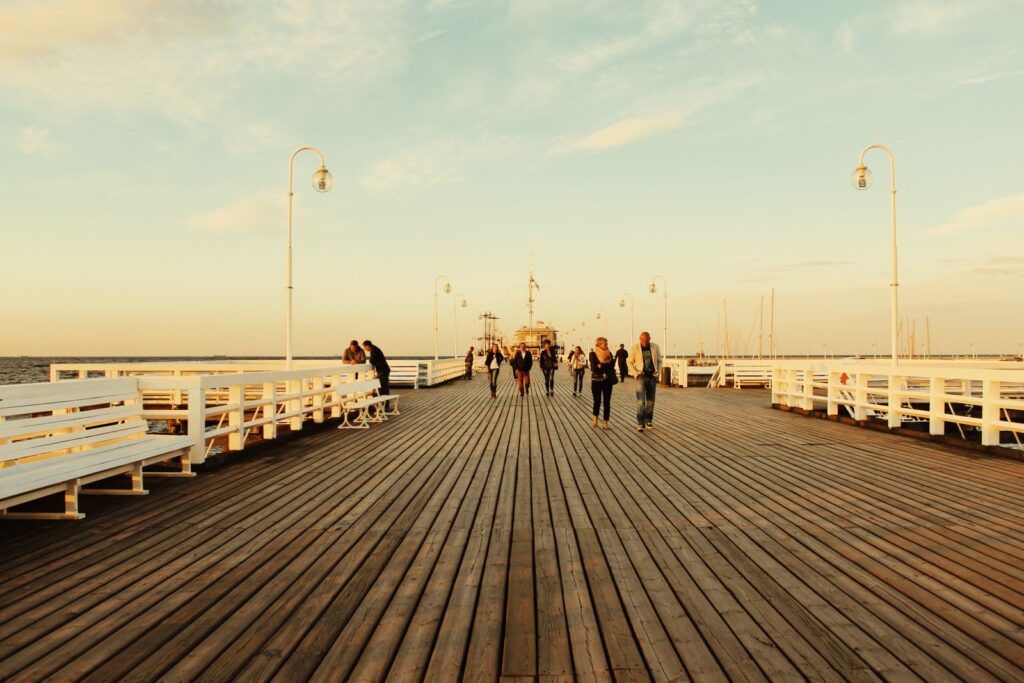
We’ll give Sopot its own article soon. For an afternoon on a Gdańsk trip, the pier, Monciak and a beach walk are plenty.
How to get from Gdańsk to Gdynia, and what to see
Gdynia is the youngest of the three cities, and in July 2026 its modernist centre was added to the UNESCO World Heritage List. The city was built between the world wars as Poland’s new port, and its centre from that era survived the war almost undamaged. It’s Poland’s 18th UNESCO site. The SKM train from Gdańsk Główny takes about 35 minutes.
Two museum ships are moored on the waterfront. The sailing ship Dar Pomorza, built in 1909, served for decades as the training ship of the maritime school. According to the National Maritime Museum, until the end of October 2026 it opened Tuesday to Sunday with a regular ticket at 28 zł; check winter hours. Next to it is the destroyer ORP Błyskawica, another museum ship.
Vegan food is harder in Gdynia. For 2026 we couldn’t find a fully vegan place there whose menu and opening we could verify. Mandu has a branch in Gdynia, but we didn’t check its menu separately. The safest plan is to eat in Gdańsk or Sopot and bring a snack to Gdynia.
A full Tricity day: take the morning train to Gdynia, go to Sopot pier in the afternoon on foot along the coast or by train, and head back to Gdańsk for dinner at Manna 68. That puts the biggest meal of the day where it’s most reliable.
Gdańsk in December: the Christmas market
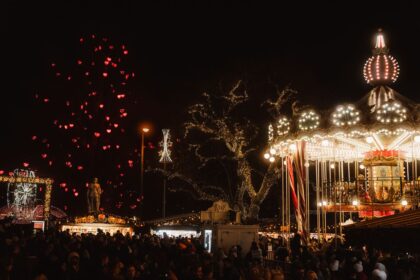
The Gdańsk Christmas market (Jarmark Bożonarodzeniowy) runs from 20 November to 23 December 2026 on Targ Węglowy square. The dates were confirmed by the city’s official news site, gdansk.pl. New this year is a small food court on the square by Ogarna street.
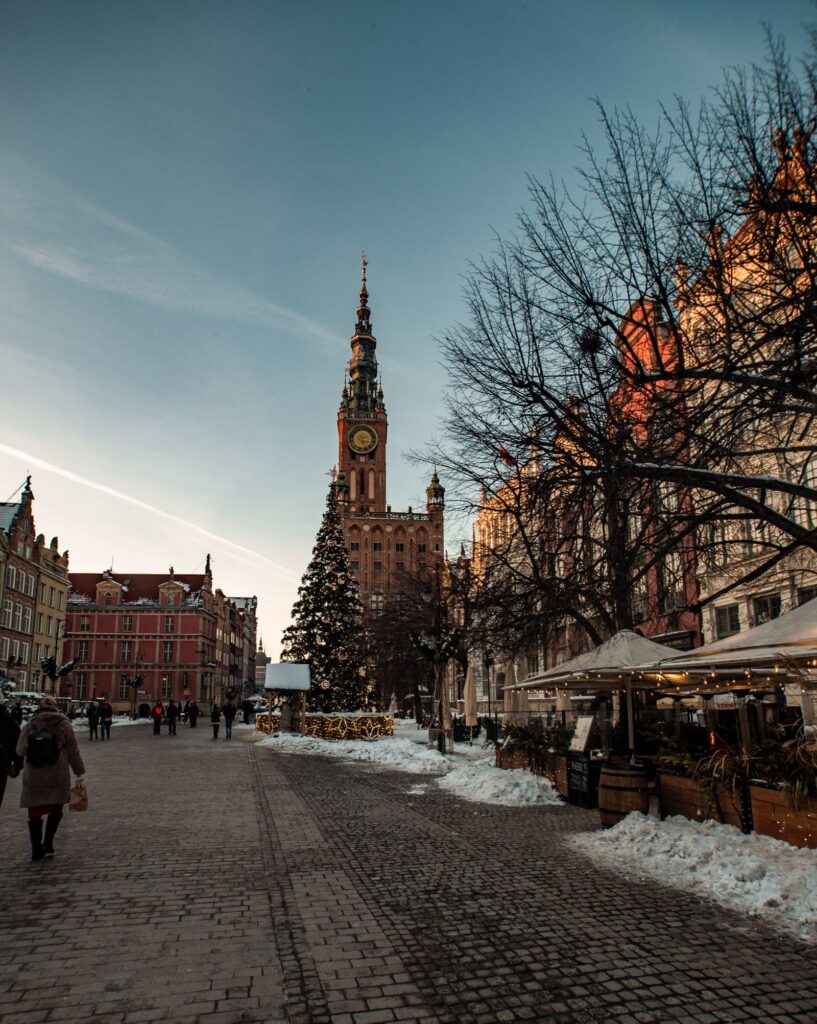
Gdańsk’s market is one of the largest in Poland and opens around midday. Vegan stalls are scarce, so plan to eat in restaurants and treat the market as mulled wine and roasted chestnuts territory. December Gdańsk has another upside: fewer tourists on Long Market and no queues at the museums.
If you’re planning a multi-city Advent trip, see our guide to the best Christmas markets in Europe for vegans.
Getting to Gdańsk and from the airport to the city centre
Most international visitors fly into Gdańsk Lech Wałęsa Airport, and from Central Europe there’s also a direct train. From Prague, the direct Baltic Express takes over eight hours, while Ryanair flies direct in about an hour and twenty minutes. For vegans the train is the easier option, since you bring your own food.
| Connection | Leaves Prague | Arrives Gdańsk | Journey | Note |
|---|---|---|---|---|
| Baltic Express (day) | 6:49 | around 15:30 | about 8 h 40 min | direct from Praha hl.n. |
| Baltic Express (day) | 10:49 | around 19:30 | about 8 h 40 min | direct from Praha hl.n. |
| Baltic Express (night) | 18:49 | 5:27 | 10 h 38 min | sleeper car (couchettes in summer only), saves a hotel night |
| Ryanair | varies | varies | about 1 h 20 min | only some days of the week |
The train times are from the Czech journey planner IDOS and are valid until 12 December 2026. A new timetable starts on 13 December, so check again for later dates.
How to get from Gdańsk airport to the city centre
To get from Gdańsk airport to the city centre, take bus 210 straight to the main railway station (Dworzec Główny) in about 40 minutes. The faster option is the train from the airport to Wrzeszcz and a change to the SKM into the centre. Between 23:00 and 4:00 the night bus N3 runs, according to the airport’s transport page.
Where to stay in Gdańsk
The best areas to stay in Gdańsk are the Main Town and Wrzeszcz. The Main Town is prettier and puts every sight within walking distance. Wrzeszcz is cheaper, has its own SKM station and the vegan places on Wajdeloty street right around the corner.
If the sea is your priority, consider staying in Brzeźno or Jelitkowo by the beach. Trams run to the centre, but evenings back take longer. For a first visit we recommend the Main Town or near the Motława, with Manna 68 and Mandu close by.
When to visit Gdańsk
The best time to visit Gdańsk is June to September, when you can combine the city with the beaches. July and August bring the warmest sea but also the biggest crowds. Every summer the city also hosts St Dominic’s Fair (Jarmark św. Dominika), a huge, centuries-old market that fills the streets of the centre with stalls.
May and September are the most pleasant months for sightseeing, warm but calmer. December brings the Christmas market. January to March are grey and windy, but the museums are empty and rooms are at their cheapest.
Don’t leave shopping for Sunday: most shops and supermarkets in Poland are closed on Sundays, except a few trading Sundays, including the three before Christmas. Restaurants, cafés and some small shops stay open, but stock up for the journey on Saturday.
Polish for vegans: phrases for restaurants
Most restaurants in Gdańsk speak English, but a few Polish phrases help at a bakery or a pierogi counter. Watch out for “wegetariańskie”, which means vegetarian, not vegan, and often comes with cheese, eggs or butter.
| English | Polish | Say it like |
|---|---|---|
| I’m vegan. | Jestem weganinem / weganką. | YES-tem veh-gah-NEE-nem / veh-GAHN-kow |
| Is this vegan? | Czy to jest wegańskie? | chih toh yest veh-GAHN-skyeh |
| No meat, no dairy, no eggs. | Bez mięsa, bez nabiału, bez jajek. | bez MYEN-sah, bez nah-BYAH-woo, bez YAH-yek |
| Is there cheese or curd cheese in it? | Czy jest w tym ser albo twaróg? | chih yest f tim ser AHL-boh TFAH-rook |
| Is it cooked in butter? | Czy to jest na maśle? | chih toh yest nah MAHSH-leh |
| The vegan version, please. | Poproszę wersję wegańską. | poh-PROH-sheh VER-syeh veh-GAHN-skow |
Our verdict
For us, Gdańsk is the best Polish city for anyone who wants history, the sea and great vegan food in one trip. Three days cover the Main Town, the Solidarity story, the beach and a day out to Sopot and Gdynia. Our ideal plan is to stay in the centre, lunch in Wrzeszcz and have dinner at Manna 68.
If you’re travelling with someone who eats meat, Gdańsk is a great place to show them that nothing is missing from a vegan table. Would you rather see Gdańsk in summer by the sea, or in December at the Christmas market? Tell us in the comments.
New to vegan travel, or travelling with someone who isn’t vegan? Read our guide on how to travel vegan, even if your partner isn’t.
Frequently asked questions
What are the best things to do in Gdańsk?
The best things to do in Gdańsk are walking the Royal Way to Long Market and Neptune’s Fountain, climbing St Mary’s Church tower, strolling Mariacka street and the medieval crane on the Motława, and visiting the European Solidarity Centre. Add the Museum of the Second World War (closed Mondays), Westerplatte, the beach at Brzeźno and a day trip to Sopot and Gdynia.
Is Gdańsk worth visiting?
Yes, Gdańsk is worth visiting for its rebuilt Hanseatic old town, two outstanding 20th-century museums and Baltic beaches within tram distance. It suits travellers who like history and the sea, and three days is enough to see the city plus Sopot and Gdynia.
How do I get from Gdańsk airport to the city centre?
Bus 210 runs from Gdańsk airport to the main railway station in about 40 minutes. You can also take the train from the airport to Gdańsk Wrzeszcz and change to the SKM into the centre. At night, between 23:00 and 4:00, the N3 night bus runs.
How do I get from Gdańsk to Gdynia?
Take the SKM commuter train from Gdańsk Główny to Gdynia Główna, which takes about 35 minutes and also stops in Sopot after about 20 minutes. City tram and bus tickets aren’t valid on SKM, so buy an SKM ticket before boarding.
Is Gdańsk vegan-friendly?
Yes, Gdańsk has fully vegan places including Manna 68 in the old town, Avocado Vegan Bistro, Avocado Vegan Spot and the café Fukafe in Wrzeszcz, and Faloviec in Przymorze. Pierogarnia Mandu near the main station has a separate vegan pierogi section. Watch out for pierogi ruskie in ordinary restaurants, which contain curd cheese.
Newsletter
Get our free e-books
Join the newsletter and download Our Vegan Christmas Kitchen straight away, 10 recipes for Czech cookies, gingerbread and vánočka. Then once a month, new places from the vegan map and new articles. Unsubscribe with one click.