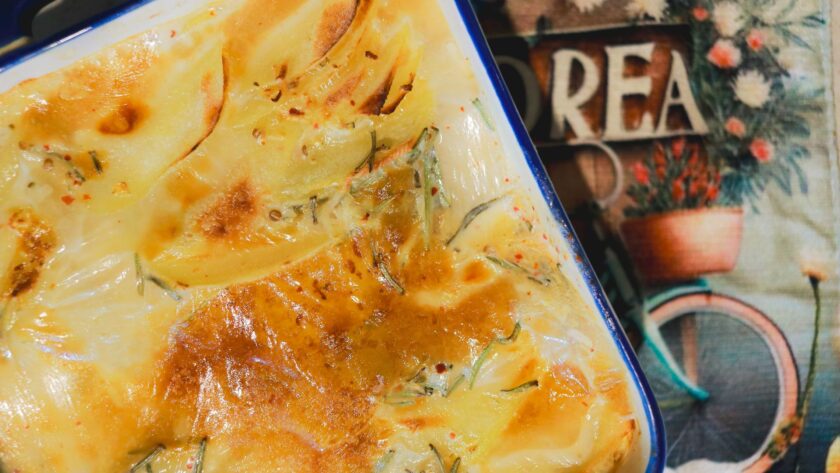
Vegan scalloped potatoes are the side dish that quietly disappears first at a holiday table, usually eaten by the people who swear they could never give up cream. Thin slices of potato, a silky sauce, a golden top. The dairy version leans on cream, butter and cheese, but none of those is what actually makes the dish work.
So how do you get that creamy sauce without dairy, or even without cashews? Can you use coconut milk? Which potatoes hold their shape, and why are yours still hard after an hour in the oven? What’s the real difference between scalloped and au gratin potatoes? And what is a Czech “French potato” bake doing in an article about a very American side dish? We’ve got you covered.
Below you’ll find six dairy-free sauces compared side by side, a potato guide and a fix for every common problem. There are also four vegan potato bakes from our own blog, from smoked tofu to plant-based mince. You don’t need to be vegan to make any of them. You just need to like potatoes.
Vegan scalloped potatoes: what replaces the dairy
Vegan scalloped potatoes swap cream for a roux sauce made with unsweetened plant milk, butter for vegan butter or olive oil, and cheese for vegan cheese or nutritional yeast. The method stays the same, with thin potato slices, a creamy sauce and a browned top. In a Czech-style bake, smoked tofu replaces the smoked meat and a chickpea-flour batter replaces the eggs.
This table shows what each classic ingredient actually does, and what does that job in a dairy-free potato bake.
| Classic ingredient | What it does | Plant-based swap |
|---|---|---|
| Cream and milk | Creaminess, coats every slice | Plant-milk roux sauce, soy cooking cream, cashew cream, silken tofu |
| Cheese | Crust, salty depth | Shredded vegan cheese, nutritional yeast, oiled breadcrumbs |
| Butter | Flavour, greasing the dish | Vegan butter or olive oil |
| Eggs (Czech style) | Sets the layers into a custard | Chickpea flour, plant milk, black salt and turmeric |
| Smoked meat (Czech style) | Smoky, salty, filling | Smoked tofu, vegan ham, tempeh, plant-based mince |
Scalloped, au gratin or dauphinoise: what’s the difference
Scalloped potatoes are thinly sliced potatoes baked in a creamy sauce. Au gratin potatoes add a browned crust of cheese or breadcrumbs. In North America, au gratin traditionally meant cheese and scalloped meant none, but that line has blurred and most recipes now use the names interchangeably. Australians just call the whole thing a potato bake.
The word “gratin” comes from the French gratter, to scrape, after the crust you scrape off the dish. “Scalloped” is murkier. One theory links it to seafood baked and served in scallop shells, another to old words for a thin slice.
The French classic, gratin dauphinois from the Dauphiné region, is raw potato slices “the thickness of a coin” baked in cream. Its first mention is usually dated to 12 July 1788, and by tradition it has no cheese at all. That’s good news for a vegan potato gratin, because only the cream needs replacing.
Francouzské brambory, the Czech potato bake
Francouzské brambory (“French potatoes”) is a Czech potato casserole of sliced, pre-boiled potatoes layered with smoked meat and baked under a custard of eggs and cream. Despite the name, it isn’t French. It’s a staple of Czech home cooking, often served with pickled gherkins. A typical version uses a kilo of potatoes, 250 g (9 oz) of smoked meat and 11 eggs, some raw in the custard and some hard-boiled in the layers.
Our vegan potato bake with smoked tofu keeps the smoky flavour and swaps the eggs for chickpea flour batter. Mixed with plant milk to a pancake-batter consistency, it sets in the oven much like an egg custard. Kala namak (Indian black salt) adds a sulphurous, egg-like aroma, and turmeric gives the yellow colour. If you’d rather use pink ham, the way some Czech cooks do, our guide to vegan ham covers shop-bought options and a homemade version.
Best potatoes for scalloped potatoes
For sliced and layered scalloped potatoes, use waxy or all-rounder potatoes, because they hold their shape. Floury potatoes tend to break down in the sauce.
US recipes often call for Yukon Gold. In the Czech Republic, bags of main-crop (late) potatoes must be labelled with a cooking type (varný typ). The Czech University of Life Sciences (page in Czech) recommends waxy type A specifically for potato gratins.
| Czech cooking type | Texture after cooking | For a potato bake | Example varieties (university list) |
|---|---|---|---|
| A (waxy) | Firm, doesn’t fall apart | Best for thin slices and layers | Filea, Milva, Nicola, Princess |
| B (slightly floury) | Semi-firm, breaks up a little | Fine for cubes and pre-boiled potatoes | Agria, Marabel, Laura |
| C (floury) | Soft, falls apart | Avoid, it turns to mash | Asterix, Symfonia |
Raw or pre-boiled potatoes
Raw slices take longer but soak up more of the sauce. That’s the dauphinoise way. Pre-boiled potatoes, cooked in their skins and cooled, cut the baking time to about 40 minutes and hold together well. That’s how Czech francouzské brambory are made.
Pre-boil whenever the dish has something acidic in it, such as tomatoes or wine. Acid strengthens the pectin that holds potato cells together, so raw slices soften far more slowly.
How thin to slice
Slice raw potatoes 2 to 3 mm thick (about 1/8 inch), roughly the thickness of a coin. A mandoline is fastest and most even, but a sharp knife does the job. Even slices matter more than the exact thickness, because mixed slices give you mush and crunch in the same bite. Cut pre-boiled potatoes thicker, 5 mm to 1 cm.
Tip: Raw potato slices brown when left in the air. Keep them in a bowl of cold water while you make the sauce, then pat them properly dry before layering, or the extra water will thin your sauce.
Six dairy-free sauces to choose from
The easiest sauce is a roux made with vegan butter, flour and unsweetened plant milk, and it needs no blender and no nuts. Cashew cream, silken tofu, coconut milk, soy cooking cream and a chickpea-flour custard all work too. Each gives a different texture, and our sauce comparison table shows what to expect from each one.
| Sauce | Base | Texture | Nut-free | Best for |
|---|---|---|---|---|
| Roux (béchamel) | Vegan butter, plain flour, unsweetened plant milk | Thick, classic | Yes | Everyday, closest to cream |
| Cashew cream | Soaked cashews, plant milk, broth, nutritional yeast | Ultra creamy, cheesy | No | Holiday gratin |
| Silken tofu | Blended silken tofu, plant milk, seasoning | Smooth, lighter | Yes | Nut allergies, extra protein |
| Coconut milk | Full-fat coconut milk, garlic, broth | Rich, heavier | Yes | Spiced versions |
| Soy cooking cream | Ready-made plant cream | Thinner, fast | Yes | Quick weeknight bake |
| Chickpea custard | Chickpea flour, plant milk, black salt, turmeric | Sets like egg | Yes | Czech-style bake |
Vegan scalloped potatoes without cashews: the roux
A roux is the most reliable way to make vegan scalloped potatoes without cashews. Cook plain flour in melted vegan butter for a minute, then whisk in the plant milk a little at a time. Pour it all in at once and you’ll get lumps. Our recipes use 25 g vegan butter and 25 g flour to 250 ml milk. For a bigger dish, that’s 30 g butter, 2 tablespoons of flour and 400 ml milk.
Always use unsweetened milk. Soy and oat milk behave best, while sweetened almond milk gives the potatoes an odd sweetness. Season with salt, pepper, garlic and nutritional yeast (deactivated yeast flakes with a nutty, cheesy flavour). A spoonful of soy sauce adds the salty depth cheese would normally bring.
Cashew cream and silken tofu
Cashew cream gives the creamiest, cheesiest result, but you need a powerful blender. Soak raw cashews in hot water to soften them, then blend with plant milk, vegetable broth, nutritional yeast and salt until completely smooth. It’s the one to make when the gratin has to look like it came from a restaurant.
For a nut-free table, swap the cashews for silken tofu. It blends just as smoothly, makes a lighter sauce and adds protein. Add a teaspoon of mustard and some garlic, because tofu on its own tastes very neutral.
Vegan scalloped potatoes with coconut milk
Coconut milk makes a rich sauce with no cooking at all, but you will taste the coconut. That makes it better for spiced bakes with paprika, curry powder or smoked paprika than for a classic, herby gratin. Thin it with roughly equal parts vegetable broth, or the dish turns heavy.
Soy or oat cooking cream is the shortcut. Check the label, though, because some “cooking creams” sold next to the plant-based products are made with buttermilk and vegetable fat. In our vegan baked potatoes with spinach and cheese, it goes straight into the frying pan with the vegetables, and everything moves to the baking dish together.
Chickpea custard instead of eggs
Chickpea custard replaces the eggs in a Czech-style potato casserole and sets in the oven the way an egg mix does. Our recipe whisks 3 tablespoons of chickpea flour with ½ teaspoon of black salt, ½ teaspoon of turmeric, herb salt, pepper and enough plant milk to make a thick pancake batter. Kala namak comes from South Asian cooking, and its sulphurous smell is surprisingly close to hard-boiled egg.
Four vegan potato bakes from our blog
We have four vegan potato bake recipes on the blog, each built on a different protein and sauce. All four bake at 200 °C (400 °F), first under foil and then uncovered so the vegan cheese browns. Pick the one that matches what’s already in your fridge.
| Recipe | Protein | Sauce | Total time | Serves |
|---|---|---|---|---|
| Smoked tofu potato bake | Smoked tofu | Chickpea custard | 60 minutes | 4 |
| Spinach and cheese | Smoked tofu or meat alternative | Soy cream | 60 minutes | 3 |
| Béchamel and tempeh | Tempeh | Roux | 65 minutes | 3 |
| Mince, peppers and cheese | Plant-based mince | Roux | 80 minutes | 4 |
Vegan potato bake with smoked tofu
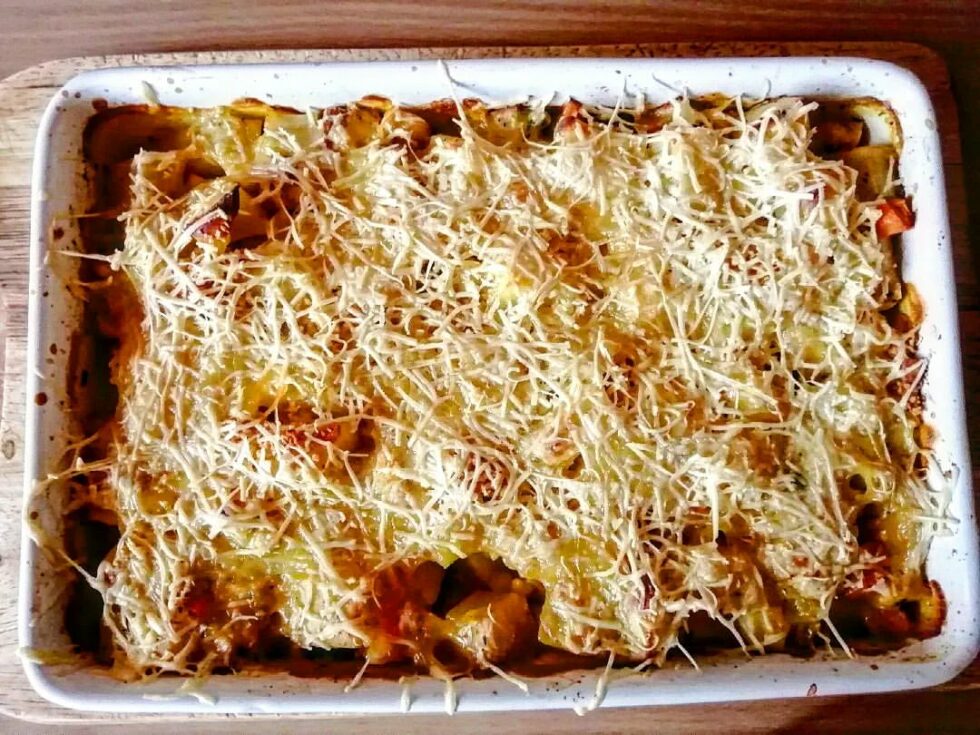
The smoked tofu potato bake is our take on Czech francouzské brambory. Diced potatoes are mixed with pan-fried smoked tofu, mushrooms, leek and frozen peas, carrots and sweetcorn. Everything goes under the chickpea “egg” custard and a layer of vegan cheese, then bakes for about 40 minutes at 200 °C. It serves 4 and takes an hour from start to finish.
Vegan baked potatoes with spinach and cheese
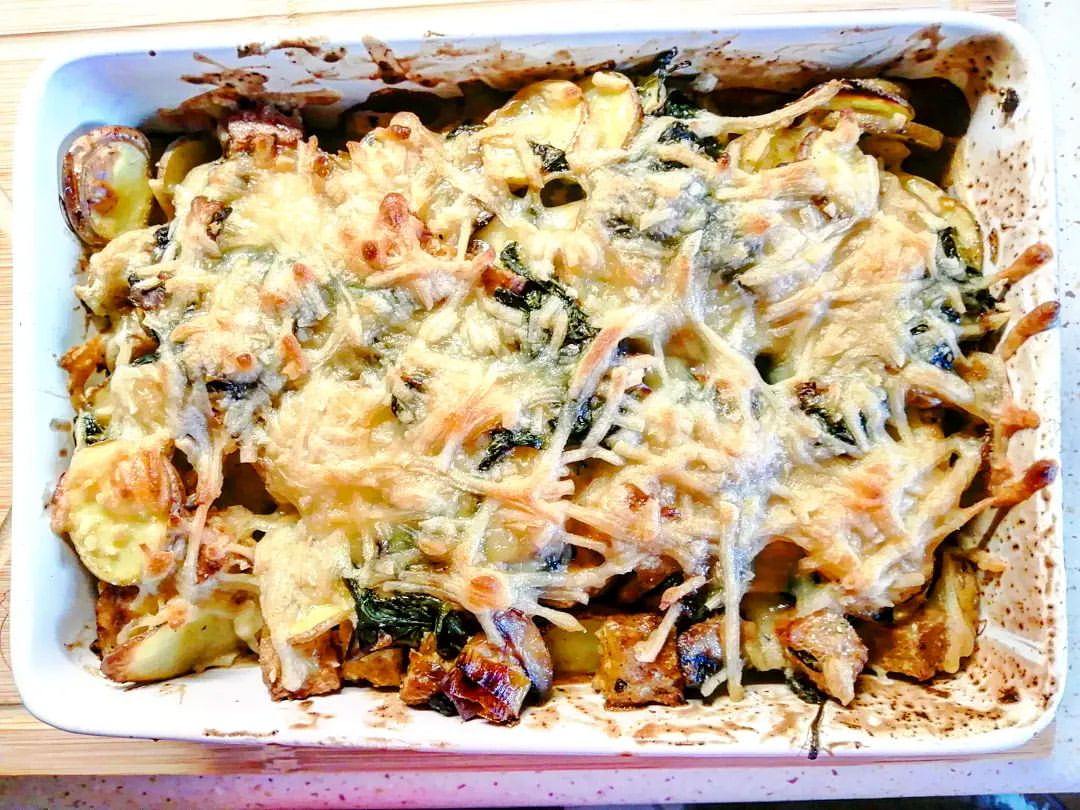
The spinach version has the shortest prep, because the sauce comes together in the pan. Sliced baby potatoes join smoked tofu, mushrooms, leek, 250 g of spinach and 150 ml of soy cream. Gyros seasoning (a Greek-style spice mix) gives it a bold edge. It bakes for 20 minutes under foil and 20 minutes uncovered with cheese, and serves 3.
Vegan potato bake with béchamel and tempeh
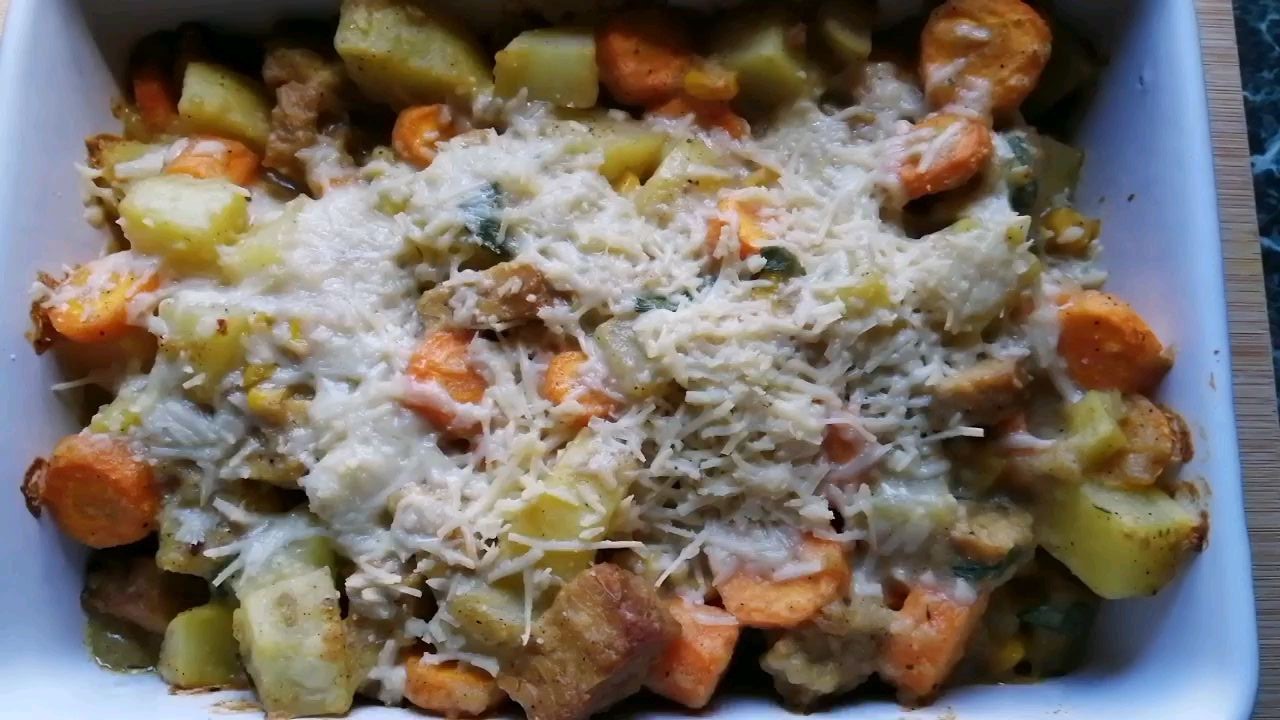
The tempeh potato bake is the most filling of the four. Tempeh is fermented soybeans pressed into a firm, nutty block, and it doesn’t fall apart in the oven. Potatoes, carrots, tempeh and leek are seasoned, folded into a roux sauce and baked under foil, with vegan cheese added after 20 minutes. Try the vegan potato bake with béchamel and tempeh when you want a protein-packed main rather than a side.
Vegan potato bake with mince, peppers and cheese
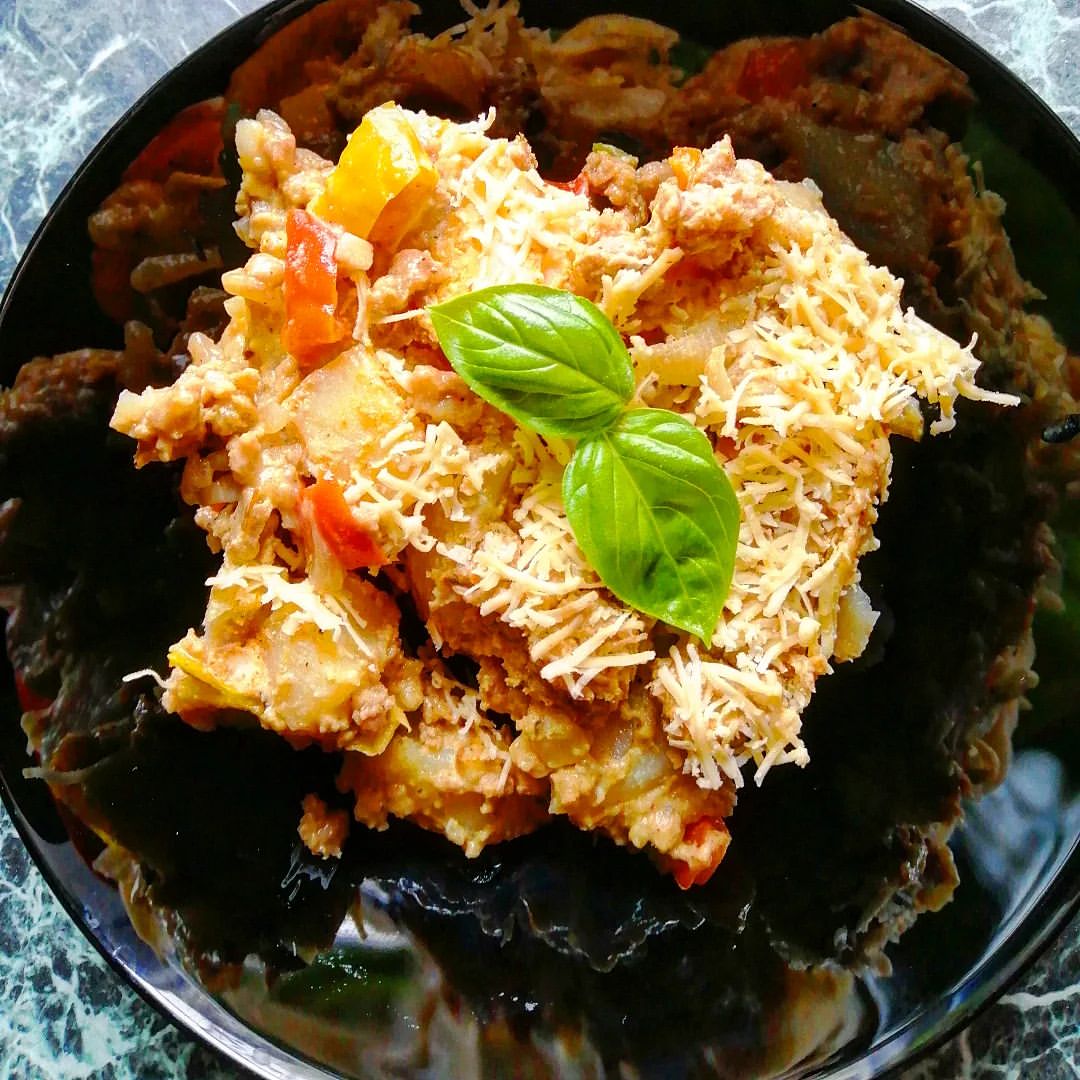
The mince and pepper potato casserole is the one for a big dish and meat-eating guests. It uses 500 g of plant-based mince, three colourful peppers, onion, garlic and 400 ml of plant milk in the roux. It bakes for 30 minutes under foil and about 15 to 20 more with cheese. Here’s the full vegan potato bake with mince, peppers and cheese.
Nobody at the table can tell what’s missing from a potato bake. They can only tell whether the potatoes are soft and the top is golden.
How long to bake scalloped potatoes, and at what temperature
Bake them at 180 to 200 °C (350 to 400 °F). Diced or pre-boiled potatoes need about 40 minutes, layered raw slices 60 to 75 minutes. Keep the dish covered with foil for the first 20 to 45 minutes so the potatoes steam soft, then uncover to brown the top. They’re done when a knife slides through to the bottom of the dish with no resistance.
Why bake under foil first
Foil traps the steam, so the potatoes cook through before the top burns. In most of our recipes the vegan cheese goes on once the foil comes off, because under foil it melts without browning. Rest the dish for 5 to 10 minutes after baking, so the sauce thickens and the slices cut cleanly.
Making it in a Remoska
A potato bake also works in a Remoska, the Czech electric “oven in a pan”, but expect it to take a little longer than a conventional oven. Engineer Oldřich Homuta developed the Remoska in the 1950s, and it has its heating element in the lid. Layer it exactly as you would a baking dish and test with a knife.
Tip: Want a crunchy top without vegan cheese? Mix 2 tablespoons of breadcrumbs with 1 tablespoon of olive oil and 1 tablespoon of nutritional yeast, and scatter it over once the foil comes off.
Why are my scalloped potatoes still hard (or watery)?
Scalloped potatoes stay hard because the slices are too thick, there isn’t enough sauce, or something acidic is in the dish. Watery scalloped potatoes usually come from wet slices or a sauce that never thickened. More time under foil fixes most of it.
Still hard after an hour
Hard potatoes after an hour usually mean slices thicker than 3 mm, a top layer the sauce doesn’t reach, or an acidic ingredient. Tomatoes, wine and vinegar all slow down how potatoes soften.
America’s Test Kitchen found this testing a Spanish potato bake with wine, and now adds the wine only once the potatoes are tender. Cover the dish again, add a splash of hot broth and keep checking every 10 minutes.
Thin or split sauce
A thin sauce usually comes from wet potato slices or a roux that wasn’t simmered long enough. Cook the sauce until it coats the back of a spoon. If it looks split after baking, rest the dish for 10 minutes and the potatoes will soak some of it up. Don’t stir vegan cheese into the sauce, as it melts far better on top.
Burnt on top, raw in the middle
A burnt top over a hard middle means the foil came off too early or the oven is too hot. Drop to 180 °C (350 °F), cover the dish and uncover only for the last 15 minutes. A deep, narrow dish always needs longer than a wide, shallow one.
Making them ahead, storing and reheating
Get leftover scalloped potatoes into the fridge within two hours of baking, and eat them within two days or freeze them. That’s the advice in the UK Food Standards Agency’s guide to chilling, freezing and defrosting food, which is stricter than the “4 to 5 days” on some recipe blogs. Keep the fridge at 0 to 5 °C and the freezer around −18 °C.
Defrost in the fridge and eat within 24 hours of thawing. Reheat covered in the oven until piping hot in the middle. The microwave works too, but it dries the potatoes a little, so add a spoonful of plant milk first. Thawed potatoes are a little softer than freshly baked ones.
Hosting tip: Make the roux sauce or chickpea custard a day ahead and keep it in the fridge. Slice the potatoes just before layering. The sauce thickens as it chills, so loosen it with a splash of milk before using.
What to serve them with
They go best with something sharp and fresh to cut through the creamy sauce. Czechs serve their potato bake with pickled gherkins, pickled vegetables or a coleslaw-style cabbage salad, and all of these work with the vegan version. A green salad with a mustard dressing turns a dish of potatoes into a full dinner.
As a holiday side, scalloped potatoes sit happily next to a tofu schnitzel, roasted vegetables or mushrooms. For main-course ideas, browse our best tofu recipes for lunch and dinner. For guests who eat meat, the plant-based mince bake is the safest choice. It tastes like the classic, and nobody asks where the meat went.
Read next
Curious about Czech comfort food? We’ve rounded up vegan Czech food, from svíčková to fruit dumplings, all without meat, eggs or dairy.
Not a compromise dish
Great scalloped potatoes were never really about the cream. They come down to the right potato, slices of the same thickness and patience under the foil. Get those right and the sauce is simply a matter of taste. A roux for the classic, cashew cream for the holiday table, chickpea custard for a Czech-style bake that tastes like the classic.
Start with whichever sauce you have the ingredients for, then try another next time. So tell us, are you team smoked tofu, or team roux and mushrooms?
Frequently asked questions
How do you make vegan scalloped potatoes without cashews?
Make the sauce as a roux. Cook flour in vegan butter, whisk in unsweetened soy or oat milk a little at a time and season with garlic and nutritional yeast. Blended silken tofu is another nut-free option. Layer it with thin potato slices and bake covered, then uncovered.
Can I use coconut milk for vegan scalloped potatoes?
Yes, full-fat coconut milk makes a rich sauce, but the coconut flavour comes through. Thin it with roughly equal parts vegetable broth and pair it with spices like paprika or curry powder rather than a classic herb gratin.
What’s the difference between scalloped and au gratin potatoes?
Scalloped potatoes are baked in a creamy sauce, while au gratin potatoes add a browned crust of cheese or breadcrumbs. In North America the difference was traditionally cheese, but today most recipes use the two names interchangeably.
Why are my scalloped potatoes still hard?
The slices are probably too thick, the sauce doesn’t cover the top layer, or there’s an acidic ingredient such as tomato or wine. Cover the dish with foil, add a splash of hot broth and bake for another 10 to 20 minutes.
What do you eat with vegan scalloped potatoes?
Serve them with something fresh and sharp, such as a green salad, coleslaw or pickled gherkins. As a holiday side, they go well with tofu schnitzel, roasted vegetables or mushrooms.
Featured photo: Golboo Maghooli, Pexels.
Newsletter
Get our free e-books
Join the newsletter and download Our Vegan Christmas Kitchen straight away, 10 recipes for Czech cookies, gingerbread and vánočka. Then once a month, new places from the vegan map and new articles. Unsubscribe with one click.